Rajasthan High Court Denies Bail to Accused in Kanhaiya Lal Murder Case, Upholds Strict UAPA Bail Restrictions
Rajasthan High Court Denies Bail to Accused in Kanhaiya Lal Murder Case, Upholds Strict UAPA Bail Restrictions Jaipur, October 3, 2026: The Rajasthan High Court, Jaipur Bench, has dismissed a batch of criminal appeals filed by five accused seeking regular bail in the high-profile Kanhaiya Lal murder case investigated by the National Investigation Agency (NIA). The Division Bench of Chief Justice Sanjay K. Agrawal and Justice Sameer Jain delivered its judgment on October 3, 2026, reaffirming the stringent standards governing bail under the Unlawful Activities (Prevention) Act (UAPA). The appeals challenged orders of the Special NIA Court, Jaipur, which had rejected the bail applications of the accused. The appellants argued that they had been in custody for over four years, that the trial was likely to take considerable time and that prolonged incarceration violated their fundamental right to personal liberty under Article 21 of the Constitution. The defence also questioned the evidence linking them to the alleged conspiracy and relied on Supreme Court judgments, including Union of India v. K.A. Najeeb, to contend that constitutional protections could override statutory restrictions on bail in cases of excessive trial delays. Opposing the appeals, the NIA lawyer in jaipur argued that the accused had played specific roles in a larger criminal conspiracy and that witness statements, call detail records, video recordings and weapon recoveries supported the prosecution’s case. The agency also submitted that the trial was progressing expeditiously, with nearly 30 material witnesses already examined and the witness list reduced from approximately 180 to 89. The High Court examined the restrictions under Section 43D(5) of the UAPA and the constitutional safeguards available under Article 21. It reiterated that courts must assess whether the prosecution material establishes a prima facie case without conducting a mini-trial at the bail stage. The Bench observed that prolonged incarceration can justify bail even in UAPA cases where a timely trial is not realistically possible. However, it found that the circumstances of the present case did not warrant such relief, particularly given the progress of the trial and the specific allegations against the appellants. Consequently, the High Court upheld the orders rejecting bail and dismissed all five appeals, while clarifying that its observations would not affect the final determination of the evidence during trial. Copy of Order Bhuvnesh Kumar GoyalHigh Court Advocate in Jaipur
Jaipur High Court on Transfer of Nursing Mothers: Infant Welfare and Article 21
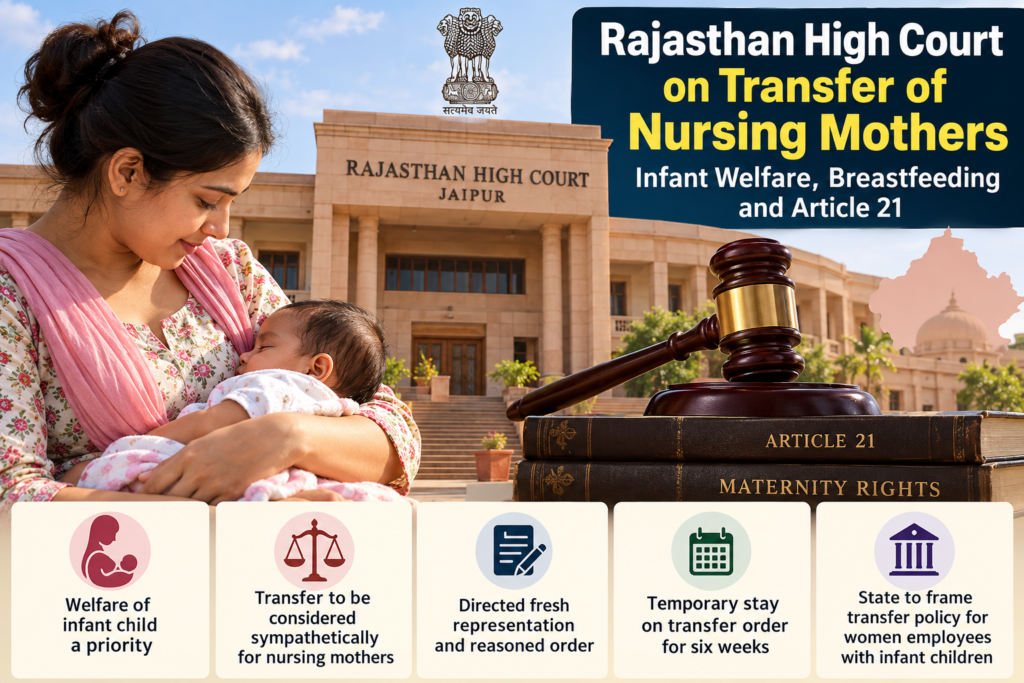
Jaipur High Court on Transfer of Nursing Mothers: Infant Welfare and Article 21 Can a government transfer a woman employee to a distant location when she has recently given birth and is caring for a two-month-old infant? Should administrative requirements take precedence over the welfare of a newborn child who depends on the mother for breastfeeding, nutrition and emotional care? These important questions came before the Rajasthan High Court, Jaipur Bench, in Suman Meena v. State of Rajasthan & Others, S.B. Civil Writ Petition No. 19649/2026. In its order dated 29 September 2026, Justice Anoop Kumar Dhand addressed the difficulties faced by a government schoolteacher who had been transferred shortly after childbirth. The Court emphasized the importance of infant welfare, maternal care, breastfeeding and a humane approach by the State when dealing with the transfer of a nursing mother. The Court directed the competent authority to reconsider the employee’s case sympathetically, ordered a temporary stay on the transfer and highlighted the need for an appropriate government transfer policy or legislation addressing the circumstances of recently delivered women employees. The judgment brings attention to an important aspect of public employment: administrative decisions involving women employees with newborn children may require consideration of the rights and welfare of both the mother and the infant. 1. Background of the Rajasthan High Court Case The case concerned Suman Meena, a Senior Teacher working at PM Shri Government Senior Secondary School, Gangapur City, District Sawai Madhopur, Rajasthan. She was transferred to Government Girls Senior Secondary School, Masalpur, District Karauli, through a transfer order dated 7 July 2026. The employee had given birth to a child on 13 May 2026, approximately two months before the transfer order was issued. The transfer created practical difficulties for the employee because her newborn child was still at an early stage of development and dependent on her for breastfeeding and maternal care. The employee challenged the transfer before the Rajasthan Civil Services Appellate Tribunal, Jaipur. However, the Tribunal rejected her appeal through an order dated 15 September 2026. Aggrieved by the Tribunal’s decision, she approached the Rajasthan High Court by filing a writ petition under its constitutional jurisdiction. The principal concern before the High Court was whether the circumstances surrounding the newborn child and the mother’s need to provide care warranted a more sensitive consideration of the transfer. 2. Why Was the Employee’s Maternity Leave Dispute Relevant? An important aspect of the case was the employee’s maternity leave history. The petitioner had previously availed maternity leave on two occasions: First maternity leave: 2 July 2020 to 28 December 2020. Second maternity leave: 13 July 2021 to 8 January 2022. During the first maternity leave period, she had given birth to a child who unfortunately passed away shortly after birth, on 2 July 2020. When she gave birth again in May 2026, her maternity leave was reportedly not granted on the technical ground that she had already availed maternity leave twice. The petitioner’s counsel argued that the earlier loss of a child and the circumstances of her latest childbirth required a compassionate assessment rather than a purely technical approach. The Court took note of the circumstances and the difficulties arising from the transfer of a recently delivered mother who was caring for an infant. It is important to distinguish the issue of maternity leave from the transfer dispute. The High Court’s operative directions concerned reconsideration of the transfer representation and temporary protection against the transfer order. The judgment did not expressly grant maternity leave or finally adjudicate the employee’s entitlement to such leave. 3. Rajasthan High Court’s Observations on Transfer of Nursing Mothers The Rajasthan High Court acknowledged the established principle that transfer is ordinarily an incident of service and that courts generally exercise restraint in interfering with administrative transfer decisions. However, the Court observed that administrative exigencies cannot be treated as an absolute justification in every circumstance. Where a transfer results in extreme hardship, particularly involving the critical care needs of an infant child, the circumstances may call for judicial consideration. The Court emphasized that the welfare of a child must receive paramount consideration when an infant’s interests are directly involved. It also observed that, as far as possible, a woman employee having an infant below one year should not be disturbed and that her case should be considered sympathetically. These observations underline the importance of examining the individual circumstances of a nursing mother before implementing a transfer that may significantly affect her ability to care for a newborn. At the same time, the Court expressly clarified that its decision was based on the peculiar facts and circumstances of the case and should not be treated as a binding precedent establishing an absolute exemption from transfer for every employee with an infant. 4. Article 21 and the Constitutional Protection of Motherhood and Infant Welfare One of the central aspects of the judgment was its discussion of Article 21 of the Constitution of India. Article 21 guarantees the right to life and personal liberty. The Court connected the welfare of the infant, maternal care, breastfeeding and the child’s development with the constitutional protection afforded by this provision. The Court observed that the right of a newborn child to receive maternal care, nutrition and development is implicit in Article 21. It also referred to Article 15(3), which enables the State to make special provisions for women and children. The judgment recognized that the relationship between a mother and a newborn infant involves more than a biological connection. It includes emotional bonding, breastfeeding, physical care and the child’s need for security during infancy. The Court further referred to the importance of the first six months of exclusive breastfeeding, recognizing the significance of this period for a child’s physical, mental and emotional development. In the circumstances before it, the Court considered that transferring the mother to a distant place could create serious difficulties for the infant and the mother. The judgment thus highlights how constitutional principles relating to dignity, motherhood and child welfare
Jaipur High Court Granted Bail in Rape Case: Prolonged Relationship, Consent and Promise of Marriage Considered
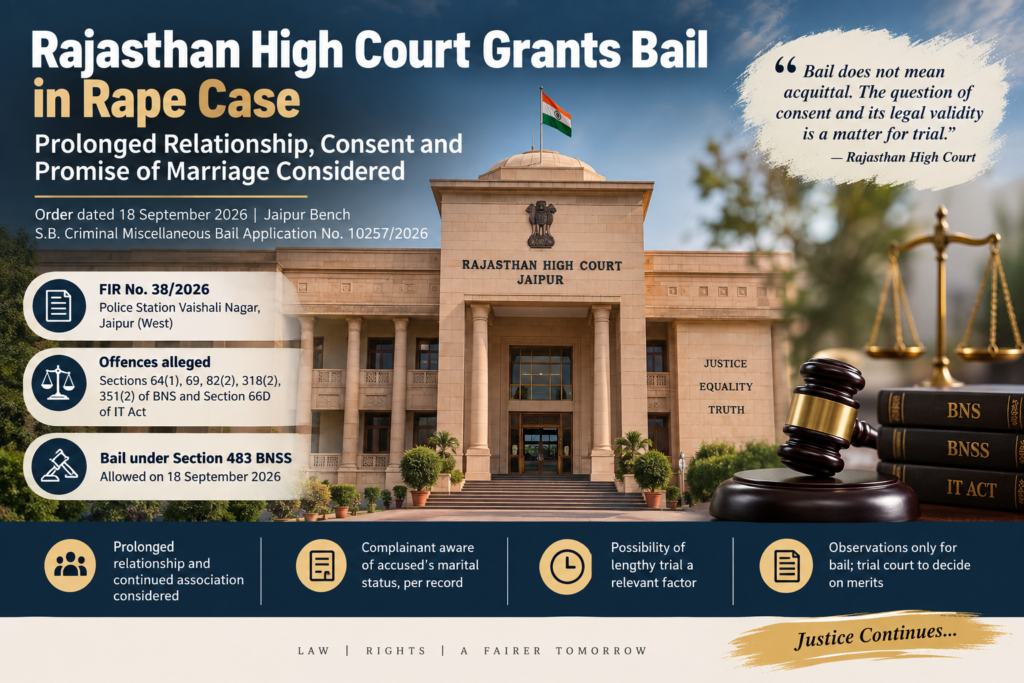
Jaipur High Court Granted Bail in Rape Case Prolonged Relationship, Consent and Promise of Marriage Considered The Rajasthan High Court, Jaipur Bench, has granted bail to an accused in a case involving allegations of rape, deception, promise of marriage, harassment and other offences under the Bharatiya Nyaya Sanhita, 2023 (BNS) and the Information Technology Act. The order was passed on 18 September 2026 by Hon’ble Mr. Justice Farjand Ali in S.B. Criminal Miscellaneous Bail Application No. 10257/2026, arising out of FIR No. 38/2026 registered at Police Station Vaishali Nagar, Jaipur (West). The bail application was filed under Section 483 of the Bharatiya Nagarik Suraksha Sanhita, 2023 (BNSS). The decision is particularly relevant to bail proceedings where the prosecution case concerns a relationship between two adults, allegations relating to a promise of marriage, and questions surrounding the nature and voluntariness of the physical relationship. The Court, while deciding the bail application, specifically examined the duration and nature of the relationship, repeated meetings, travelling and staying together, continuation of physical relations, and the complainant’s knowledge of the accused’s existing marital status. Importantly, the High Court clarified that its observations were confined to the consideration of bail and would not prejudice the trial court while deciding the case on merits. What Was the Case Before the Rajasthan High Court? The accused-petitioner was Dinesh, aged about 48 years, who was confined at Central Jail, Jaipur. The case arose from FIR No. 38/2026, registered at Police Station Vaishali Nagar, Jaipur (West). The FIR invoked: Section 64(1) BNS Section 69 BNS Section 82(2) BNS Section 318(2) BNS Section 351(2) BNS Section 66D of the Information Technology Act The order records these offences in its opening case details. The complainant, according to the FIR as recorded by the Court, was a 52-year-old divorcee residing in Pune. She allegedly came into contact with the accused through Shaadi.com, where he represented himself as a divorcee and allegedly assured her of marriage. The FIR alleged that after she came to Jaipur on 11 October 2025, the accused established physical relations with her against her will and thereafter continued the relationship on the assurance that he would marry her. The complainant further alleged that the accused repeatedly postponed the marriage and subsequently disclosed that he was already married and living with his wife and son. Allegations were also made concerning threats, harassment and pressure relating to pregnancy and miscarriage. These are allegations recorded from the FIR, and the High Court’s bail order does not constitute a final determination of their truth. What Did the Accused Argue for Bail? On behalf of the accused, it was argued that the ingredients of the alleged offences were not made out and that continued incarceration was not warranted. The defence also contended that the accused had been implicated on the basis of conjectures and surmises. The prosecution opposed the bail application and submitted that the accused should not be enlarged on bail. The High Court considered the submissions of both sides and examined the material available on record before reaching its decision on bail. Why Did the Rajasthan High Court Grant Bail? One of the most significant aspects of the order is the Court’s examination of the overall nature and duration of the relationship. The Court noted that the material on record indicated that the complainant had: remained in the company of the petitioner for a considerable period; voluntarily accompanied him on several occasions; travelled with him; stayed with him at different places; met him repeatedly; and continued physical relations over a substantial period. The Court observed that these circumstances, taken cumulatively, prima facie indicated her continued association with the petitioner. The Court also noted that, according to the material available on record, the complainant was aware that the petitioner was married and nevertheless continued associating with him for a considerable period. This aspect became one of the circumstances considered by the Court while deciding the bail application. Rajasthan High Court on Consent in a Rape Case A particularly important portion of the order concerns the distinction between consent and subsequent grievance or disappointment arising from a relationship. The Court observed that an allegation of rape necessarily involves sexual intercourse against the will or without the consent of the prosecutrix. However, at the stage of bail, the Court found that the circumstances emerging from the record did not disclose a continuous absence of willingness on the complainant’s part. The Court referred to the prolonged association, repeated meetings, travelling together, staying together and continuation of physical relations over a considerable period as circumstances that were, at that stage, suggestive of voluntary participation in the relationship. This observation was made for the limited purpose of deciding bail. What Did the Court Say About the Promise of Marriage? The Court also considered the subsequent revelation regarding the accused’s marital status and the fact that the relationship did not culminate in marriage. The Court observed that these circumstances could undoubtedly have caused distress and grievance to the complainant. However, it held that such subsequent events, by themselves, could not retrospectively render every act of physical intimacy between the parties as an act committed against her will. The Court emphasised that the surrounding circumstances and conduct of the parties must be considered in their entirety. This is an important aspect for understanding the order: the Court did not finally decide whether the complainant’s consent was legally valid or whether it was vitiated. Rather, the Court expressly stated that this ultimate question would have to be examined at the appropriate stage of trial. Did the Rajasthan High Court Decide the Accused Was Innocent? No. The order is a bail order, not a judgment after trial. The Court specifically stated that the question of whether the complainant consented to the physical relationship and whether such consent was legally vitiated was a matter to be examined at the appropriate stage of trial. Further, while granting bail, the Court expressly stated that it was not expressing any final opinion on the merits of
Delayed Written Statement Under Order 8 Rule 1 CPC – Condonation Upheld – Jaipur Rajasthan High Court
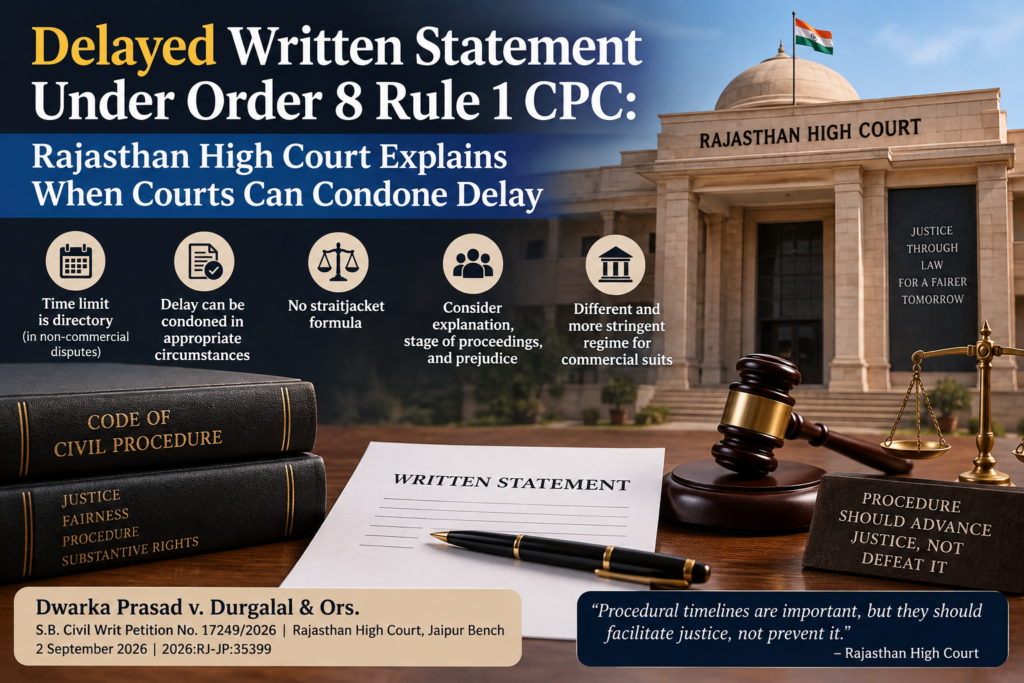
Delayed Written Statement Under Order 8 Rule 1 CPC – Condonation Upheld – Jaipur Rajasthan High Court The question of whether a civil court can accept a written statement filed beyond the prescribed period under Order 8 Rule 1 of the Code of Civil Procedure, 1908 (CPC) continues to arise frequently in civil litigation. A recent reportable judgment of the Rajasthan High Court, Jaipur Bench, has once again examined this issue and clarified that, particularly in non-commercial disputes, the court retains jurisdiction to condone delay and take a belated written statement on record, provided there is a satisfactory justification or explanation for the delay. The judgment was delivered by Hon’ble Mr. Justice Sudesh Bansal on 2 September 2026 in Dwarka Prasad v. Durgalal & Ors., S.B. Civil Writ Petition No. 17249/2026. The judgment is particularly important because it discusses the interplay between Order 8 Rule 1 CPC, procedural timelines, the discretion of the trial court, prejudice to the opposite party, and the distinction between commercial and non-commercial disputes. What Was the Issue Before the Rajasthan High Court? The petitioner had instituted a civil suit for permanent injunction in 2021 against several defendants. The trial court had held service of summons sufficient on the defendants. However, while several defendants appeared through their respective advocates, Defendant No. 3 did not initially appear. Importantly, the trial court did not pass an order proceeding against Defendant No. 3 ex parte, nor did it pass an order forfeiting his right to file a written statement. The litigation continued for several years. Defendant No. 3 eventually entered appearance on 21 January 2026 and filed an application under Order 9 Rule 7 CPC. That application was subsequently withdrawn on 12 March 2026 because there had never been an order directing that he be proceeded against ex parte. Thereafter, Defendant No. 3 filed his written statement on 23 April 2026, accompanied by an application seeking condonation of delay. The trial court accepted the explanation, condoned the delay and permitted the written statement to be taken on record, subject to payment of ₹1,000 as costs to Legal Aid. The plaintiff challenged that order before the Rajasthan High Court under Article 227 of the Constitution of India. What Does Order 8 Rule 1 CPC Say About Filing a Written Statement? Order 8 Rule 1 CPC prescribes the timeline within which a defendant is expected to present a written statement. The provision is intended to prevent unnecessary delay in civil proceedings and to ensure that the defendant’s defence is placed before the court within the prescribed period. However, the important question is: Can a court accept a written statement after expiry of the statutory period? According to the line of Supreme Court judgments considered by the Rajasthan High Court, the answer depends upon the nature of the proceeding and the circumstances of the particular case. In non-commercial disputes, the time schedule under Order 8 Rule 1 CPC has been treated as directory rather than absolutely mandatory, although this does not mean that defendants have an unrestricted right to file written statements whenever they choose. Supreme Court’s Decision in Kailash v. Nanhku The Rajasthan High Court relied upon the landmark Supreme Court judgment in Kailash v. Nanhku & Ors., AIR 2005 SC 2441. The Supreme Court had considered the nature of the time limit prescribed under Order 8 Rule 1 CPC and held that the provision is essentially directory in nature. The objective of prescribing a time limit is to expedite the proceedings and not to scuttle the hearing. The Rajasthan High Court reiterated that the court’s power to extend the time for filing a written statement is not completely taken away by Order 8 Rule 1 CPC. This distinction is crucial. Directory does not mean optional A common misconception is that if Order 8 Rule 1 CPC is directory, a defendant can file a written statement at any stage without consequence. That is not the correct position. The court still has to consider: the length of the delay; the explanation offered for the delay; the circumstances of the case; the stage of the proceedings; prejudice caused to the plaintiff; the purpose behind the procedural timeline; and whether accepting the written statement would frustrate the objective of expeditious disposal. The discretion is therefore judicial discretion, not an automatic entitlement. What Did Atcom Technologies Say? The Rajasthan High Court also referred to the Supreme Court’s decision in Atcom Technologies Ltd. v. Y.A. Chunawala & Co. & Ors., (2018) 6 SCC 639. As noted by the High Court, the Supreme Court considered the period prescribed under Order 8 Rule 1 CPC and held that the proviso permits the court, for sufficient reasons, to extend the initial period of 30 days up to 90 days from the date of service of summons. At the same time, the Supreme Court recognised that the power of the court to accept a written statement beyond the prescribed period had not been completely taken away in non-commercial matters because the provision concerns procedural law. Thus, the law is not simply: 90 days expired = written statement can never be accepted. Rather, in an ordinary civil/non-commercial dispute, the court may still have jurisdiction to consider a belated written statement in appropriate circumstances. What Did Desh Raj v. Balkishan Add? The petitioner in the Rajasthan High Court relied upon the Supreme Court’s decision in Desh Raj v. Balkishan (D) through proposed LR Ms. Rohini, (2020) 2 SCC 708. The High Court observed that Desh Raj followed and reiterated the principles laid down in Kailash and Atcom Technologies. However, the Supreme Court had also cautioned that routine condonation of delay and a cavalier attitude towards procedural timelines should not be encouraged because such conduct can adversely affect the administration of justice. This creates an important balance: Courts have discretion—but discretion must not become routine indulgence. Rajasthan High Court’s Key Finding The Rajasthan High Court summarised the legal position in particularly clear terms. The court held that in a non-commercial dispute, it
Husband Not Liable for Wife’s Dues : Rajasthan High Court on Panchayat Election No-Dues Certificate

Husband Not Liable for Wife’s Dues Rajasthan High Court on Panchayat Election No-Dues Certificate Jaipur, September 2, 2026: The Rajasthan High Court, Jaipur Bench, has held that a husband cannot be compelled to pay an amount recoverable from his wife merely because she is the erstwhile Sarpanch against whom recovery proceedings have been initiated. The Court further held that the authorities cannot deny a No-Dues/No-Objection Certificate to the husband for contesting a forthcoming Panchayati Raj election solely on the ground that an amount is recoverable from his wife. The judgment was delivered by Justice Anoop Kumar Dhand in S.B. Civil Writ Petition No. 11020/2026, Ramlaxman Meena v. State of Rajasthan & Ors., decided on September 2, 2026. The order is marked “Reportable.” Key Takeaway A person’s eligibility to contest a Panchayati Raj election cannot be made dependent upon recovery of dues from a spouse when the person himself is neither a surety nor a guarantor and there is no statutory provision making him liable for those dues. The High Court ultimately directed the authorities to issue the petitioner a No-Dues/No-Objection Certificate forthwith for the purpose of contesting the upcoming Panchayati Raj elections. What Was the Dispute Before the Rajasthan High Court? The petitioner, Ramlaxman Meena, approached the Rajasthan High Court seeking directions to the authorities to issue him a no-dues certificate so that he could contest the upcoming Panchayati Raj election for Gram Panchayat Falenda. The dispute arose because the petitioner’s wife, Laxmi Bai, had earlier served as Sarpanch of Gram Panchayat Falenda during the 1995–2000 tenure. An enquiry had been conducted against her, following which a recovery order was issued. When the amount was not deposited, proceedings for attachment/auction of her property were initiated. She challenged those proceedings before the High Court in S.B. Civil Writ Petition No. 11544/2009. An interim order dated September 16, 2009 restrained the authorities from auctioning her property, and that petition remained pending for adjudication. The petitioner subsequently sought to contest the forthcoming Panchayati Raj election. However, the authorities refused to issue him the required certificate because of the amount allegedly recoverable from his wife. Can a Husband Be Made Liable for His Wife’s Government Dues? No, not merely because he is her husband. This was the central legal issue considered by the High Court. The State argued that since the petitioner was the husband of the erstwhile Sarpanch, he was duty-bound to deposit the amount due from his wife. According to the State, until the amount was deposited by either the petitioner or his wife, a no-dues certificate could not be issued and the petitioner could not be permitted to contest the election. The High Court rejected this position. The Court specifically observed that while a surety or guarantor may be liable for the dues of another person, the petitioner in the present case was neither a surety nor a guarantor of his wife in respect of the recovery amount. Therefore, the recovery dispute remained a separate matter between the State and the erstwhile Sarpanch. Husband and Wife Are Separate Legal Entities One of the most significant observations in the judgment concerns the independent legal status of spouses. The Court held that a public representative is personally responsible for his or her own misconduct or disgraceful act. If recovery proceedings arise against that person, that person is responsible for clearing the dues. The Court questioned the basis on which recovery proceedings could be initiated against family members of an erstwhile Sarpanch merely because the Sarpanch had outstanding dues. The judgment expressly states that husband and wife are separate entities and that one spouse cannot ordinarily be held liable for the misconduct or liability of the other merely because of the marital relationship. Importantly, the Court also identified an exception: the husband could potentially be proceeded against if an enquiry established that he had himself been involved in the Panchayat works or had participated in the alleged misconduct. Thus, the judgment does not mean that a spouse can never have liability connected with the other’s conduct. Rather, liability cannot be imposed simply because of the marital relationship when there is no independent legal basis for doing so. What Did the Court Say About the Panchayati Raj Act, 1994? The petitioner had argued that failure of his wife to deposit the disputed amount could not disqualify him from contesting the election under Section 19(m) of the Panchayati Raj Act, 1994. The High Court’s reasoning focused on the absence of any provision authorising recovery of the wife’s dues from her family members. The Court observed that neither the Panchayati Raj Act, 1994, nor the Panchayati Raj Rules, 1996, contained a provision authorising recovery of such an amount from family members of the Sarpanch merely because the Sarpanch had failed to pay the amount. This absence of statutory authority was central to the Court’s decision. Can Authorities Deny a No-Dues Certificate Because of a Spouse’s Dues? In the circumstances of this case, the Rajasthan High Court said no. The Court considered whether the authorities could: force the petitioner to deposit the amount allegedly due from his wife; or deny the petitioner a no-dues/no-objection certificate required for contesting the Panchayati Raj election. The Court found that the authorities could not make the petitioner pay his wife’s dues when he had not undertaken liability as a surety or guarantor and there was no statutory provision making him responsible for those dues. The Court described the action of requiring the petitioner to pay the amount owed by his wife in order to obtain the certificate as an example of “non-application of mind” and held that such action was unwarranted. Rajasthan High Court’s Final Order The High Court allowed the writ petition. The respondents were directed to issue the petitioner a No-Dues/No-Objection Certificate forthwith for the purpose of contesting the forthcoming Panchayati Raj elections. The Court also disposed of the stay application and all pending applications, if any. Frequently Asked Questions 1. Can a husband be forced to pay his
Government Can Transfer Employees, But Transfer Orders Must Be Fair, Lawful and Free From Arbitrariness – Jaipur High Court

Government Can Transfer Employees, But Transfer Orders Must Be Fair, Lawful and Free From Arbitrariness – Jaipur High Court The Rajasthan High Court, Jaipur Bench, in a significant judgment pronounced on 17 August 2026, has laid down a structured mechanism for dealing with grievances arising from government and institutional transfer orders. The judgment was delivered by Hon’ble Mr. Justice Sameer Jain in S.B. Civil Writ Petition No. 14009/2026, Dr. Mahesh Meena v. State of Rajasthan, which was treated as the lead matter for a large batch of connected writ petitions. The Court clarified that its decision would apply to the connected petitions on a mutatis mutandis basis. The judgment is important because the Court has attempted to strike a balance between the State’s administrative power to transfer employees and the requirement that such power be exercised lawfully, fairly, transparently and without arbitrariness. Importantly, the Court did not hold that government employees have a right to remain posted at a particular station. Instead, it created a time-bound mechanism through which individual transfer grievances are to be reconsidered by the competent authorities. What did the Rajasthan High Court decide on transfer orders? The Rajasthan High Court held that transfer is ordinarily an incident of service and an employee has no vested right to remain posted at a particular place. However, the State’s power to transfer is not absolute and remains subject to statutory provisions, applicable policies, constitutional principles of fairness and judicial review where the decision is affected by illegality, mala fides, arbitrariness or other recognised grounds. This distinction is the central principle running through the judgment: The existence of the power to transfer and the legality of exercising that power are two different questions. The Court accepted the settled principle that courts ordinarily should not substitute their own view for that of the competent administrative authority regarding where an employee should be posted. At the same time, judicial review remains available where the transfer is shown to involve circumstances such as: violation of a mandatory statutory provision; lack of jurisdiction or an incompetent authority; mala fide exercise of power; extraneous considerations; colourable exercise of power; patent arbitrariness; non-application of mind; or disregard of relevant and compelling circumstances. Why did the transfer dispute reach the Rajasthan High Court? The batch involved transfer orders affecting employees across various government departments, Boards, Corporations, Discoms, local authorities and other establishments. The petitioners raised several common grievances. These included allegations of blanket, premature and repeated transfers, failure to consider individual circumstances, violation of departmental transfer guidelines, lack of sanctioned posts at transferred locations, political or extraneous interference, and transfers allegedly being used for punitive or other impermissible purposes. The Court also noted that transfer litigation had become a recurring feature of its service-law docket. A significant institutional problem identified by the Court was the functioning of the Rajasthan Civil Services Appellate Tribunal (RCSAT). According to material placed before the Court, vacancies and non-availability or non-sitting of requisite Members had contributed to delays in adjudication. The statistics reproduced in the judgment are particularly striking. According to the RCSAT data recorded by the Court, the Tribunal disposed of 4,094 out of 5,290 appeals in 2025, a disposal rate of 77.39%. For 2026, the figures recorded were 1,027 disposed out of 3,467 appeals, leaving 2,440 pending, with a disposal rate of 29.62%. The Court therefore treated the issue as extending beyond individual transfer disputes and into the larger question of administrative and institutional reform. Does a government employee have a right to stay at a particular posting? No. The judgment expressly reiterates that a government employee holding a transferable post does not have an indefeasible or vested right to remain posted at a particular station. The State must retain reasonable latitude to deploy its human resources to ensure administrative efficiency, continuity of public service and implementation of governmental policies. The Court relied upon established Supreme Court jurisprudence, including Shilpi Bose, S.L. Abbas, Rajendra Singh, Gobardhan Lal and other decisions dealing with judicial interference in transfer matters. However, this does not mean that the administration possesses an unrestricted power of transfer. The Court specifically observed that administrative power, however wide, remains subject to law and constitutional governance. Can an employee challenge a transfer order on medical, spouse or family grounds? Such circumstances can certainly be placed before the competent authority, but they do not automatically create a legal right to a particular posting. The Court specifically considered: spouse-related circumstances; serious medical conditions; disability; proximity to retirement; family hardship; dependent family members; previous service in difficult or remote areas; and other compelling personal circumstances. The Court held that these circumstances may justify sympathetic and reasoned administrative consideration, but, in the absence of a statutory mandate or binding provision, they do not themselves create an absolute legal right to remain at a particular station. This is an important distinction: A personal hardship may be a ground for representation without necessarily being a ground for judicially quashing a transfer. What if a transfer violates a statutory rule? That is different. The Court made a clear distinction between violation of a non-statutory administrative guideline and violation of a mandatory statutory provision. A mere departure from an executive instruction or administrative guideline does not automatically give an employee an enforceable right to have a transfer order quashed. But where the alleged violation concerns a statutory rule or mandatory condition governing the exercise of the transfer power, the issue becomes amenable to judicial review. The judgment specifically referred to Rule 20 of the Rajasthan Service Rules and Section 89(8)(ii) of the Rajasthan Panchayati Raj Act, 1994 as examples of statutory provisions whose violation may have legal consequences. What did the High Court say about “administrative exigency”? The State argued that administrative exigency could arise from several circumstances, including: administrative restructuring; manpower rationalisation; vacancy position; functional requirements; public interest; efficiency of administration; reorganisation of work; and other circumstances that may not always be capable of being fully disclosed in an individual transfer order. The Court accepted
Bank Account Frozen Due to Cyber Crime? Jaipur Rajasthan High Court Says Only Disputed Amount Can Be Frozen, Entire Account Cannot Be Blocked

Bank Account Frozen Due to Cyber Crime? Jaipur Rajasthan High Court Says Only Disputed Amount Can Be Frozen, Entire Account Cannot Be Blocked Jaipur Rajasthan High Court, Jaipur Bench | Judgment dated 20 August 2026 | Hon’ble Justice Anand Sharma A bank account can be frozen in connection with a cyber fraud investigation, but an alleged cyber-fraud transaction does not automatically justify freezing the entire bank account indefinitely. In a significant and reportable judgment dated 20 August 2026, the Rajasthan High Court, Jaipur Bench, dealt with a large batch of writ petitions concerning bank account freezing, debit freezes, lien marking and holds imposed in cyber financial crime investigations. The Court recognised the need to protect cyber-fraud victims and preserve suspected proceeds of crime, but at the same time held that innocent account holders cannot be subjected to arbitrary, indefinite or disproportionate financial restrictions. The principal matter in the judgment is S.B. Civil Writ Petition No. 2679/2026, Shree Balaji Enterprises v. Reserve Bank of India & Ors., along with connected writ petitions. The judgment was pronounced by Hon’ble Mr. Justice Anand Sharma on 20 August 2026. What did the Rajasthan High Court decide about frozen bank accounts? The Rajasthan High Court has laid down important safeguards governing the freezing, debit-freezing, lien marking, holding and seizure of bank accounts in cyber financial crime investigations in the State of Rajasthan. The central principle is one of proportionality: If the disputed cyber-fraud amount is identifiable, the ordinary course should be to place a lien or hold on that disputed amount, rather than freeze the entire bank account. The Court expressly directed that an identifiable disputed amount should ordinarily be protected without unnecessarily preventing the account holder from operating the remaining legitimate balance.This is particularly important where, for example, an account contains several lakh rupees but the alleged disputed transaction is only a few hundred or a few thousand rupees. Why is this judgment important? Cyber fraud investigations frequently involve multiple bank accounts and rapid movement of funds. A genuine cyber-fraud investigation may therefore require immediate action to prevent the suspected proceeds from being withdrawn or transferred. However, the Court recognised that a complete bank-account freeze can have serious consequences. A bank account is not merely a place where money is stored. It is often essential for: receiving salary; receiving business payments; paying employees; paying suppliers and creditors; paying taxes and statutory dues; meeting household expenses; paying rent and utilities; and conducting day-to-day business. The Court therefore observed that a complete freeze can have immediate and serious civil and financial consequences and must satisfy the requirements of legality, rationality, reasonableness, non-arbitrariness and proportionality. Can the police freeze an entire bank account because of a cyber crime complaint? Not automatically. The Rajasthan High Court has clarified that the mere existence of a suspected cyber-fraud transaction does not, by itself, justify an indefinite blanket debit freeze. Before imposing or continuing a restraint, the Investigating Officer must have material demonstrating a prima facie nexus between the particular account or transaction and the offence under investigation. The Court further held that expressions such as: “suspicious transaction”; “mule account”; “Layer-1 account”; or “cyber fraud transaction” cannot, by themselves, constitute sufficient reasons for indefinitely immobilising an entire bank account. Such terminology may justify investigation, but it cannot replace the underlying material supporting the suspicion. Therefore, the important question is not merely whether an account has received a suspicious transaction. The authorities must consider: Is there lawful authority for the restraint? Is there objective material connecting the account or transaction with the alleged offence? What particular transaction and amount needs to be protected? Is freezing the entire account actually necessary and proportionate? These four requirements were specifically identified by the Court. What happens if only a small amount is disputed? This is one of the most significant aspects of the judgment. The Court gave an illustrative example where an alleged cyber-fraud amount is ₹500 while the bank account contains ₹5 lakh. According to the Court, the investigative objective would ordinarily be achieved by preserving the disputed ₹500 rather than depriving the account holder of access to the remaining ₹4,99,500. Accordingly, where the disputed amount is identifiable, the normal approach should be: Disputed amount → lien/hold rather than: Disputed amount → complete debit freeze of the entire account. This distinction is fundamental because a lien or hold over the disputed amount preserves the subject matter of the investigation while allowing the account holder to use legitimate funds. When can the entire bank account still be frozen? The judgment does not say that a complete bank-account freeze is never permissible. A wider restraint may be justified in exceptional circumstances. The Court identified examples including situations where: the account appears to be a deliberately operated mule account; there are repeated suspicious credits and onward transfers; the account holder is a named accused; there is material showing conscious participation; the entire balance is reasonably suspected to be proceeds of crime; multiple linked transactions make segregation impracticable; or allowing the account to operate would demonstrably defeat the investigation. Even in such cases, the reasons for adopting the more restrictive measure should be recorded in writing and the restraint should be periodically reviewed. Thus, the judgment does not create an absolute right to operate every bank account during an investigation. Instead, it requires the restriction to be legally justified, evidence-based and proportionate. What information should a police freezing communication contain? The Rajasthan High Court has also addressed another major problem: account holders often do not know why their bank account has been frozen. The Court directed that, subject to legitimate investigative confidentiality, communications issued by police or investigating agencies to banks should contain sufficient particulars to identify the account, transaction and nature of the restraint. As far as legally permissible, such communication should specify: Name and designation of the Investigating Officer; Police station or investigating agency and contact particulars; FIR/crime/NCRP/CFCFRMS reference number, wherever available; Legal provision under which the action is taken; Account number and bank details;
Rajasthan High Court: No Concept of Criminal Writ Petition Under the Constitution
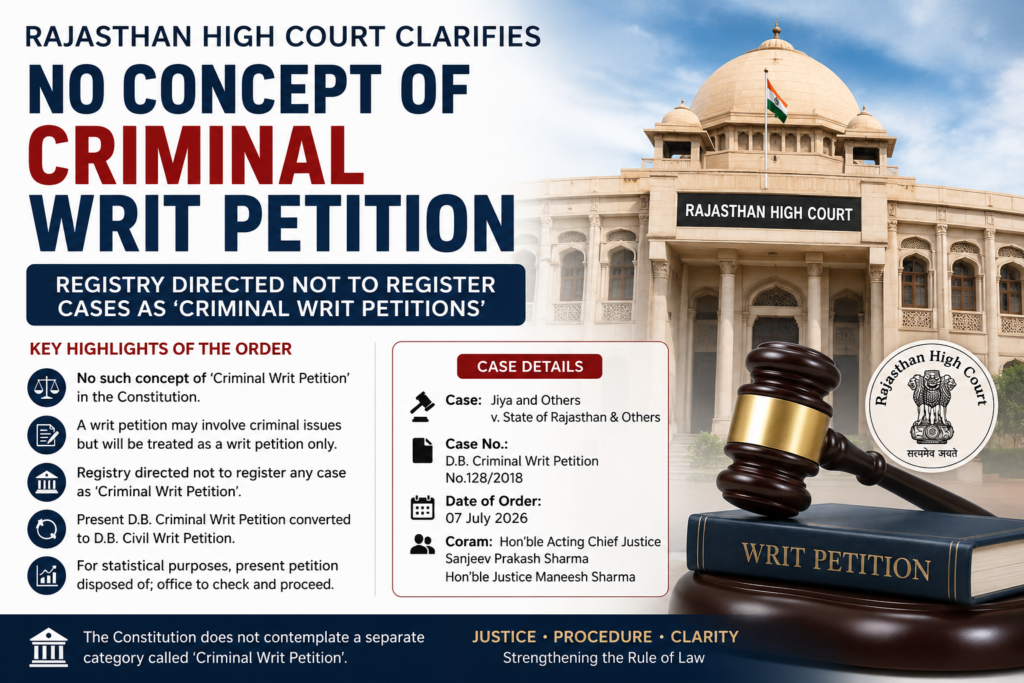
Rajasthan High Court: No Concept of Criminal Writ Petition Under the Constitution In a significant procedural ruling, the Rajasthan High Court, Jaipur Bench, has clarified that there is no separate concept of a “Criminal Writ Petition” under the Constitution of India. The Court directed the Registry not to register any case under the category of “Criminal Writ Petition” in the future. The Division Bench observed that although a writ petition may raise issues connected with a criminal matter, its criminal subject matter does not convert it into a separate constitutional category called a “Criminal Writ Petition.” Such proceedings are to be registered simply as writ petitions, while the Court may examine their nature for placement before the appropriate roster or Bench. The ruling in Jiya and Others v. State of Rajasthan and Others provides important guidance regarding the classification, registration and listing of writ petitions involving criminal law issues before the Rajasthan High Court. Case: Jiya and Others v. State of Rajasthan and OthersCourt: Rajasthan High Court, Jaipur BenchCase No.: D.B. Criminal Writ Petition No. 128/2018Date of Order: 07 July 2026Coram: Hon’ble Acting Chief Justice Mr. Sanjeev Prakash Sharma and Hon’ble Mr. Justice Maneesh Sharma Background of the Case The petition was instituted before the Rajasthan High Court as D.B. Criminal Writ Petition No. 128/2018. The Registry had also entertained and registered the matter as a criminal writ petition. While considering the matter, the Division Bench examined whether the Constitution recognises “Criminal Writ Petition” as an independent category of legal proceeding. The Court noted that the petition had earlier been adjourned sine die without any plausible reason. While dealing with its procedural status, the Court addressed the broader issue concerning the registration of cases as criminal writ petitions. No Concept of “Criminal Writ Petition” Under the Constitution The principal observation made by the Rajasthan High Court was that the Constitution does not provide for a separate category known as a “Criminal Writ Petition.” The Court observed: “A writ petition can be filed for raising the issues which may also relate to a criminal matter but the same would not be treated as a ‘Criminal Writ Petition’ and the same can only be registered as a writ petition alone.” This clarification distinguishes the nature of the issue raised in a writ petition from the constitutional character of the proceeding. A writ petition may involve issues such as: Police inaction; Illegal detention; Protection of life and personal liberty; Unlawful exercise of police powers; Failure to register an FIR; Improper criminal investigation; Violation of fundamental rights during criminal proceedings; or Illegal or arbitrary action by law-enforcement authorities. However, merely because the subject matter relates to criminal law does not create a separate constitutional proceeding called a “Criminal Writ Petition.” Registry Directed Not to Register Criminal Writ Petitions The Rajasthan High Court issued a clear direction that, henceforth, the Registry shall not register any case as a “Criminal Writ Petition.” The Court clarified that it is for the Court to examine the nature of a case and determine its placement before the appropriate roster. The Registry’s role is to register the proceeding as a writ petition rather than create a separate classification based solely on whether the dispute involves a criminal issue. This direction is likely to bring greater procedural consistency in the registration and classification of writ petitions before the Rajasthan High Court. Existing Criminal Writ Petition Converted into Civil Writ Petition In the present matter, the Court directed the Registry to treat the existing D.B. Criminal Writ Petition as a D.B. Civil Writ Petition. The Court further stated that, for statistical purposes, the D.B. Criminal Writ Petition would stand disposed of. However, the office was directed to check the matter and proceed further. Therefore, the order appears to deal primarily with the procedural classification of the petition rather than deciding the substantive rights or claims raised by the petitioners. Does the Judgment Bar Writ Petitions in Criminal Matters? No. The judgment does not prohibit a person from approaching the High Court through a writ petition merely because the dispute relates to a criminal matter. The Court expressly recognised that a writ petition may raise issues connected with criminal law. The ruling concerns the nomenclature and registration category of such petitions. Accordingly, where a person alleges a violation of fundamental or legal rights arising from police action, investigation, detention or another criminal-law-related issue, an appropriate writ petition may still be maintainable, subject to the facts of the case and applicable legal principles. The effect of the ruling is that such a petition should not be separately classified or registered as a “Criminal Writ Petition.” Difference Between a Criminal Writ Petition and a Writ Petition Involving Criminal Issues Following this judgment, the distinction may be understood as follows: Particular Position Clarified by the Rajasthan High Court Criminal Writ Petition as a separate category Not contemplated under the Constitution Writ petition involving a criminal issue May be filed in an appropriate case Registration by the High Court Registry To be registered as a writ petition Nature of dispute May still involve criminal law or police action Placement before the appropriate Bench To be examined according to the Court’s roster Existing petition in the present case Directed to be treated as a D.B. Civil Writ Petition Practical Impact of the Rajasthan High Court Judgment The judgment may have important procedural implications for advocates, litigants and the Rajasthan High Court Registry. First, petitions involving criminal issues may continue to invoke the constitutional writ jurisdiction of the High Court where legally maintainable. However, such petitions should not be treated as belonging to a separate constitutional category merely because the underlying dispute relates to criminal law. Second, the Registry has been expressly directed not to register future matters as criminal writ petitions. Third, the Court retains the authority to examine the nature of the dispute and determine the appropriate roster or Bench before which the matter should be placed. Fourth, advocates filing writ petitions concerning police action, personal
Rajasthan High Court Examines JDA’s Withdrawal of OTS Flyover EPC Contract and Re-Tendering of DPR Work
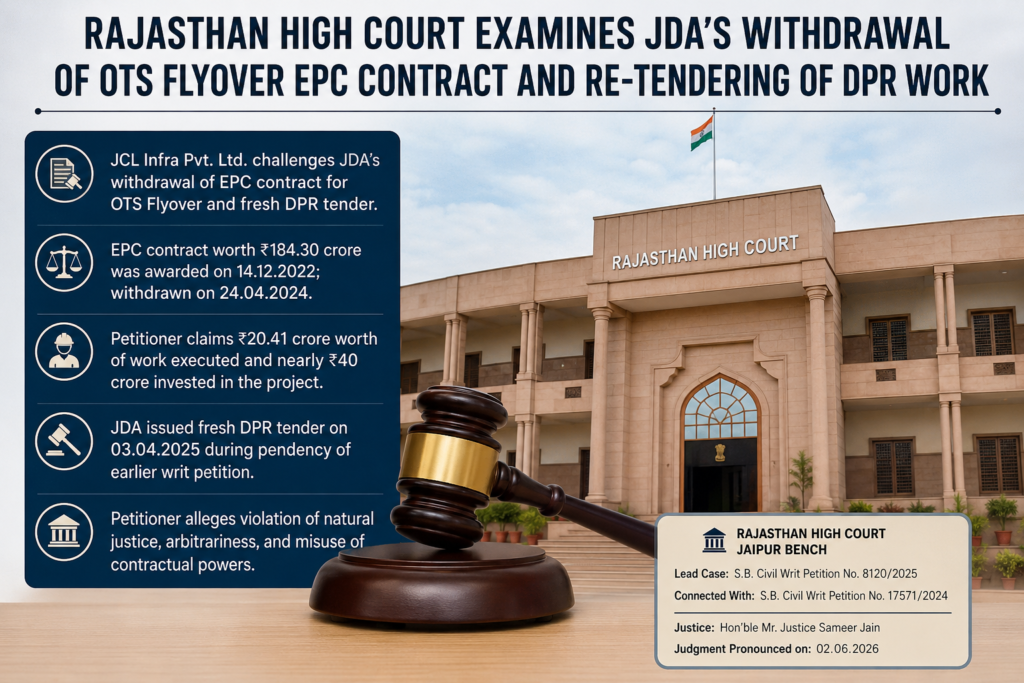
Rajasthan High Court Examines JDA’s Withdrawal of OTS Flyover EPC Contract and Re-Tendering of DPR Work The Rajasthan High Court, Jaipur Bench, in a batch of writ petitions led by JCL Infra Private Limited v. Jaipur Development Authority, examined the legality of Jaipur Development Authority’s actions relating to the OTS Flyover project at JLN Marg, Jaipur. The dispute concerns the withdrawal of an Engineering, Procurement and Construction (EPC) contract previously awarded to JCL Infra and the subsequent issuance of a fresh tender for preparation of a Detailed Project Report (DPR) for the same project. Background of the Dispute The OTS Crossing project was conceived as a traffic improvement and beautification initiative aimed at easing congestion at one of Jaipur’s busiest intersections. The project included construction of a flyover and associated infrastructure works. According to the petitioner, JDA had earlier engaged consultants for preparation of the DPR, which subsequently formed the basis for the EPC tender. Pursuant to the tender process, JCL Infra was awarded the EPC contract through a Letter of Acceptance dated 14 December 2022, followed by execution of a formal contract agreement on 27 December 2022. The contract related to traffic improvement and beautification works at OTS Crossing, JLN Marg, Jaipur, and was valued at approximately ₹184.30 crore. Petitioner’s Case JCL Infra contended that after execution of the contract, it mobilized manpower, machinery, and financial resources and commenced work in accordance with contractual requirements. The company asserted that: Multiple drawings, designs, survey reports and engineering documents were submitted to JDA during 2023. Necessary approvals and site clearances were repeatedly sought from the authority. Despite continuous correspondence, approvals required for execution of the project were allegedly not granted. Work worth approximately ₹20.41 crore had already been executed. Investments of nearly ₹40 crore had been made in the project. The petitioner further argued that repeated representations seeking approvals and release of payments did not receive appropriate responses from JDA. Extension of Time and Subsequent Withdrawal A significant aspect of the dispute relates to the extension of the project period. The petitioner pointed out that JDA extended the project completion timeline up to 30 April 2024. According to JCL Infra, this extension reflected acknowledgment of the subsisting contract and ongoing execution of work. However, shortly thereafter, JDA withdrew the awarded work through a communication dated 24 April 2024 by invoking Clause 32 of the contract. The petitioner challenged this withdrawal, alleging that: The action was arbitrary and illegal. No opportunity of hearing was provided. No adequate reasons were supplied. Clause 32 did not permit withdrawal of the entire contract in the manner adopted by JDA. Fresh DPR Tender and Challenge Before the Court During the pendency of the earlier writ proceedings challenging the withdrawal, JDA issued a fresh Notice Inviting Bid dated 3 April 2025 for consultancy services relating to preparation of a DPR for the proposed elevated road and OTS Flyover project. JCL Infra argued that re-tendering DPR consultancy work for the OTS Flyover was unjustified because: A DPR had already been prepared earlier. The EPC contract had already been awarded on the basis of that DPR. Significant work and investment had already been undertaken. The petitioner characterized the fresh tender as an attempt to restart the project despite the existence of an earlier DPR and a concluded EPC contract. Legal Grounds Raised by the Petitioner The petitioner relied upon several legal principles, including: 1. Violation of Natural Justice JCL Infra contended that withdrawal of the contract was undertaken without affording an opportunity of hearing, contrary to the principles of natural justice. 2. Arbitrary Exercise of Power It was argued that the withdrawal notice lacked sufficient reasons and was therefore arbitrary and unsustainable. 3. Promissory Estoppel and Legitimate Expectation The petitioner claimed that it had acted upon JDA’s representations and contractual commitments by mobilizing resources and investing substantial amounts. Consequently, withdrawal of the project allegedly caused severe prejudice. 4. State Obligation to Act Fairly The petitioner emphasized that JDA, being a public authority, was obligated to act fairly, transparently and reasonably even in contractual matters. Respondents’ Stand JDA opposed the petitions and raised objections regarding maintainability as well as merits. The respondents contended that: The petitions were not instituted by a duly authorized person on behalf of the company. Material facts had allegedly been suppressed. The dispute arose from contractual obligations involving disputed questions of fact. Such issues should be adjudicated through appropriate civil or commercial proceedings rather than writ jurisdiction. On merits, JDA maintained that the withdrawal of work was within the powers available under Clause 32 of the contract and that the Engineer-in-Charge possessed authority to take such action. The respondents also asserted that multiple communications and meetings had been conducted regarding delays and deficiencies in execution. Key Issues Before the High Court The proceedings raised several important legal questions: Whether JDA was justified in withdrawing the EPC contract awarded to JCL Infra. Whether the withdrawal complied with contractual provisions and principles of natural justice. Whether re-inviting bids for preparation of a DPR concerning the OTS Flyover was legally sustainable. Whether the dispute could be examined under Article 226 of the Constitution despite arising from a contractual relationship. Whether the petitioner had established arbitrariness in the actions of the public authority. Conclusion The litigation concerning the OTS Flyover project highlights the intersection of public procurement, infrastructure development, contractual obligations and administrative fairness. The dispute revolves around JCL Infra’s allegation that substantial work, investment and contractual commitments were disregarded through withdrawal of the EPC contract and subsequent re-tendering of DPR consultancy services, while JDA maintains that its actions were contractually justified and undertaken in public interest. The Rajasthan High Court examined these competing claims while considering questions of contractual interpretation, natural justice, public law principles and judicial review of governmental decisions in infrastructure projects.
Jaipur High Court on Power of High Court Under Section 311 CrPC / Section 348 BNSS to Summon Material Witness
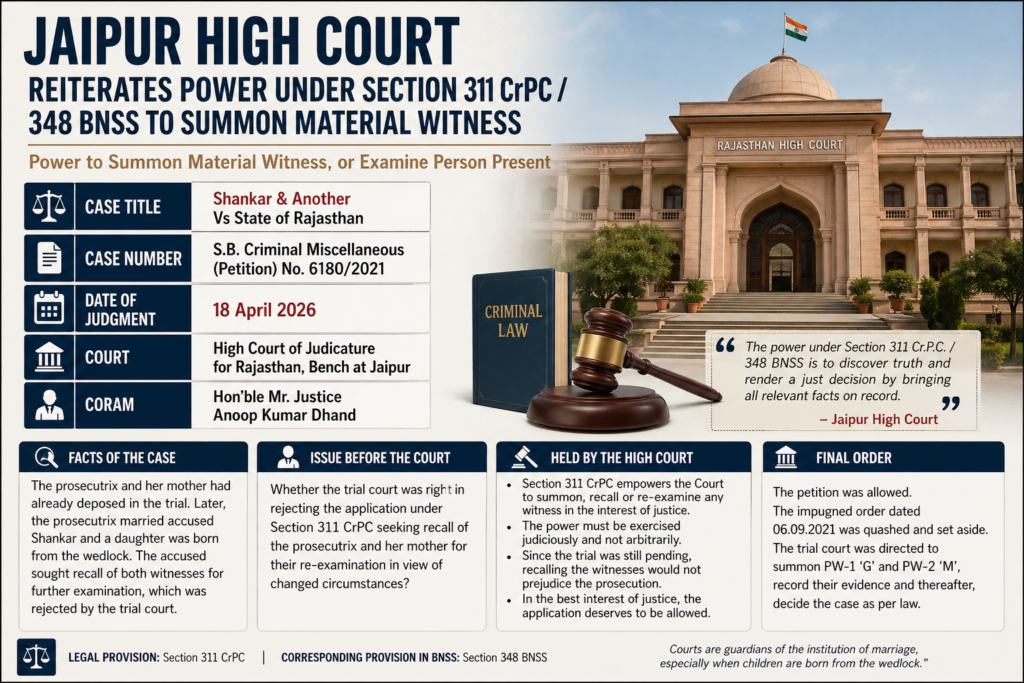
Jaipur High Court on Power of High Court Under Section 311 CrPC / Section 348 BNSS to Summon Material Witness In an important ruling concerning the power of High Court under Section 311 CrPC / Section 348 BNSS, the Jaipur High Court reaffirmed that criminal courts possess wide authority to summon any material witness, recall witnesses already examined, or examine any person present before the court whenever such evidence is necessary for a just decision. The judgment was delivered in Shankar & Anr. Vs State of Rajasthan, S.B. Criminal Miscellaneous (Petition) No. 6180/2021, decided on 18/04/2026 by Hon’ble Mr. Justice Anoop Kumar Dhand. Case Title, Number and Date of Judgment Case Title: Shankar & Another Vs State of RajasthanCase Number: S.B. Criminal Miscellaneous (Petition) No. 6180/2021Court: High Court of Judicature for Rajasthan, Bench at JaipurDate of Judgment: 18 April 2026 Facts Considered by Jaipur High Court The accused persons were facing trial for offences under Sections 376, 363 and 366 IPC along with provisions of the POCSO Act. During trial, statements of the prosecutrix and her mother had already been recorded. Later, a changed circumstance arose when the prosecutrix married one of the accused, namely Shankar, and from the marriage a daughter was born. Thereafter, the accused moved an application seeking recall of the prosecutrix and her mother for fresh examination in view of subsequent events. The trial court rejected the application on 06.09.2021, which was challenged before the Jaipur High Court. Power to Summon Material Witness or Examine Person Present The Jaipur High Court held that the object of Section 311 CrPC is to enable the court to discover truth and render a just decision after bringing all relevant facts on record. The Court observed that this power must be exercised judiciously and not arbitrarily. It further clarified that the provision cannot be used merely to fill lacunae in prosecution or defence, but can certainly be invoked where fresh evidence is necessary in the interest of justice. Section 311 CrPC / Section 348 BNSS: Court may summon, recall, or re-examine witnesses in the interest of justicetext{Section 311 CrPC / Section 348 BNSS: Court may summon, recall, or re-examine witnesses in the interest of justice}Section 311 CrPC / Section 348 BNSS: Court may summon, recall, or re-examine witnesses in the interest of justice The High Court specifically noted that since the trial was still pending, recalling the prosecutrix and her mother would not prejudice the prosecution. Rather, their further statements could assist the court in properly adjudicating the matter after considering changed circumstances. Jaipur High Court Set Aside Trial Court Order Allowing the petition, the Jaipur High Court quashed the order dated 06.09.2021 and directed the trial court to summon PW-1 and PW-2 again, record their evidence, and thereafter decide the case strictly in accordance with law. This judgment is a significant precedent on the power to summon material witness, or examine person present, showing that courts can revisit evidence where justice so requires. Legal Significance Under BNSS After replacement of CrPC by BNSS, the corresponding provision is Section 348 BNSS. Therefore, the principle laid down by the Jaipur High Court remains highly relevant even today. Courts continue to retain authority to summon any witness, recall witnesses already examined, and secure the best available evidence for a fair trial. Bhuvnesh Kumar GoyalAdvocate in Jaipur
 Call: 7300056080
 Email: advocatebhuvneshgoyal@gmail.com
 Office: 109, Fortune Heights, Ahinsa Circle, C-Scheme, Jaipur-302001