Jaipur High Court Sets Aside RTI Second Appeal Order: Major Relief in RTI Matter Against Rajasthan State Information Commission, Jaipur
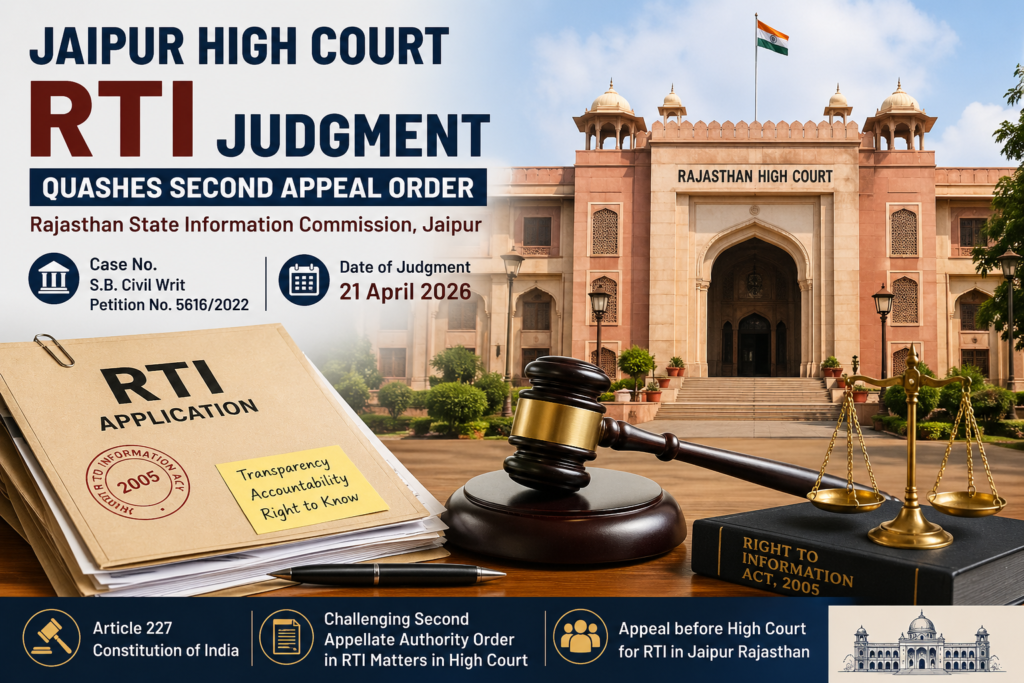
Jaipur High Court Sets Aside RTI Second Appeal Order: Major Relief in RTI Matter Against Rajasthan State Information Commission, Jaipur In an important judgment for transparency and citizens’ rights, the Jaipur High Court has quashed an order passed by the Rajasthan State Information Commission, Jaipur, holding that information under the RTI Act cannot be denied merely because the records relate to events more than twenty years old. The Court clarified that Section 8(3) of the Right to Information Act actually supports disclosure after twenty years rather than blocking it. This ruling is highly relevant for anyone considering challenging second appellate authority order in RTI matters in High Court or filing an appeal before High Court for RTI in Jaipur Rajasthan. Case Title, Date of Judgment and Case Number Case Title: Dr. Mahipal Singh Sihag vs State Public Information Officer Cum Commissioner & AnotherCase Number: S.B. Civil Writ Petition No. 5616/2022Court: High Court of Judicature for Rajasthan, Bench at JaipurJudge: Hon’ble Mr. Justice Sameer JainDate of Judgment: 21 April 2026 Background of the RTI Dispute The petitioner had filed an RTI application seeking service-related information regarding a third-party public servant, including joining date, retirement date, office orders and note sheets. The Public Information Officer rejected the request stating that the matter related to a third party and concerned events more than twenty years old. The first appeal was dismissed, and thereafter the Rajasthan State Information Commission, Jaipur, acting as the second appellate authority, also rejected the appeal on 18.12.2021. Aggrieved by this, the petitioner approached the Jaipur High Court under Article 227 of the Constitution. Jaipur High Court Findings on RTI Law The Jaipur High Court strongly criticised the reasoning adopted by the appellate authorities. The Court held that Section 8(3) of the RTI Act is a “sunset clause”, meaning that after twenty years most exemptions lose force and disclosure should ordinarily be allowed. Therefore, using the twenty-year rule as a ground to deny information was legally incorrect. The Court further observed that where third-party information is involved, the authority must follow the procedure under Section 11 of the RTI Act by issuing notice to the concerned third party and balancing privacy rights with public interest. The second appellate authority failed to follow this mandatory legal process. Final Order Passed by High Court The Jaipur High Court quashed the order dated 18.12.2021 passed by the second appellate authority. The Court directed the competent authority to supply the requested information to the petitioner within sixty days. It also directed the Registrar (Judicial) to send a copy of the judgment to the Rajasthan State Information Commission, Jaipur for compliance. Why This Judgment is Important for RTI Applicants in Rajasthan This judgment is a strong precedent for citizens seeking transparency. It confirms that when an unjust order is passed by the Information Commission, parties may consider challenging second appellate authority order in RTI matters in High Court. It also strengthens the legal route of filing an appeal before High Court for RTI in Jaipur Rajasthan where statutory authorities misinterpret the RTI Act. For litigants and advocates dealing with RTI disputes, this ruling from the Jaipur High Court sends a clear message that authorities must act according to law and cannot reject applications on arbitrary grounds Bhuvnesh Kumar GoyalAdvocate in Jaipur
Section 153C Proceedings & Taxability of Agricultural Land
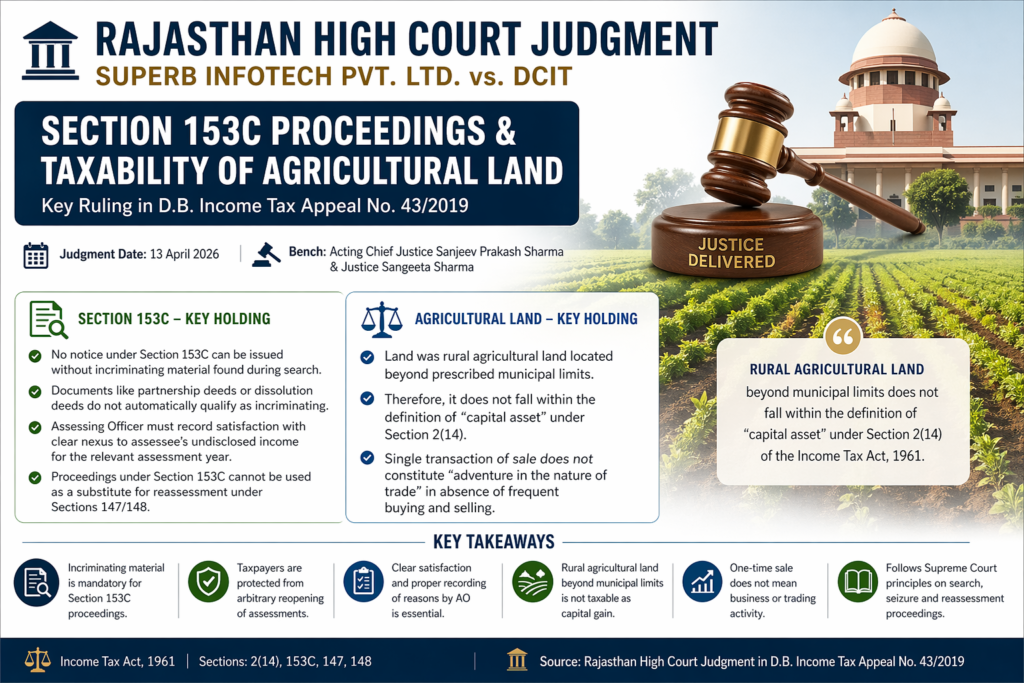
Section 153C Proceedings & Taxability of Agricultural Land The Rajasthan High Court, in Superb Infotech Pvt. Ltd. vs. DCIT (D.B. Income Tax Appeal No. 43/2019), has delivered a significant ruling clarifying the scope of Section 153C of the Income Tax Act, 1961 and the taxability of agricultural land transactions. This judgment reinforces that reassessment proceedings under Section 153C cannot be initiated casually and must strictly comply with legal prerequisites, especially the existence of incriminating material discovered during a valid search. The Court held that merely finding documents such as partnership deeds or dissolution deeds during a search on a third party does not automatically justify invoking Section 153C. There must be a clear nexus between the seized material and undisclosed income of the assessee for the relevant assessment year. In this case, the Assessing Officer failed to establish such linkage, and no incriminating material relating to the assessee’s income for A.Y. 2007–08 was found. Therefore, the entire reassessment proceeding was declared invalid. Another crucial aspect addressed was whether profit from the sale of agricultural land could be taxed as business income or capital gains. The Court observed that the land in question was rural agricultural land located beyond prescribed municipal limits, and hence did not fall within the definition of a “capital asset” under Section 2(14). It further clarified that a single transaction of sale does not amount to an “adventure in the nature of trade,” especially in the absence of frequent buying and selling activities. Importantly, the judgment reiterates the principle laid down by the Supreme Court that no addition can be made in completed assessments without incriminating material found during search proceedings. It also emphasizes that Section 153C cannot be used as a substitute for reassessment under Sections 147/148 when no new evidence is available. In conclusion, this ruling strengthens taxpayer protection by ensuring that tax authorities follow due process before reopening assessments. It also provides clarity on the tax treatment of rural agricultural land, confirming that such transactions, when meeting statutory conditions, remain outside the scope of capital gains taxation. Bhuvnesh Kumar GoyalAdvocate in Jaipur
Legal Heirs Can Continue Criminal Appeal After Death of Victim: Jaipur High Court Clarifies Law
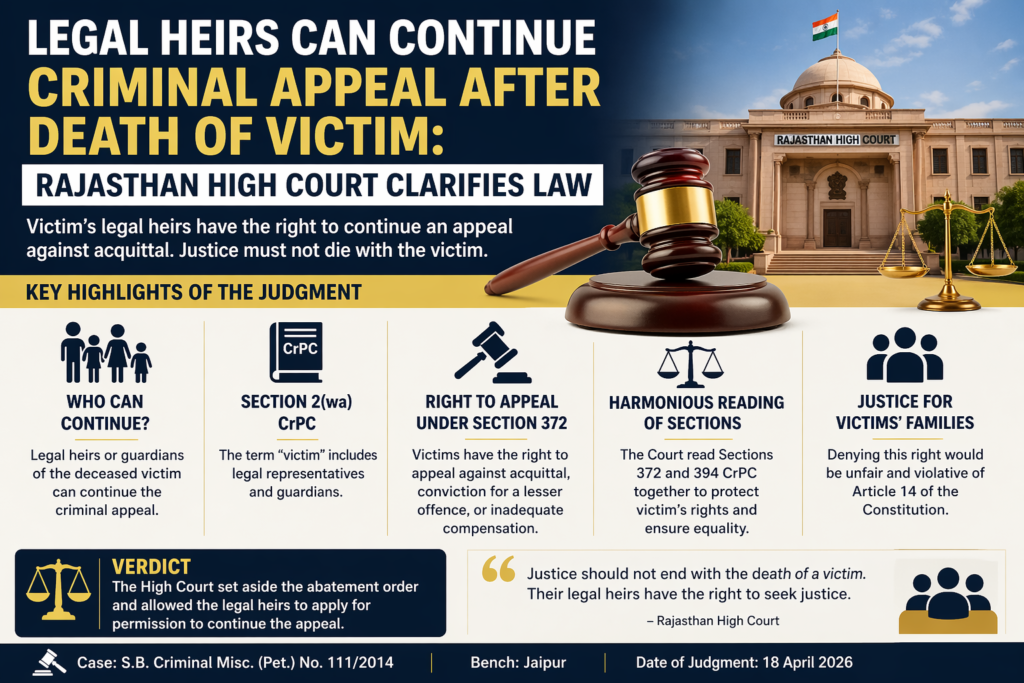
Legal Heirs Can Continue Criminal Appeal After Death of Victim: Rajasthan High Court Clarifies Law The Rajasthan High Court has recently delivered a significant judgment that strengthens the rights of victims and their families in criminal proceedings. The Court clearly held that legal heirs of a deceased victim can continue a criminal appeal against acquittal, even after the death of the original complainant. This decision brings much-needed clarity to an area where there was confusion due to gaps in the law. In the case before the Court, the original complainant had filed a criminal case alleging fraud, forgery, and conspiracy related to land mutation. After trial, the accused were acquitted, and the complainant filed an appeal. However, during the pendency of the appeal, the complainant passed away. The appellate court dismissed the appeal as “abated” due to her death. The legal heirs then approached the High Court challenging this decision. The central issue before the Court was whether legal heirs of a deceased victim can continue an appeal filed against acquittal. The Court examined the definition of “victim” under Section 2(wa) of the Criminal Procedure Code (CrPC), which clearly includes legal heirs and guardians. Based on this, the Court held that legal heirs step into the shoes of the victim and therefore have the right to continue legal proceedings. Further, the Court relied on the proviso to Section 372 CrPC, which gives victims the right to appeal against acquittal, conviction for a lesser offence, or inadequate compensation. The Court interpreted this provision in a liberal and progressive manner, emphasizing that the term “victim” should not be restricted and must include legal representatives. One of the key legal conflicts in this case was with Section 394 CrPC, which deals with abatement of appeals on the death of the appellant. Traditionally, this section allows continuation of appeals only when the accused dies, permitting their relatives to pursue the appeal. However, it does not explicitly provide the same right to the legal heirs of a victim. The High Court resolved this conflict by adopting a purposive interpretation of the law. It held that the absence of explicit provision in Section 394 CrPC should not defeat the substantive rights granted to victims under Section 372. The Court also relied on recent Supreme Court judgments which have recognized the rights of victims and their heirs to continue appeals and prosecution. Importantly, the Court observed that denying such a right to victims’ families would create inequality and may violate Article 14 of the Constitution. While relatives of an accused can continue appeals to protect their honour, denying the same right to victims’ families would be unjust. Based on this reasoning, the High Court set aside the order of abatement and restored the appeal. It allowed the legal heirs to file an application seeking permission to continue the appeal, which the lower court must decide on merits. The Court also made an important recommendation to the legislature, highlighting that Section 394 CrPC should be amended to explicitly allow legal heirs of victims to continue appeals after death. This observation shows a progressive approach towards victim rights in the criminal justice system. In conclusion, this judgment is a landmark step in strengthening victim-centric justice in India. It ensures that legal proceedings do not end abruptly due to the death of a victim and that their family members can continue the fight for justice. This ruling will have a wide impact on criminal appeals, especially in cases involving acquittal, and provides a clear legal pathway for legal heirs to pursue justice. Bhuvnesh Kumar GoyalAdvocate in Jaipur
Rajasthan High Court: Plea of Alibi Not Considerable at Section 319 CrPC Stage
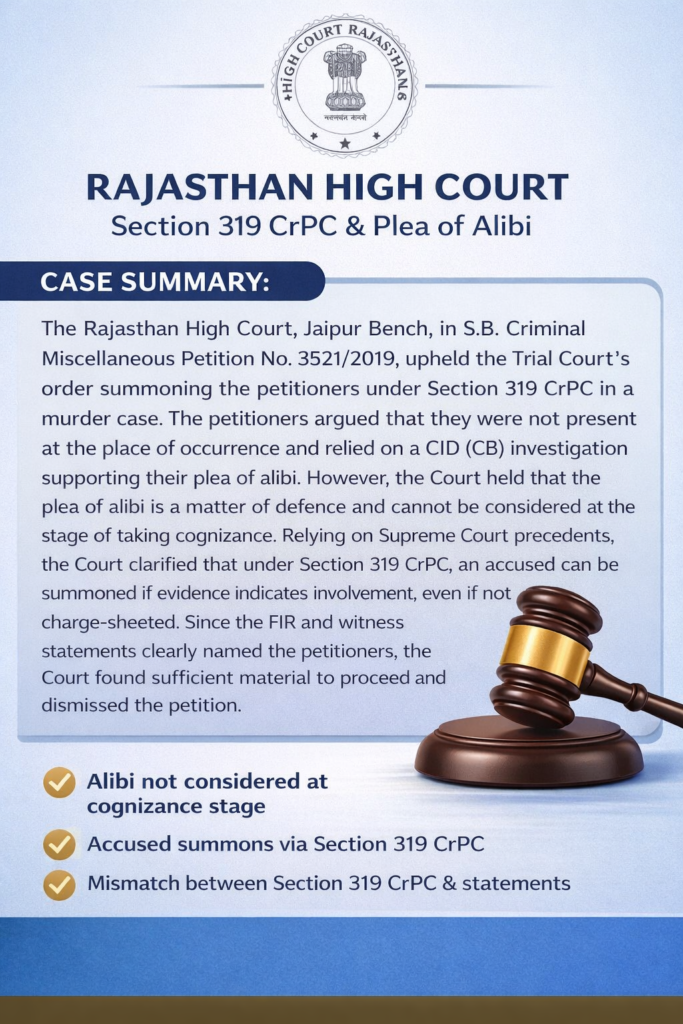
Rajasthan High Court Plea of Alibi Not Considerable at Section 319 CrPC Stage The Rajasthan High Court, Jaipur Bench, in S.B. Criminal Miscellaneous Petition No. 3521/2019, through reportable order dated 25.03.2026, upheld the Trial Court’s order summoning the petitioners under Section 319 CrPC in a murder case. The petitioners argued that they were not present at the place of occurrence and relied on a CID (CB) investigation supporting their plea of alibi. However, the Court held that the plea of alibi is a matter of defence and cannot be considered at the stage of taking cognizance. Relying on Supreme Court precedents, the Court clarified that under Section 319 CrPC, an accused can be summoned if evidence indicates involvement, even if not charge-sheeted. Since the FIR and witness statements clearly named the petitioners, the Court found sufficient material to proceed and dismissed the petition. Prelude: Supreme Court Directions and Background of the Case The Rajasthan High Court, Jaipur Bench, in S.B. Criminal Miscellaneous Petition No. 3521/2019, dealt with an important issue concerning the scope of Section 319 CrPC and the plea of alibi. The matter came up before the Court pursuant to directions issued by the Supreme Court in Vijay Kumar & Ors. vs State of Rajasthan, wherein High Courts were directed to prioritise long-pending criminal matters, especially where interim orders had stalled trials involving serious offences like murder and rape. In compliance with these directions, the High Court took up the present petition, which challenged an order passed by the Additional District & Sessions Judge, Ajmer, allowing an application under Section 319 CrPC and summoning the petitioners as additional accused. Challenge to Section 319 CrPC Cognizance Order The petitioners challenged the order dated 15.01.2019 whereby the Trial Court had taken cognizance against them under various IPC provisions including Sections 147, 148, 302, 307, and 120B. The case arose from an incident dated 10.11.2016, followed by an FIR lodged the next day by the wife of the deceased, wherein the petitioners were named along with other accused persons. However, during investigation, the CID (CB) found that the petitioners were not present at the place of occurrence. One petitioner was stated to be 5 km away, while the other was in Pushkar, approximately 15 km away. Based on this, an application under Section 169 CrPC was filed, and the Magistrate ordered their release. Despite this, during trial, based on the statement of PW-4 (wife of the deceased), the Trial Court exercised its powers under Section 319 CrPC and summoned the petitioners. Arguments of Parties: Alibi vs Evidentiary Threshold The petitioners high court lawyer in jaipur argued that the Trial Court failed to consider the CID (CB) investigation which supported their plea of alibi. They relied on Supreme Court judgments such as Brijendra Singh v. State of Rajasthan and Jogendra Yadav v. State of Bihar, contending that more than a prima facie case is required under Section 319 CrPC and that relevant investigative material must be considered. On the other hand, the Public Prosecutor and the complainant argued that the FIR and statements under Section 161 CrPC clearly named the petitioners with specific overt acts. They contended that at the stage of cognizance, the Court is not required to evaluate the defence or test the credibility of evidence. Reliance was placed on Sandeep Kumar v. State of Haryana and Hardeep Singh v. State of Punjab, emphasizing that courts have the power to summon additional accused if evidence indicates their involvement. Court’s Analysis: Scope of Section 319 CrPC and Plea of Alibi The High Court undertook a detailed analysis of Section 319 CrPC and reiterated that the provision empowers the Court to summon any person who appears, from the evidence, to have committed an offence, even if not charge-sheeted by the police. A crucial issue before the Court was whether the plea of alibi could be considered at the stage of taking cognizance. The Court categorically held that alibi is a defence that must be proved during trial and cannot be examined at the stage of summoning under Section 319 CrPC. It relied on the Supreme Court judgment in Harjinder Singh v. State of Punjab (2025), which clarified that unproven defence material cannot override prosecution evidence at the threshold stage. The Court further observed that the standard under Section 319 CrPC is higher than a mere prima facie case but does not require proof beyond reasonable doubt. If evidence such as eyewitness testimony indicates involvement, the Court is justified in summoning the accused. Conclusion: Petition Dismissed, Alibi to Be Tested at Trial Stage The Rajasthan High Court concluded that there was sufficient material on record, including FIR and witness statements, to justify summoning the petitioners under Section 319 CrPC. It held that the defence of alibi cannot be considered at this stage and must be tested during trial. Accordingly, the criminal miscellaneous petition was dismissed, and the order of the Trial Court was upheld. However, considering that the petitioners had earlier been released under Section 169 CrPC, the Court granted relief by directing that petitioner No. 2 shall not be arrested if he appears before the Trial Court and furnishes bail bonds. The Court also clarified that its observations are limited to the adjudication under Section 319 CrPC and shall not affect the final appreciation of evidence during trial.
Jaipur High Court: RIICO Cannot Claim Better Title Than State of Rajasthan, 3 Bigha 4 Biswa Land Remains with Khatedar
Jaipur High Court RIICO Cannot Claim Better Title Than State of Rajasthan, 3 Bigha 4 Biswa Land Remains with Khatedar In a significant judgment, the Jaipur Bench of the Rajasthan High Court clarified an important principle in land acquisition law—RIICO (Rajasthan State Industrial Development & Investment Corporation) cannot claim a better title than the State of Rajasthan itself. The Court held that where acquisition notifications and awards covered only a specific extent of land, any excess land—here 3 bigha 4 biswa—would continue to remain with the original khatedar (landholder). Background of the Case The dispute revolved around agricultural land situated in Khasra Nos. 203 and 204 in Jaipur district. The key controversy was regarding the actual extent of land and ownership rights after acquisition. Key Facts The plaintiffs (khatedars) filed a revenue suit claiming that: Total land measured 22 bigha 8 biswa, but It was wrongly recorded as 19 bigha 4 biswa during settlement. The State of Rajasthan itself admitted that the correct measurement was 22 bigha 8 biswa. The Revenue Appellate Authority (RAA) eventually: Declared the plaintiffs as khatedar tenants, and Recognised their rights over 3 bigha 4 biswa of land. This finding was upheld by: Board of Revenue Single Judge of the High Court RIICO’s Argument RIICO contended that: Entire land in Khasra Nos. 192, 203, and 204 had been acquired Possession was taken in 1982 and handed over to RIICO Therefore, no portion of land remained with the khatedars RIICO further argued: Acquisition attaches to the entire khasra number, not just part of it Even if actual area is larger, entire land should vest in the State/RIICO Stand of the Khatedars The landholders argued that: Only 19 bigha 4 biswa was acquired as per notification and award The remaining 3 bigha 4 biswa was never acquired No compensation was paid and possession was never taken for that portion They further emphasized: The State never challenged earlier revenue findings Hence, the declaration in favour of khatedars had attained finality Key Legal Issues The Court examined the following core questions: Whether acquisition of a khasra number means acquisition of the entire land irrespective of area Whether excess land (beyond notified area) automatically vests in the State Whether RIICO can claim ownership beyond what the State acquired Validity of earlier revenue court findings Findings of the High Court 1. Acquisition Limited to Notified Area The Court held: Acquisition is confined to the land specifically mentioned in the notification and award Any additional land beyond that cannot be treated as acquired Thus: If only part of a khasra is acquired, the remaining land continues with the khatedar 2. Entire Khasra Does Not Automatically Vest Rejecting RIICO’s argument, the Court clarified: Mention of a khasra number does not mean the entire land is acquired Only the measured and notified portion vests in the State 3. Reliance on Supreme Court Precedents The Court relied on key rulings: DDA vs. Samey Singh (2005) – Land not included in Section 6 declaration cannot be treated as acquired State of UP vs. Abdul Ali (2017) – No acquisition is valid without proper notification These rulings reinforced that acquisition must strictly follow statutory procedure. 4. RIICO Cannot Have Better Title Than State The Court made a crucial observation: RIICO is only an agency of the State Ownership remains with the State Therefore: RIICO cannot claim a better title than the State of Rajasthan 5. Finality of Revenue Proceedings The Court noted: Earlier findings of RAA and Board of Revenue had attained finality The State did not challenge them RIICO could not reopen settled issues after long delay Final Judgment The Division Bench held: Acquisition covered only 19 bigha 4 biswa Remaining 3 bigha 4 biswa was never acquired Therefore, it continues to remain with the khatedars The Court concluded: RIICO has no right over the remaining land and cannot claim ownership beyond what was acquired by the State. Legal Significance of the Judgment This judgment lays down important principles: Strict Interpretation of Acquisition Land acquisition must strictly follow: Section 4 notification Section 6 declaration Award details No Automatic Expansion of Acquisition Additional land cannot be presumed acquired Measurement errors do not enlarge acquisition Limited Rights of Development Authorities Bodies like RIICO act as agents of the State They cannot claim independent or superior title Protection of Landowners Any land not legally acquired remains with original owners Conclusion The Jaipur High Court has reaffirmed a fundamental rule—the State can only acquire what it legally notifies and compensates for. By holding that RIICO cannot claim better title than the State, the Court protected the rights of khatedars and prevented overreach in land acquisition matters. This judgment will have wide implications in disputes involving: Industrial land allotments Revenue record corrections Partial land acquisitions By Bhuvnesh Kumar GoyalAdvocate in Jaipur High Court
Rajasthan HC: Recovery Alone Not Enough in Bribery Case
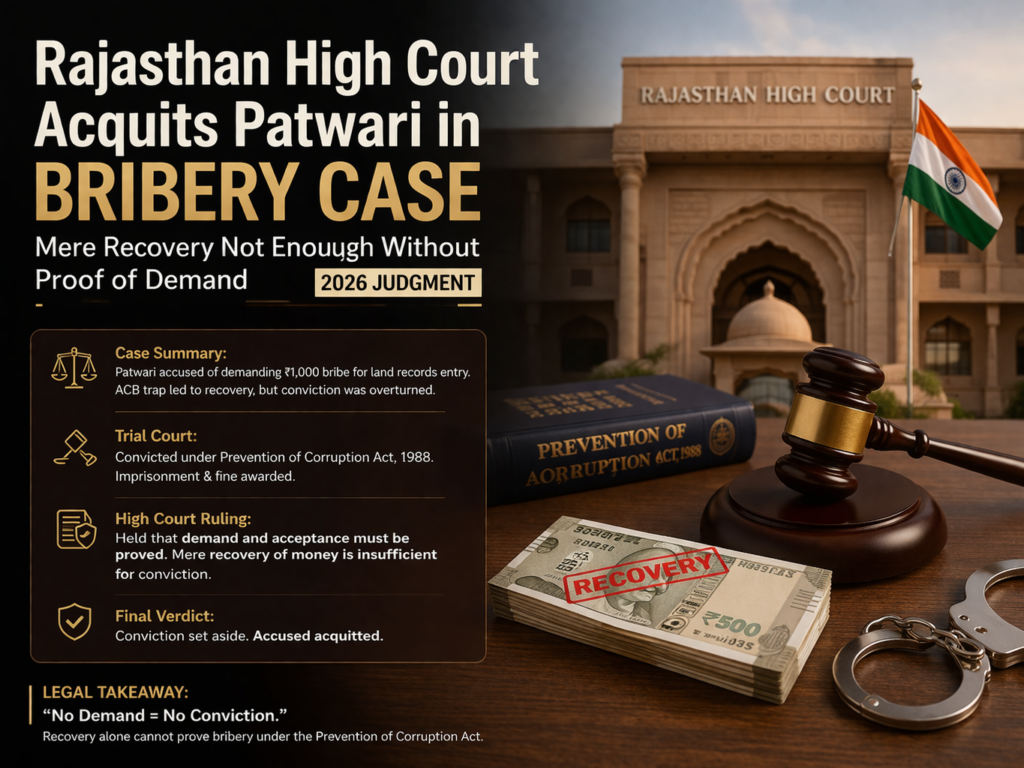
Rajasthan High Court Acquits Patwari in Bribery Case : Mere Recovery Not Enough Without Proof of Demand (2026 Judgment) In a significant judgment dated 19 March 2026, the Rajasthan High Court (Jaipur Bench) acquitted a Patwari who had earlier been convicted under the Prevention of Corruption Act, 1988. The Court clearly held that mere recovery of money is not enough to prove a bribery offence unless the prosecution is able to establish both demand and acceptance of illegal gratification beyond reasonable doubt. The case, Mohan Lal Gupta vs State of Rajasthan, arose from allegations that the accused Patwari demanded ₹1,000 from the complainant for entering certain land records. Based on the complaint, the Anti-Corruption Bureau arranged a trap and claimed to have recovered the bribe amount from the accused. The trial court relied on this recovery and convicted the accused under Sections 7 and 13 of the Prevention of Corruption Act, awarding imprisonment and fine. However, before the High Court, the accused strongly challenged the conviction. It was argued that he was not responsible for the work related to the complainant’s land and that the relevant work had already been completed earlier. The defence also pointed out that the complainant did not fully support the prosecution’s version, and there were multiple contradictions in the statements of witnesses. It was further contended that the alleged recovery of money was not properly linked to any illegal demand or acceptance. While examining the case, the High Court focused on the core legal requirement in corruption cases — proof of demand and acceptance of bribe. The Court reiterated that demand of illegal gratification is the foundation of an offence under the Prevention of Corruption Act. Without clear and reliable evidence of demand, a conviction cannot be sustained. The Court also emphasized that even if money is recovered from the accused, it must be shown that the accused knowingly accepted it as a bribe. Relying on settled law laid down by the Supreme Court, the High Court held that mere recovery of currency notes does not automatically establish guilt. The prosecution must prove a complete chain of events, starting from demand, followed by acceptance, and then recovery. If the initial demand itself is doubtful or not proved, the entire case collapses. In this case, the Court found serious deficiencies in the prosecution’s evidence. There was no clear and convincing proof that the accused had demanded any bribe. The complainant’s testimony did not fully support the prosecution, and independent evidence was lacking. Additionally, there were inconsistencies in witness statements and doubts regarding the recovery process. The Court also noted that the work for which the bribe was allegedly demanded had already been completed, which further weakened the prosecution’s case. Considering all these factors, the High Court concluded that the prosecution had failed to prove the essential ingredients of the offence beyond reasonable doubt. As a result, the benefit of doubt was given to the accused, and the conviction passed by the trial court was set aside. The accused was accordingly acquitted of all charges. This judgment is highly important from a legal perspective as it reinforces a fundamental principle of criminal law — that no person can be convicted without strict proof of guilt. In corruption cases, courts require clear evidence of demand and acceptance of bribe, and mere recovery of money is not sufficient. The decision also highlights the importance of independent and reliable evidence, especially in trap cases conducted by anti-corruption agencies. In conclusion, the Rajasthan High Court has once again clarified that in bribery cases, “no demand means no conviction.” This ruling will serve as a strong precedent for similar cases and will be particularly useful for defence in corruption matters where the prosecution relies solely on recovery without proving the basic ingredients of the offence. Bhuvnesh Kumar GoyalAdvocate in Jaipur
JDA vs Sai Darshan Hotels (2026): Rajasthan HC Upholds 15% Developed Land in Lieu of Compensation
JDA vs Sai Darshan Hotels (2026): Rajasthan HC Upholds 15% Developed Land in Lieu of Compensation The Rajasthan High Court, Jaipur Bench, in D.B. Civil Special Appeal (Writ) No. 658/2010 decided a significant dispute concerning land acquisition compensation and the right to allotment of developed land in lieu of such compensation. The case arose from acquisition proceedings initiated in 1969 for land situated in Village Chainpura, Sanganer, Jaipur, culminating in an award dated 09.04.1981 granting monetary compensation to the original khatedars. Although the amount was determined and even deposited, it was never actually paid to the landowners, and possession of the land was taken over by the Jaipur Development Authority (JDA) in 1983. Over the years, multiple challenges to the acquisition proceedings were made by the original khatedars and subsequent stakeholders, all of which were dismissed up to the level of the Supreme Court. Thereafter, the respondent company, having acquired rights from earlier landholders, applied to the State Government in 2003 seeking allotment of 15% developed land in lieu of compensation under the prevailing State policy. This policy, particularly the circular dated 13.12.2001 (as amended in 2002), permitted such allotment subject to surrender of rights and withdrawal of litigation. Acting upon this, the respondent withdrew all pending cases, including proceedings before the Supreme Court, and complied with the conditions stipulated by the State. Pursuant to the policy, the State Government issued orders dated 12.05.2003 and 19.05.2003 directing allotment of Plot No. 7 admeasuring 9000 square meters at Airport Plaza, Jaipur, to the respondent. However, these orders were subsequently kept in abeyance by an order dated 23.06.2009, which led to the filing of a writ petition. The learned Single Judge allowed the petition and quashed the abeyance order, holding that the State was bound by the principle of promissory estoppel since the respondent had already acted upon the assurance by withdrawing litigation. In appeal, the JDA contended that the respondent had no valid claim to such allotment, alleging irregularities and asserting that the land had already been acquired and possession taken, leaving no scope for further benefits. It was also argued that the allotment caused financial loss to JDA and was based on improper actions by State authorities. However, the Division Bench, after examining the entire record and affidavits, found that neither the original compensation nor the enhanced compensation awarded by the Reference Court in 1990 had been paid or properly deposited. The Court relied on the Supreme Court judgment in Indore Development Authority v. Manoharlal to reiterate that mere deposit of compensation does not amount to payment, and therefore, the right to compensation survives. The Court further held that the respondent, as an assignee of the original khatedars, was entitled to claim compensation in accordance with the State policy. Since the respondent had fulfilled all conditions, including withdrawal of litigation, the State Government was bound to honour its promise. The action of keeping the allotment order in abeyance was found to be arbitrary, amounting to giving with one hand and taking away with the other, which is impermissible in law. The Court also observed that the policy providing 15% developed land had already been upheld by the Supreme Court and was binding on the authorities, including JDA. Rejecting the objections raised by JDA, the Court held that the allotment orders had attained finality and could not be questioned on vague allegations. It was further clarified that earlier proceedings did not attract the doctrine of merger or res judicata, as observed by the Supreme Court, and therefore the matter could be examined independently on merits. Ultimately, the Division Bench found no illegality in the order of the learned Single Judge and upheld the respondent’s entitlement to 15% developed land. Accordingly, the Special Appeal filed by JDA was dismissed, and the Court directed JDA to implement the State Government’s orders dated 12.05.2003 and 19.05.2003 by allotting Plot No. 7 admeasuring 9000 square meters at Airport Plaza, Jaipur, to the respondent. The judgment reinforces the principles that non-payment of compensation preserves the right of landowners, that government policies must be implemented fairly, and that the doctrine of promissory estoppel applies when a party has altered its position based on governmental assurances. Bhuvnesh Kumar GoyalAdvocate in Jaipur
Rajasthan High Court Upholds Acquittal in Murder Case Due to Contradictory Circumstantial Evidence and Unexplained FIR Delay
Rajasthan High Court Upholds Acquittal in Murder Case Due to Contradictory Circumstantial Evidence and Unexplained FIR Delay State of Rajasthan v. Sampat & Anr., D.B. Criminal Appeal No. 363/2002, decided on 25 February 2026 (Raj HC, Jaipur Bench), reported in 2026:RJ-JP:8788-DB, per Mahendar Kumar Goyal & Sameer Jain, JJ. (Connected with: Kalyan Ram v. Sampat Singh & Anr., D.B. Criminal Revision Petition No. 674/2001) The Rajasthan High Court, Jaipur Bench, in D.B. Criminal Appeal No. 363/2002 and connected Criminal Revision Petition No. 674/2001, delivered its judgment on 25.02.2026, dismissing both the appeal filed by the State and the revision petition filed by the complainant. The case arose from Sessions Case No. 23/1999 decided by the Additional District and Sessions Judge, Kishangarh, District Ajmer, wherein the accused persons were acquitted of the charge under Section 302 read with Section 34 IPC. The prosecution case was based on a written report dated 05.03.1999 submitted by Kalyan Ram, on the basis of which FIR No. 31/1999 was registered at Police Station Rupangarh, District Ajmer, for offences under Sections 302 and 34 IPC. It was alleged that the accused had committed the murder of Rupa Ram. After investigation, a charge-sheet was filed and charges were framed. However, after trial, the learned trial court acquitted the accused, leading to the present appeal and revision before the High Court. Before the High Court, the State and the complainant argued that the trial court had failed to properly appreciate the circumstantial evidence and that the chain of circumstances clearly established the guilt of the accused. It was submitted that the postmortem report showed an ante-mortem head injury and that a lathi was recovered on the disclosure statement of one of the accused. It was also contended that the delay in lodging the FIR was not fatal to the prosecution case. On the other hand, the counsel for the accused supported the acquittal and argued that the prosecution evidence was contradictory and unreliable. The High Court carefully examined the evidence on record and noted that the case was entirely based on circumstantial evidence. It found material contradictions in the statements of prosecution witnesses, particularly regarding what the deceased allegedly told them about the incident and who was responsible. The Court also observed that although the family members claimed to have known about the incident on the same night, the FIR was lodged after a delay of two days by a person who was neither a close family member nor a resident of the same village. No satisfactory explanation for this delay was provided. Further, the medical evidence did not fully support the prosecution version, as only a swelling on the skull was found and there were inconsistencies regarding the alleged dragging of the deceased. Importantly, the medical evidence suggested the possibility that the deceased might have suffered the fatal injury due to a fall, especially as there was evidence indicating consumption of alcohol. The Court held that the prosecution failed to establish beyond reasonable doubt that the fatal injury was caused by the accused. In view of these findings, the High Court concluded that the trial court’s judgment of acquittal did not suffer from any perversity, illegality, or infirmity warranting interference in appellate or revisional jurisdiction. Accordingly, both the criminal appeal and the revision petition were dismissed, and the acquittal of the accused was upheld. By Bhuvnesh Kumar GoyalAdvocate in Jaipur High Court
Rajasthan HC Rejects Sentence Suspension in POCSO Appeal Case
Rajasthan HC Rejects Sentence Suspension in POCSO Appeal Case Date of Order: 13.02.2026 The Rajasthan High Court, Jaipur Bench, recently dealt with a significant suspension of sentence application filed by an accused convicted under the Protection of Children from Sexual Offences (POCSO) Act. The case arose from D.B. Criminal Misc. Suspension of Sentence Application No. 2047/2024, filed along with a criminal appeal by the accused Vishnu @ Vikram, who had been sentenced to life imprisonment by the Special Court, POCSO Act, Dausa. The conviction was primarily under Sections 5(l)(m)/6 of the POCSO Act, along with alternative provisions of the Indian Penal Code, for serious allegations involving a minor victim. The applicant approached the High Court seeking suspension of sentence during the pendency of the appeal. The defence argued that the trial court had wrongly treated the victim as being below eleven years of age without sufficient evidence, and further contended that the allegations of rape were not medically corroborated. It was also submitted that there existed prior enmity between the parties, which allegedly resulted in false implication. On these grounds, the counsel requested the Court to grant relief and suspend the sentence until the appeal was decided. The State strongly opposed the plea, emphasizing the seriousness of the offence and the material evidence available on record. Upon hearing both sides, the Division Bench carefully examined the trial court judgment dated 20.03.2024. The Court noted that the victim’s age had been determined based on the birth certificate (Exhibit P-16), which showed that she was below eleven years at the time of the offence. Further, the victim’s testimony as PW-2 contained specific allegations of repeated sexual assault. Importantly, forensic evidence played a crucial role, as the DNA profile obtained from semen found on the victim’s clothing matched with the DNA sample of the accused, strengthening the prosecution’s case. Considering the gravity of the accusations, the age of the victim, and the supporting forensic material, the High Court held that this was not a fit case for granting suspension of sentence. The Bench observed that the nature of evidence and seriousness of the offence weighed against the applicant. Consequently, the application for suspension of sentence was dismissed, and the accused was directed to continue serving the sentence awarded by the trial court. This order highlights the cautious approach adopted by courts in cases involving offences against children, especially where strong testimonial and scientific evidence is available. It reiterates that suspension of sentence in serious POCSO convictions is not granted as a matter of routine and depends heavily on the strength of the prosecution’s evidence and the overall circumstances of the case.
Rajasthan High Court Allows Re-Medical Examination in Police Telecommunication Operator Recruitment Due to Weight Discrepancy
Rajasthan High Court Allows Re-Medical Examination in Police Telecommunication Operator Recruitment Due to Weight Discrepancy The Rajasthan High Court, Jaipur Bench, in S.B. Civil Writ Petition No. 1612/2026, dealt with an important issue concerning recruitment eligibility and medical assessment in the police telecommunication operator recruitment process. The petitioner, Anushka Sonwal, had applied for the post of Constable Police Telecommunication Operator under the Rajasthan Police Subordinate Service Rules, 1989, pursuant to an advertisement dated 09.04.2025. She claimed that she had secured a suitable position in the merit list and belonged to the SC Female category, fulfilling all required qualifications for the post. However, during the Physical Measurement Test, she was declared ineligible on the ground that her recorded weight was 43.30 kg, which was below the prescribed minimum requirement of 47.5 kg. The petitioner challenged the disqualification by producing a health certificate issued shortly after the rejection by a Medical Officer from a Government Hospital at Jhalana Doongri, Jaipur, which certified her weight as 48 kg. The petitioner argued that there was a clear discrepancy between the weight measurements taken by two different authorities, and therefore she sought an opportunity for re-medical examination by an independent medical board. The counsel submitted that a fresh assessment by experts at AIIMS would help resolve the factual dispute regarding her eligibility. While considering the matter, the High Court observed that writ jurisdiction is generally not invoked in cases involving disputed questions of fact, particularly those related to physical measurements or medical fitness. Nevertheless, the Court took note of the special circumstances of the case, namely that a government medical officer had issued a certificate indicating that the petitioner met the prescribed weight requirement within a short span of time after she was declared ineligible. Taking a balanced approach, the Court granted liberty to the petitioner to undergo a fresh medical examination by a Medical Board to be constituted by AIIMS, Jodhpur. The order directed that the petitioner must submit an application within seven days along with a demand draft of Rs. 10,000 in favour of the Superintendent of AIIMS, Jodhpur, following which the medical board would assess her weight within a stipulated period. The Court further clarified that if the AIIMS medical experts certify that the petitioner’s weight is 48 kg or more, she would be entitled to submit a representation before the concerned recruitment authorities, who must then consider her case strictly in accordance with law. Importantly, the Court emphasized that it had not expressed any opinion on the merits of the recruitment dispute and had only provided a procedural remedy to resolve the factual inconsistency. Consequently, the writ petition was disposed of with these directions, leaving the final decision to the competent authorities based on the outcome of the medical examination.
 Call: 7300056080
 Email: advocatebhuvneshgoyal@gmail.com
 Office: 109, Fortune Heights, Ahinsa Circle, C-Scheme, Jaipur-302001