
Rajasthan High Court Examines JDA's Withdrawal of OTS Flyover EPC Contract and Re-Tendering of DPR Work
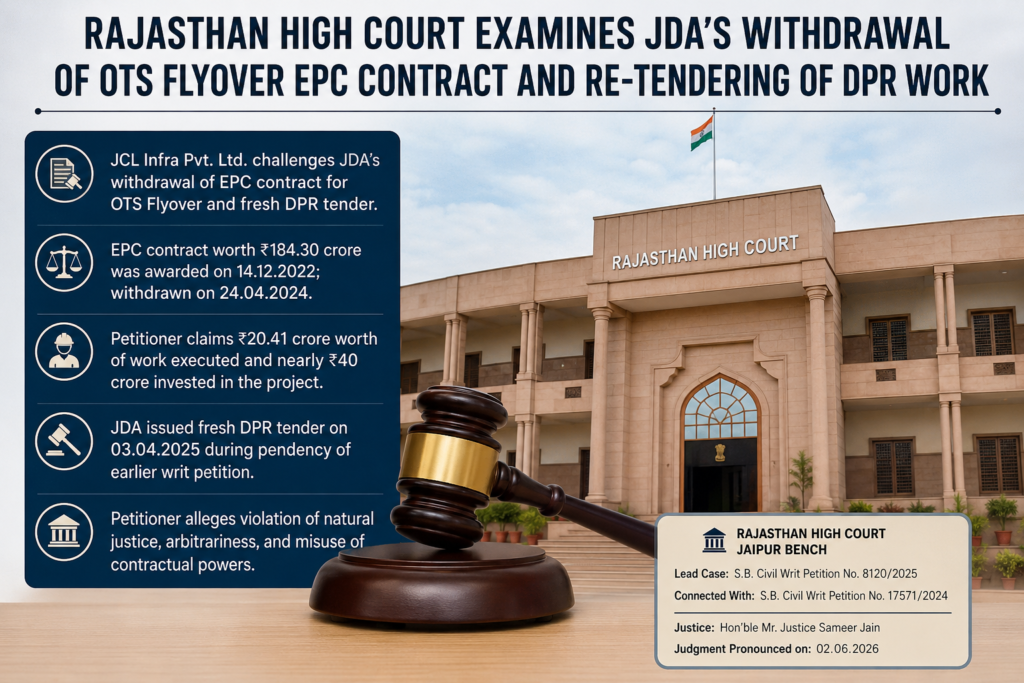
The Rajasthan High Court, Jaipur Bench, in a batch of writ petitions led by JCL Infra Private Limited v. Jaipur Development Authority, examined the legality of Jaipur Development Authority’s actions relating to the OTS Flyover project at JLN Marg, Jaipur. The dispute concerns the withdrawal of an Engineering, Procurement and Construction (EPC) contract previously awarded to JCL Infra and the subsequent issuance of a fresh tender for preparation of a Detailed Project Report (DPR) for the same project.
Background of the Dispute
The OTS Crossing project was conceived as a traffic improvement and beautification initiative aimed at easing congestion at one of Jaipur’s busiest intersections. The project included construction of a flyover and associated infrastructure works.
According to the petitioner, JDA had earlier engaged consultants for preparation of the DPR, which subsequently formed the basis for the EPC tender. Pursuant to the tender process, JCL Infra was awarded the EPC contract through a Letter of Acceptance dated 14 December 2022, followed by execution of a formal contract agreement on 27 December 2022.
The contract related to traffic improvement and beautification works at OTS Crossing, JLN Marg, Jaipur, and was valued at approximately ₹184.30 crore.
Petitioner’s Case
JCL Infra contended that after execution of the contract, it mobilized manpower, machinery, and financial resources and commenced work in accordance with contractual requirements.
The company asserted that:
- Multiple drawings, designs, survey reports and engineering documents were submitted to JDA during 2023.
- Necessary approvals and site clearances were repeatedly sought from the authority.
- Despite continuous correspondence, approvals required for execution of the project were allegedly not granted.
- Work worth approximately ₹20.41 crore had already been executed.
- Investments of nearly ₹40 crore had been made in the project.
The petitioner further argued that repeated representations seeking approvals and release of payments did not receive appropriate responses from JDA.
Extension of Time and Subsequent Withdrawal
A significant aspect of the dispute relates to the extension of the project period.
The petitioner pointed out that JDA extended the project completion timeline up to 30 April 2024. According to JCL Infra, this extension reflected acknowledgment of the subsisting contract and ongoing execution of work.
However, shortly thereafter, JDA withdrew the awarded work through a communication dated 24 April 2024 by invoking Clause 32 of the contract.
The petitioner challenged this withdrawal, alleging that:
- The action was arbitrary and illegal.
- No opportunity of hearing was provided.
- No adequate reasons were supplied.
- Clause 32 did not permit withdrawal of the entire contract in the manner adopted by JDA.
Fresh DPR Tender and Challenge Before the Court
During the pendency of the earlier writ proceedings challenging the withdrawal, JDA issued a fresh Notice Inviting Bid dated 3 April 2025 for consultancy services relating to preparation of a DPR for the proposed elevated road and OTS Flyover project.
JCL Infra argued that re-tendering DPR consultancy work for the OTS Flyover was unjustified because:
- A DPR had already been prepared earlier.
- The EPC contract had already been awarded on the basis of that DPR.
- Significant work and investment had already been undertaken.
The petitioner characterized the fresh tender as an attempt to restart the project despite the existence of an earlier DPR and a concluded EPC contract.
Legal Grounds Raised by the Petitioner
The petitioner relied upon several legal principles, including:
1. Violation of Natural Justice
JCL Infra contended that withdrawal of the contract was undertaken without affording an opportunity of hearing, contrary to the principles of natural justice.
2. Arbitrary Exercise of Power
It was argued that the withdrawal notice lacked sufficient reasons and was therefore arbitrary and unsustainable.
3. Promissory Estoppel and Legitimate Expectation
The petitioner claimed that it had acted upon JDA’s representations and contractual commitments by mobilizing resources and investing substantial amounts. Consequently, withdrawal of the project allegedly caused severe prejudice.
4. State Obligation to Act Fairly
The petitioner emphasized that JDA, being a public authority, was obligated to act fairly, transparently and reasonably even in contractual matters.
Respondents’ Stand
JDA opposed the petitions and raised objections regarding maintainability as well as merits.
The respondents contended that:
- The petitions were not instituted by a duly authorized person on behalf of the company.
- Material facts had allegedly been suppressed.
- The dispute arose from contractual obligations involving disputed questions of fact.
- Such issues should be adjudicated through appropriate civil or commercial proceedings rather than writ jurisdiction.
On merits, JDA maintained that the withdrawal of work was within the powers available under Clause 32 of the contract and that the Engineer-in-Charge possessed authority to take such action.
The respondents also asserted that multiple communications and meetings had been conducted regarding delays and deficiencies in execution.
Key Issues Before the High Court
The proceedings raised several important legal questions:
- Whether JDA was justified in withdrawing the EPC contract awarded to JCL Infra.
- Whether the withdrawal complied with contractual provisions and principles of natural justice.
- Whether re-inviting bids for preparation of a DPR concerning the OTS Flyover was legally sustainable.
- Whether the dispute could be examined under Article 226 of the Constitution despite arising from a contractual relationship.
- Whether the petitioner had established arbitrariness in the actions of the public authority.
Conclusion
The litigation concerning the OTS Flyover project highlights the intersection of public procurement, infrastructure development, contractual obligations and administrative fairness. The dispute revolves around JCL Infra’s allegation that substantial work, investment and contractual commitments were disregarded through withdrawal of the EPC contract and subsequent re-tendering of DPR consultancy services, while JDA maintains that its actions were contractually justified and undertaken in public interest.
The Rajasthan High Court examined these competing claims while considering questions of contractual interpretation, natural justice, public law principles and judicial review of governmental decisions in infrastructure projects.

 Call: 7300056080
 Email: advocatebhuvneshgoyal@gmail.com
 Office: 109, Fortune Heights, Ahinsa Circle, C-Scheme, Jaipur-302001