Rajasthan High Court Grants Bail to 19-Year-Old Accused under Section 309(4) BNS Analysis of Dhan Singh Faujdar v. State of Rajasthan
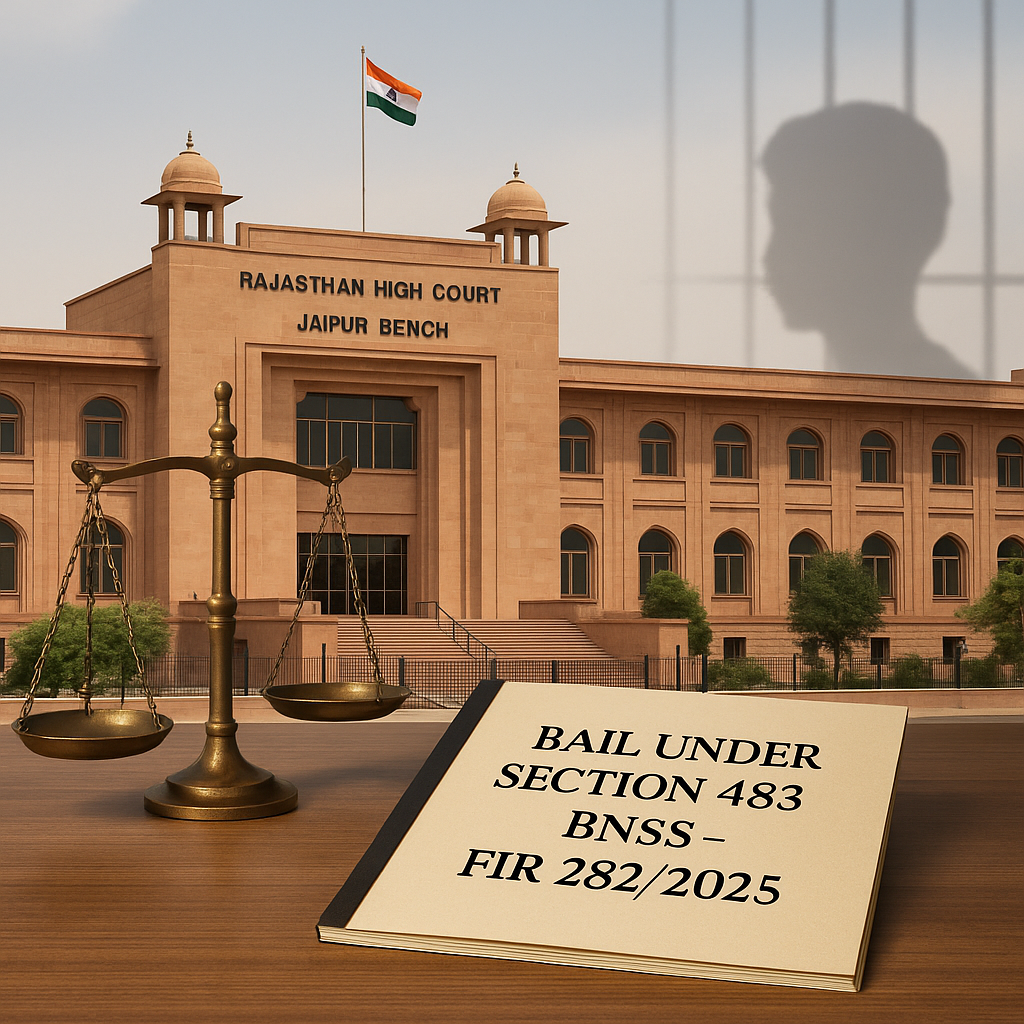
Rajasthan High Court Grants Bail to 19-Year-Old Accused under Section 309(4) BNS Analysis of Dhan Singh Faujdar v. State of Rajasthan Background of the Case The present order has been passed by the Rajasthan High Court, Jaipur Bench, in S.B. Criminal Miscellaneous Bail Application No. 13411/2025, titled Dhan Singh Faujdar v. State of Rajasthan, decided on 01.12.2025 by Hon’ble Mr. Justice Sameer Jain. The accused-applicant, Dhan Singh Faujdar, aged about 19 years, was arrested in connection with FIR No. 282/2025 registered at Police Station Kotwali, District Bharatpur, for offences under Section 309(4) of the Bharatiya Nyaya Sanhita (BNS). He has been in judicial custody since 15.08.2025 and is presently lodged in Central Jail, Bharatpur. The application before the High Court was filed under Section 483 of the Bharatiya Nagarik Suraksha Sanhita (BNSS) seeking regular bail. Notably, the prosecution record also showed five criminal antecedents against the applicant, in which he had already been acquitted in four cases, with one case apparently still subsisting. Defence Submissions On behalf of the accused-applicant, it was argued that he is a young boy of 19 years and continued incarceration at this formative age would cause irreparable harm to his future. The defence pointed out that the co-accused in the same FIR had already been enlarged on bail by the learned trial Court, and therefore the principle of parity required that the present applicant also be given similar relief. Counsel submitted that the applicant has been in custody since 15.08.2025, and the investigating agency has already filed the charge-sheet. Hence, the investigation is complete and his further detention is no longer necessary for the purposes of investigation. It was further emphasized that out of the five criminal antecedents, the applicant stands acquitted in four, indicating that earlier allegations did not withstand judicial scrutiny. Another important plank of the defence was the likely delay in conclusion of trial. Considering the usual pace of criminal trials, it was argued that the proceedings are likely to take a long time and no useful purpose would be served by keeping a 19-year-old behind bars for an uncertain period when the presumption of innocence still operates in his favour. Stand of the Prosecution The learned Public Prosecutor opposed the bail application and vehemently resisted the plea for release. Though the order does not detail every argument of the State, the opposition indicates that the prosecution considered either the nature of the offence, the antecedents, or the gravity of allegations as sufficient to deny bail. However, despite this opposition, the Court weighed the competing interests and applied settled principles governing grant of bail, ultimately tilting the balance in favour of personal liberty, subject to conditions. Judicial Reasoning and Findings After hearing both sides, the Court considered the following key factors: First, the Court took note of the age of the accused-applicant — only 19 years. Juvenile or near-juvenile age has consistently been treated by courts as a relevant consideration while dealing with bail, as incarceration at a young age can severely impact rehabilitation and reintegration into society. Second, the Court relied on the factor of parity. The co-accused in the same case had already been granted bail by the trial court. When multiple accused are similarly placed on facts and law, denying bail to one while granting it to others is generally seen as unjustified unless there is some distinguishing material. No such strong distinguishing factor was shown against Dhan Singh. Third, the Court recorded that the accused-applicant has been in custody since 15.08.2025 and that the charge-sheet has been filed. Once investigation is complete and the accused is no longer required for custodial interrogation, the continued detention largely serves the purpose of securing his presence at trial, which can often be adequately ensured by appropriate conditions and sureties. Fourth, the Court noted the criminal antecedents but simultaneously acknowledged that in four out of the five earlier cases, the accused has already been acquitted. This shows that mere pendency of previous cases or existence of past FIRs, without resulting conviction, cannot by itself be a ground to deny bail, especially when the accused is a young adult. Lastly, keeping in view the overall facts and circumstances and the material on record, the Court concluded that further incarceration would serve no useful purpose while the trial is likely to take time. At the same time, the Court consciously refrained from making any comment on the merits or demerits of the prosecution case to ensure that the trial remains uninfluenced. Operative Order In light of these considerations, the High Court allowed the bail application under Section 483 BNSS. The accused-applicant, Dhan Singh Faujdar S/o Ramu Singh, was ordered to be released on bail subject to the following conditions: He shall furnish a personal bond of ₹50,000/- along with two sureties of ₹25,000/- each to the satisfaction of the learned trial Judge. He is required to appear before the concerned Court on all dates of hearing as and when called upon to do so. The order thus restores the applicant’s liberty but keeps sufficient safeguards in place to ensure his presence during trial. Legal Significance of the Judgment This order, though brief, is significant in the context of the new criminal procedure regime under the BNSS. It demonstrates that while statutory provisions have changed nomenclature and structure, the core constitutional principles governing bail remain intact: Presumption of innocence continues to be the foundational principle. Pre-trial detention cannot be used as a form of punishment. Bail, not jail remains the rule, especially where investigation is complete, the accused is a young person, and there is no concrete material to show that he will abscond or tamper with evidence. Parity among co-accused is reaffirmed; once co-accused have obtained bail and stand on a similar footing, courts are inclined to extend similar benefit unless there is a clear reason to differentiate. Long custody and delay in trial are recognised as strong grounds in favour of bail, preventing an accused from effectively undergoing a sentence even before
Rajasthan High Court Quashes Criminal Proceedings Against MLA–Shareholder: Mere Shareholding Not Sufficient for Cheating Case Under Section 482 CrPC / Section 528 BNSS

he Jaipur Bench of the Rajasthan High Court, in Smt. Shobha Rani Kushwah v. State of Rajasthan & Ors., S.B. Criminal Misc. Petition No. 3302/2023, has quashed the criminal proceedings arising out of FIR No. 17/2017 registered at Police Station Mathura Gate, Bharatpur, for offences under Sections 420, 406 and 120-B IPC. The judgment was delivered by Hon’ble Mr. Justice Sameer Jain on 3 December 2025. The petitioner is an MLA from Dholpur belonging to a non-ruling party, and the matter was taken up on priority in view of the Supreme Court’s directions regarding early disposal of cases relating to MPs and MLAs. The petition was filed under Section 482 CrPC (now Section 528 of the Bharatiya Nagarik Suraksha Sanhita) challenging two specific orders: the cognizance order dated 18.10.2022 passed by the Additional Chief Judicial Magistrate No. 2, Bharatpur in Criminal Case No. 522/2022, and the revisional order dated 12.05.2023 passed by the Additional Sessions Judge (Women Atrocities Cases), Bharatpur in Criminal Revision No. 05/2023. The core complaint of the petitioner was that she had been unnecessarily dragged into criminal proceedings despite the absence of any material against her during investigation. On facts, the High Court noted that after registration of the FIR in 2017, the police investigation culminated in a charge-sheet only against certain co-accused. No charge-sheet was ever filed against the petitioner, nor were proceedings kept pending against her under Section 173(8) CrPC. This, in the Court’s view, clearly reflected that there was no incriminating material found to link the petitioner with the alleged offences. Despite this, cognizance came to be taken and the revisional court declined to interfere, leading to the present petition. A central plank of the petitioner’s case was her status in relation to the company involved in the transaction. It was specifically argued, and not disputed by any material on record, that she was neither part of the management nor a member of the Board of Directors. She was only a shareholder holding 8,000 shares. The Court accepted the submission that mere shareholding, without involvement in the day-to-day affairs or decision-making of the company, cannot by itself give rise to vicarious criminal liability. The judgment reiterates the basic criminal law principle of actus non facit reum nisi mens sit rea—an act does not render a person guilty unless accompanied by a guilty mind—and holds that no mens rea or overt act had been attributed to the petitioner in the investigation record. Another important facet considered by the Court was the nature of the dispute and the subsequent developments. The underlying dispute was essentially between investors and the company, arising out of financial/commercial transactions. The Court accepted the contention that the controversy had an overwhelmingly civil and commercial flavour, rather than a purely criminal one. It was brought to the Court’s notice that similar proceedings had earlier been initiated in Chhattisgarh and Punjab, where also the petitioner was neither named nor implicated, indicating that she was never considered a principal actor in the business dealings in question. Significantly, a compromise had been entered into between the complainant and the accused persons whose service had been effected. On behalf of the respondents, counsel expressly did not dispute the factum of compromise and rather supported it. Furthermore, the co-accused against whom charge-sheets had been filed were acquitted on 11.11.2024. With the co-accused already acquitted and the complainant having settled the dispute, the Court found that the very substratum of the prosecution case against the petitioner no longer survived. Continuation of proceedings against her alone would serve no useful purpose and would only amount to harassment. The Public Prosecutor opposed the petition in form, but the Court recorded that no substantive or convincing rebuttal was offered to the factual position presented on behalf of the petitioner. After a detailed consideration of the record and rival submissions, the Court framed its reasoning within the well-settled contours of Section 482 CrPC. It reiterated that inherent powers of the High Court exist to prevent miscarriage of justice, to secure the ends of justice and to prevent abuse of the process of the Court. The judgment relies on the Latin maxim quando lex aliquid alicui concedit, concedere videtur et id sine quo res ipsa esse non potest—when the law gives anything, it gives that without which the thing itself cannot exist—emphasising that effective exercise of inherent power is essential to preserve justice in appropriate cases. In support of quashing, the Court referred to the leading Supreme Court authorities in Gian Singh v. State of Punjab, (2012) 10 SCC 303; State of Haryana v. Bhajan Lal, 1992 Supp (1) SCC 335; and Narinder Singh v. State of Punjab, (2014) 6 SCC 466. These decisions lay down that criminal proceedings arising out of commercial or financial transactions, where the dispute is predominantly civil in nature, where there is a compromise between the parties, and where the possibility of conviction is remote due to lack of evidence, can and should be quashed to secure the ends of justice. The judgment specifically reproduces the broad summary from Gian Singh on the scope of the High Court’s inherent powers and the test of “ends of justice” and “prevention of abuse of process.” Applying these principles, the Court concluded that the present case clearly falls within the parameters identified by the Supreme Court. There was no mens rea on the petitioner’s part, no overt act alleged, and no vicarious liability that could be legally fastened to her on the mere basis of shareholding. No charge-sheet had been filed against her, no material indicated her participation in the alleged acts, the dispute had been amicably settled by a compromise deed, and the co-accused already stood acquitted. In such a scenario, compelling the petitioner to face a criminal trial would be nothing but an abuse of the process of law. In its operative part, the Rajasthan High Court, Jaipur Bench, allowed the criminal miscellaneous petition. It quashed and set aside the order dated 12.05.2023 passed by the Additional Sessions
Rajasthan High Court Allows Teacher Grade-III Aspirants to Apply Despite Aadhaar Name Mismatch
On 04 December 2025, the Rajasthan High Court, Jaipur Bench, passed an important order in the matter of Babali Kumari vs. Rajasthan Staff Selection Board along with a connected petition filed by Rubina Yadav. The judgment was delivered by Hon’ble Justice Ashok Kumar Jain and deals with a recurring issue faced by applicants during government recruitment processes—name discrepancies between Aadhaar Card and educational certificates due to marriage or surname variations. The matter arose in the backdrop of Advertisement No. 08/2025 issued on 06.11.2025 by the Rajasthan Staff Selection Board (RSSB) for recruitment to the post of Primary School Teacher Grade-III, Level-I (Class I to V). The petitioners approached the Court when they were unable to complete their online applications due to mandatory Aadhaar-based OTP verification not matching their documentary records. In the first petition, the applicant Babali Kumari asserted that while her educational records reflected her name accurately as “Babali Kumari,” her Aadhaar card displayed her name as “Babali Pareek.” The difference arose because “Pareek” is her family surname and appears in Aadhaar based on her marital and household identity. She maintained that despite repeated attempts, she was unable to correct her Aadhaar details through UIDAI, and due to this mismatch, the recruitment portal failed to generate the OTP necessary for One Time Registration (OTR), which was mandatory under the recruitment process. The second petitioner, Rubina Yadav, faced a similar difficulty. Her educational qualification documents carried her maiden name “Rubina Yadav,” whereas after marriage, her name was changed to “Rashmi,” which was reflected in her Aadhaar card. This inconsistency prevented the portal system from validating her details and generating the authentication OTP. She also tried to amend her Aadhaar details but could not succeed. Since the deadline for applications was approaching and she was unable to access the online form, she sought judicial intervention through a writ petition under Article 226 of the Constitution. The Rajasthan Staff Selection Board opposed the petitions by arguing that the difficulties faced by the candidates were due to their own negligence. According to the Board, candidates were expected to ensure that their Aadhaar records matched their educational certificates prior to application. The Board submitted that at the last stage of recruitment, the petitioners could not claim a right to seek relaxation or bypassing of the system merely because the deadline was approaching. The State further argued that Aadhaar authentication ensured transparency and helped prevent impersonation and fraud in recruitment. After considering the facts and submissions, the Court noted that the petitioners’ identity could be fully established from their educational documents and supporting identification records. The Court observed that excluding them from the recruitment process solely because their Aadhaar details could not be corrected in time would violate their right to equality under Article 14. The Court further held that administrative procedure cannot defeat lawful eligibility, and Aadhaar authentication, though useful, cannot become an absolute condition that overrides other verifiable records. The Court termed the situation a genuine and unavoidable hardship rather than negligence. To balance fairness and administrative convenience, the Court issued a pragmatic direction. It permitted both petitioners to submit their online applications without Aadhaar authentication, subject to verification of identity by the authorities. If technically not feasible, the Court allowed the petitioners to submit offline application forms. The petitioners were directed to appear personally before the Secretary, Rajasthan Staff Selection Board, Jaipur along with all original documents and self-attested copies on 05.12.2025 to enable due verification and timely processing. With this direction, the petitions and pending applications were disposed of. This judgment holds significance beyond the individual petitioners and sets a precedent for similarly placed candidates in future recruitments. The Court reaffirmed that public employment opportunities cannot be denied due to technicalities, particularly for women applicants who often change their names post-marriage. It clarified that Aadhaar is a tool for identity verification—not the sole determinant of eligibility. In conclusion, the Rajasthan High Court has reinforced constitutional safeguards in recruitment and ensured that genuine candidates are not deprived of participation due to bureaucratic or technical hurdles. The ruling will likely influence future administrative practices and serve as persuasive precedent in matters involving Aadhaar discrepancies in government hiring. Read the complete judgment here By Advocate Bhuvnesh Kumar Goyal
Rajasthan High Court Judgment on Prosecution Sanction: No Quashing Without “Failure of Justice”
Case Title: Swapan Kumar v. State of RajasthanCourt: Rajasthan High Court, Jaipur BenchBench: Hon’ble Mr. Justice Anand SharmaDate of Judgment: 4 November 2025Citation: S.B. Criminal Misc. Petition No. 3958/2025 🔍 Introduction In a significant Rajasthan High Court judgment, the Court refused to quash a prosecution sanction granted under the Prevention of Corruption Act, 1988 (PC Act). The ruling in Swapan Kumar v. State of Rajasthan strengthens the principle that procedural defects in sanction cannot automatically nullify a corruption trial unless the accused proves a failure of justice. This judgment provides critical clarity for advocates handling corruption matters, government officials involved in sanctioning, and public servants facing trial under the PC Act. 📜 Case Background The petitioner, Swapan Kumar, was accused of demanding and accepting illegal gratification, leading to FIR No. 46/2024 registered at Police Station CPS, Jaipur, District ACB. After investigation, the ACB obtained sanction for prosecution from the Commissioner of Police, Barrackpore (West Bengal) on 28 January 2025.The trial court took cognizance on 22 May 2025, framed charges, and began examining witnesses. At this stage, the petitioner approached the High Court under Section 528 of the Bharatiya Nagarik Suraksha Sanhita, 2023 (Section 482 CrPC), claiming that the sanction was mechanically issued without due consideration of evidence. ⚖️ Petitioner’s Arguments The petitioner contended that: The sanction order lacked application of mind and was passed in a mechanical manner. The sanctioning authority did not peruse investigation materials like trap proceedings or digital evidence. Hence, the entire prosecution stood vitiated under Section 19 of the Prevention of Corruption Act. ⚖️ State’s Stand The State countered that: The sanction was granted by a competent authority after proper examination of the case record. Even if minor errors existed, Section 19(3) and 19(4) PC Act clearly state that a trial cannot be set aside unless a failure of justice is shown. Since the trial had already advanced, the High Court should not interfere mid-proceeding. 🧑⚖️ Court’s Observations Justice Anand Sharma dismissed the petition and made several key findings: 1️⃣ Sanction Must Exist, But Need Not Be Perfect A valid sanction is mandatory before prosecuting a public servant. However, an imperfect sanction order does not invalidate the trial unless real prejudice is proved. 2️⃣ Trial Court is the Correct Forum Once charges are framed and witnesses are being examined, the trial court—not the High Court—is the proper forum to test the sanction’s validity. 3️⃣ No “Failure of Justice” The Court noted that the petitioner could not demonstrate any prejudice or miscarriage of justice. Brevity of the sanction order did not imply non-application of mind. 4️⃣ Reliance on Supreme Court Precedents The Court cited several landmark rulings, including: CBI v. Ashok Kumar Aggarwal Dinesh Kumar v. Airport Authority of India State of Bihar v. Rajmangal Ram Matajog Dobey v. H.C. Bhari These precedents confirm that defects in sanction are curable and must be examined at trial, not through pre-trial quashing. ⚖️ Decision The Rajasthan High Court dismissed the petition, holding that: The sanctioning authority was competent. The petitioner failed to prove failure of justice. The trial had progressed beyond the initial stage, and interference would be unwarranted. 🧠 Key Legal Takeaways ✅ Sanction irregularities do not automatically vitiate a trial.Section 19(3)–(4) PC Act protects proceedings unless injustice is clearly shown. ✅ Challenges to sanction are best raised at trial.Interference under Section 528 of the Bharatiya Nagarik Suraksha Sanhita, 2023 (Section 482 CrPC) is rare and exceptional. ✅ Short sanction orders are not invalid per se.Concise orders can still be valid if records show due consideration. ✅ Failure of justice must be demonstrated, not presumed.Courts require proof of prejudice before quashing any proceeding. ✅ Public interest in corruption cases prevails.Judicial restraint is necessary to ensure timely completion of trials. 💬 Lawyer’s Commentary This judgment aligns with a growing judicial trend to discourage hyper-technical objections in corruption prosecutions. Courts now emphasize substance over form, ensuring that procedural lapses do not defeat the larger goal of accountability in public service. From a defence perspective, lawyers must carefully document how the absence or defect in sanction directly affected the accused’s rights—for example, by denying a fair opportunity to rebut evidence or causing procedural prejudice. Mere allegations of “mechanical sanction” are no longer enough. For government departments, the decision underscores the importance of maintaining a transparent record of sanction consideration—not necessarily lengthy, but reflecting that relevant documents were reviewed. Our litigation and compliance teams routinely advise public servants and institutions on corruption law compliance, departmental inquiries, and criminal defence strategy under the Prevention of Corruption Act.This case reiterates that timely legal consultation and proper documentation can prevent unnecessary litigation at later stages. 🏁 Conclusion The Rajasthan High Court’s ruling in Swapan Kumar v. State of Rajasthan firmly reiterates that a prosecution sanction cannot be quashed unless a tangible “failure of justice” is established. This decision not only protects the integrity of ongoing corruption trials but also provides clear procedural guidance to both prosecution and defence on handling sanction-related disputes. 📚 Relevant Legal Provisions Section 19, Prevention of Corruption Act, 1988 Section 528 of theBharatiya Nagarik Suraksha Sanhita, 2023 (Section 482, Code of Criminal Procedure) Click here for Complete Judgment
 Call: 7300056080
 Email: advocatebhuvneshgoyal@gmail.com
 Office: 109, Fortune Heights, Ahinsa Circle, C-Scheme, Jaipur-302001