Rajasthan High Court Denies Bail to Accused in Kanhaiya Lal Murder Case, Upholds Strict UAPA Bail Restrictions
Rajasthan High Court Denies Bail to Accused in Kanhaiya Lal Murder Case, Upholds Strict UAPA Bail Restrictions Jaipur, October 3, 2026: The Rajasthan High Court, Jaipur Bench, has dismissed a batch of criminal appeals filed by five accused seeking regular bail in the high-profile Kanhaiya Lal murder case investigated by the National Investigation Agency (NIA). The Division Bench of Chief Justice Sanjay K. Agrawal and Justice Sameer Jain delivered its judgment on October 3, 2026, reaffirming the stringent standards governing bail under the Unlawful Activities (Prevention) Act (UAPA). The appeals challenged orders of the Special NIA Court, Jaipur, which had rejected the bail applications of the accused. The appellants argued that they had been in custody for over four years, that the trial was likely to take considerable time and that prolonged incarceration violated their fundamental right to personal liberty under Article 21 of the Constitution. The defence also questioned the evidence linking them to the alleged conspiracy and relied on Supreme Court judgments, including Union of India v. K.A. Najeeb, to contend that constitutional protections could override statutory restrictions on bail in cases of excessive trial delays. Opposing the appeals, the NIA lawyer in jaipur argued that the accused had played specific roles in a larger criminal conspiracy and that witness statements, call detail records, video recordings and weapon recoveries supported the prosecution’s case. The agency also submitted that the trial was progressing expeditiously, with nearly 30 material witnesses already examined and the witness list reduced from approximately 180 to 89. The High Court examined the restrictions under Section 43D(5) of the UAPA and the constitutional safeguards available under Article 21. It reiterated that courts must assess whether the prosecution material establishes a prima facie case without conducting a mini-trial at the bail stage. The Bench observed that prolonged incarceration can justify bail even in UAPA cases where a timely trial is not realistically possible. However, it found that the circumstances of the present case did not warrant such relief, particularly given the progress of the trial and the specific allegations against the appellants. Consequently, the High Court upheld the orders rejecting bail and dismissed all five appeals, while clarifying that its observations would not affect the final determination of the evidence during trial. Copy of Order Bhuvnesh Kumar GoyalHigh Court Advocate in Jaipur
Jaipur High Court Granted Bail in Rape Case: Prolonged Relationship, Consent and Promise of Marriage Considered
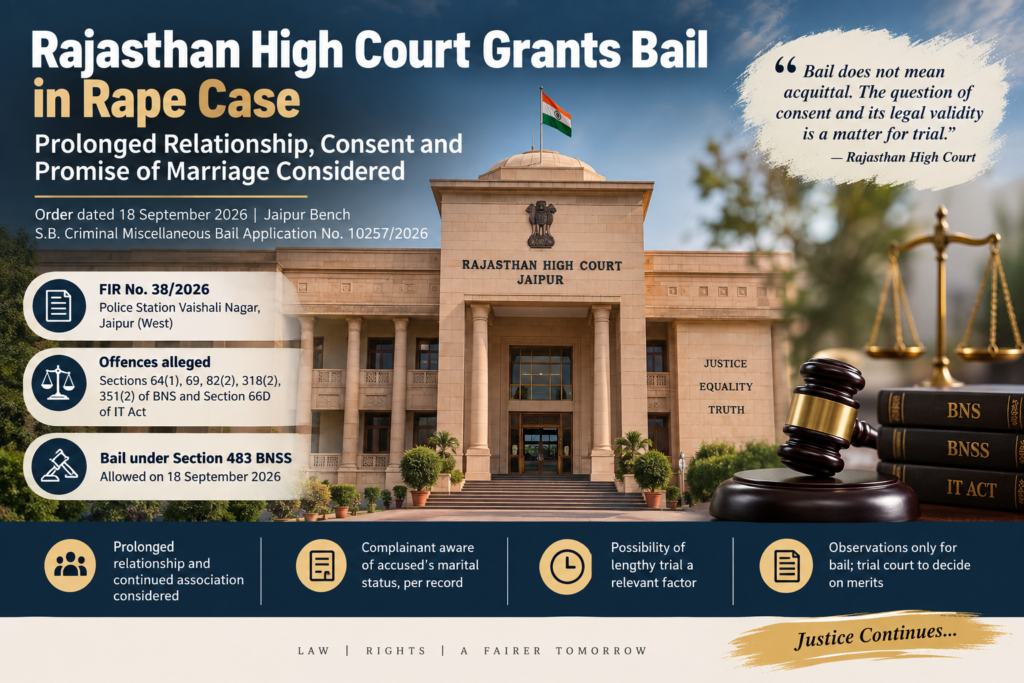
Jaipur High Court Granted Bail in Rape Case Prolonged Relationship, Consent and Promise of Marriage Considered The Rajasthan High Court, Jaipur Bench, has granted bail to an accused in a case involving allegations of rape, deception, promise of marriage, harassment and other offences under the Bharatiya Nyaya Sanhita, 2023 (BNS) and the Information Technology Act. The order was passed on 18 September 2026 by Hon’ble Mr. Justice Farjand Ali in S.B. Criminal Miscellaneous Bail Application No. 10257/2026, arising out of FIR No. 38/2026 registered at Police Station Vaishali Nagar, Jaipur (West). The bail application was filed under Section 483 of the Bharatiya Nagarik Suraksha Sanhita, 2023 (BNSS). The decision is particularly relevant to bail proceedings where the prosecution case concerns a relationship between two adults, allegations relating to a promise of marriage, and questions surrounding the nature and voluntariness of the physical relationship. The Court, while deciding the bail application, specifically examined the duration and nature of the relationship, repeated meetings, travelling and staying together, continuation of physical relations, and the complainant’s knowledge of the accused’s existing marital status. Importantly, the High Court clarified that its observations were confined to the consideration of bail and would not prejudice the trial court while deciding the case on merits. What Was the Case Before the Rajasthan High Court? The accused-petitioner was Dinesh, aged about 48 years, who was confined at Central Jail, Jaipur. The case arose from FIR No. 38/2026, registered at Police Station Vaishali Nagar, Jaipur (West). The FIR invoked: Section 64(1) BNS Section 69 BNS Section 82(2) BNS Section 318(2) BNS Section 351(2) BNS Section 66D of the Information Technology Act The order records these offences in its opening case details. The complainant, according to the FIR as recorded by the Court, was a 52-year-old divorcee residing in Pune. She allegedly came into contact with the accused through Shaadi.com, where he represented himself as a divorcee and allegedly assured her of marriage. The FIR alleged that after she came to Jaipur on 11 October 2025, the accused established physical relations with her against her will and thereafter continued the relationship on the assurance that he would marry her. The complainant further alleged that the accused repeatedly postponed the marriage and subsequently disclosed that he was already married and living with his wife and son. Allegations were also made concerning threats, harassment and pressure relating to pregnancy and miscarriage. These are allegations recorded from the FIR, and the High Court’s bail order does not constitute a final determination of their truth. What Did the Accused Argue for Bail? On behalf of the accused, it was argued that the ingredients of the alleged offences were not made out and that continued incarceration was not warranted. The defence also contended that the accused had been implicated on the basis of conjectures and surmises. The prosecution opposed the bail application and submitted that the accused should not be enlarged on bail. The High Court considered the submissions of both sides and examined the material available on record before reaching its decision on bail. Why Did the Rajasthan High Court Grant Bail? One of the most significant aspects of the order is the Court’s examination of the overall nature and duration of the relationship. The Court noted that the material on record indicated that the complainant had: remained in the company of the petitioner for a considerable period; voluntarily accompanied him on several occasions; travelled with him; stayed with him at different places; met him repeatedly; and continued physical relations over a substantial period. The Court observed that these circumstances, taken cumulatively, prima facie indicated her continued association with the petitioner. The Court also noted that, according to the material available on record, the complainant was aware that the petitioner was married and nevertheless continued associating with him for a considerable period. This aspect became one of the circumstances considered by the Court while deciding the bail application. Rajasthan High Court on Consent in a Rape Case A particularly important portion of the order concerns the distinction between consent and subsequent grievance or disappointment arising from a relationship. The Court observed that an allegation of rape necessarily involves sexual intercourse against the will or without the consent of the prosecutrix. However, at the stage of bail, the Court found that the circumstances emerging from the record did not disclose a continuous absence of willingness on the complainant’s part. The Court referred to the prolonged association, repeated meetings, travelling together, staying together and continuation of physical relations over a considerable period as circumstances that were, at that stage, suggestive of voluntary participation in the relationship. This observation was made for the limited purpose of deciding bail. What Did the Court Say About the Promise of Marriage? The Court also considered the subsequent revelation regarding the accused’s marital status and the fact that the relationship did not culminate in marriage. The Court observed that these circumstances could undoubtedly have caused distress and grievance to the complainant. However, it held that such subsequent events, by themselves, could not retrospectively render every act of physical intimacy between the parties as an act committed against her will. The Court emphasised that the surrounding circumstances and conduct of the parties must be considered in their entirety. This is an important aspect for understanding the order: the Court did not finally decide whether the complainant’s consent was legally valid or whether it was vitiated. Rather, the Court expressly stated that this ultimate question would have to be examined at the appropriate stage of trial. Did the Rajasthan High Court Decide the Accused Was Innocent? No. The order is a bail order, not a judgment after trial. The Court specifically stated that the question of whether the complainant consented to the physical relationship and whether such consent was legally vitiated was a matter to be examined at the appropriate stage of trial. Further, while granting bail, the Court expressly stated that it was not expressing any final opinion on the merits of
POCSO Case Procedure: FIR to Trial & Judgment
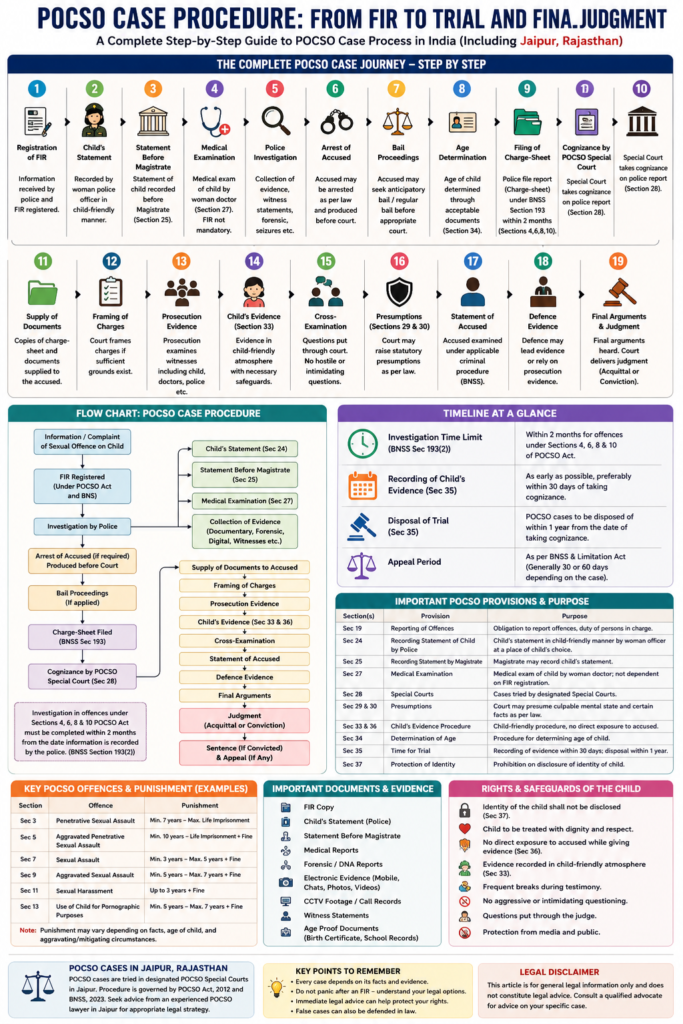
POCSO Case Procedure: FIR to Trial & Judgment A POCSO case can be significantly different from an ordinary criminal case because the Protection of Children from Sexual Offences Act, 2012 (POCSO Act) provides special procedures for reporting, investigation, recording of the child’s statement, medical examination, trial and protection of the child’s identity. If an FIR is registered under the POCSO Act, the accused and the victim’s family should understand the complete legal process—from registration of FIR and police investigation to arrest, bail, filing of the charge-sheet, framing of charges, evidence, cross-examination, final arguments and judgment. This article explains the POCSO case procedure in India, including the procedure followed before POCSO Special Courts in Jaipur, Rajasthan, and other parts of the country. Important: The procedural law applicable to criminal investigations and trials has changed with the introduction of the Bharatiya Nagarik Suraksha Sanhita, 2023 (BNSS). For cases governed by the new criminal laws, relevant BNSS provisions apply alongside the POCSO Act. What Is a POCSO Case? The POCSO Act is a special legislation enacted to protect children below the age of 18 years from sexual assault, sexual harassment and pornography-related offences. The Act covers offences including: Penetrative sexual assault under Section 3 Aggravated penetrative sexual assault under Section 5 Sexual assault under Section 7 Aggravated sexual assault under Section 9 Sexual harassment under Section 11 Use of a child for pornographic purposes under Section 13 Abetment and attempt of POCSO offences The Act also establishes a special procedure intended to make the investigation and trial more child-friendly. Sections 24 to 40 of the Act deal extensively with recording of statements, medical examination, Special Courts, presumptions, trial procedure and protection of the child during evidence. POCSO Case Procedure: Step-by-Step The broad procedure in a POCSO case can be understood as follows: Complaint/Information → FIR → Child’s Statement → Medical Examination → Investigation → Arrest/Bail → Collection of Evidence → Charge-Sheet → Cognizance → Supply of Documents → Framing of Charges → Prosecution Evidence → Cross-Examination → Statement of Accused → Defence Evidence → Final Arguments → Judgment → Appeal Stage What Happens Important Point 1. FIR Police register information regarding alleged offence POCSO + BNS sections may be invoked 2. Child’s Statement Statement recorded in child-friendly manner Section 24 POCSO 3.Magistrate Statement Statement may be recorded before Magistrate Section 25 POCSO / applicable BNSS provision 4. Medical Examination Child medically examined Section 27 POCSO 5. Investigation Police collect documentary, forensic, digital and oral evidence Investigation strategy is critical 6. Arrest Accused may be arrested depending on facts and law Arrest and FIR are separate issues 7. Bail Accused can seek appropriate bail remedy Depends on offence and stage 8. Age Determination Court determines whether victim was below 18 Extremely important in many cases 9. Charge-sheet Police submit investigation report Section 193 BNSS 10. Special Court POCSO Special Court proceeds with case Section 28 POCSO 11. Charges Court determines offences for trial Defence can challenge prosecution case where legally permissible 12. Prosecution Evidence Prosecution examines witnesses Includes child, doctors, police, forensic witnesses etc. 13. Cross-examination Defence tests prosecution evidence Subject to child-protection safeguards 14. Accused Statement Accused is examined regarding circumstances appearing against him Applicable BNSS procedure 15. Defence Evidence Defence may produce evidence Not mandatory in every case 16. Final Arguments Both sides present their case Evidence is analysed as a whole 17. Judgment Court acquits or convicts Reasons must be recorded 18. Sentence Sentence considered after conviction Depends on applicable POCSO offence 19. Appeal Aggrieved party may pursue statutory appellate remedy Forum and limitation depend on applicable law Each stage is explained below. 1. Registration of FIR in a POCSO Case A POCSO case ordinarily begins when information regarding an alleged sexual offence against a child reaches the police. Section 19 of the POCSO Act imposes obligations relating to reporting of offences. Once information discloses a cognizable offence, the police can register an FIR and commence investigation. Under the present criminal procedure framework, Section 173 of the BNSS deals with information relating to cognizable offences. The FIR may contain allegations attracting provisions of both: POCSO Act; and Bharatiya Nyaya Sanhita, 2023 (BNS). For example, depending upon the allegations and facts, a case may involve POCSO provisions along with provisions relating to rape, kidnapping, criminal intimidation or other offences under the BNS. Can a POCSO FIR be quashed? In appropriate cases, an accused may approach the High Court seeking quashing of the FIR or criminal proceedings. However, the availability of such a remedy depends heavily upon the facts, evidence, statutory provisions and the stage of the proceedings. A mere settlement between the accused and the victim’s family does not automatically terminate a POCSO prosecution. 2. Recording of the Child’s Statement One of the most important stages in a POCSO case is recording the statement of the child. Section 24 of the POCSO Act lays down special requirements for recording the child’s statement. The objective is to ensure that the child is not unnecessarily exposed to a hostile or intimidating environment. The law requires that the statement be recorded in a child-sensitive manner. The statement should, as far as practicable, be recorded: at the residence of the child or another place where the child ordinarily resides; by a woman police officer not below the rank prescribed by law; without bringing the child into contact with the accused; in a manner that does not cause unnecessary distress to the child. The law also contemplates recording through audio-video means wherever possible. 3. Statement Before the Magistrate The child’s statement may also be recorded before a Magistrate under the applicable procedural law. Under the POCSO framework, Section 25 specifically deals with recording of the statement of a child by a Magistrate. Under the current criminal procedure regime, Section 183 BNSS deals with recording of confessions and statements by a Magistrate. This statement can become an important piece of the prosecution case. However, it is important to understand that a statement recorded during investigation is not
Sexting Between Teenagers – Is It a POCSO Offence?
Sexting Between Teenagers – Is It a POCSO Offence in India? Sexting generally refers to sending, receiving or exchanging sexually explicit messages, intimate photographs, videos or other sexual content through mobile phones, WhatsApp, Instagram, Snapchat or other digital platforms. Among teenagers, sexting may sometimes occur between two people who are in a relationship and may even be mutually consensual. However, Indian law takes a particularly strict approach when a person below the age of 18 is involved. The Protection of Children from Sexual Offences Act, 2012 (POCSO Act) defines a child as a person below 18 years of age and contains specific provisions dealing with sexual harassment, sexual exploitation and pornographic material involving children. Therefore, an important question arises: Is sexting between two teenagers a POCSO offence even when both of them consent? The answer depends substantially on what was exchanged, the ages of the persons involved, the nature of the communication, whether photographs or videos were involved, and the surrounding circumstances. What Does “Sexting” Mean? Indian statutes do not specifically use the word “sexting.” The term is generally used to describe digital communication having a sexual nature. It can include: Sexually explicit text messages Sexual conversations through social media Sending intimate or nude photographs Sending sexually explicit videos Asking another person to send intimate photographs Taking or creating intimate images for another person Forwarding or sharing intimate images Threatening to circulate intimate images Sharing sexual content involving a child Sexting can therefore cover conduct ranging from sexual conversations to the creation and distribution of sexually explicit images. Government and child-protection materials recognise that sexting can involve both sexual conversations and the creation or sharing of intimate images by children. Is Sexting Between Teenagers a POCSO Offence? Not every instance of teenage communication can automatically be labelled a POCSO offence. However, certain forms of sexting can clearly fall within provisions of the POCSO Act. This distinction is important. For example, there is a significant legal difference between: Two teenagers exchanging ordinary romantic messages; Two teenagers having sexually explicit conversations; One teenager repeatedly sending sexually explicit messages to another; A teenager asking another minor to send an intimate photograph; A minor sending an intimate photograph to another minor; A person storing or forwarding sexually explicit material depicting a child; and An adult engaging in sexual communication with a minor. The applicable legal provision may differ depending upon the facts. Who Is a “Child” Under POCSO? Under Section 2(1)(d) of the POCSO Act, a child means any person below 18 years of age. This means that the law does not make a distinction between: a 10-year-old, a 15-year-old, a 17-year-old, or two teenagers who are only a few months apart in age. For purposes of the statutory definition, all persons below 18 are children. This becomes particularly important in cases involving teenage relationships. Sexting Through Sexual Messages – Can Section 11 POCSO Apply? Section 11 of the POCSO Act deals with sexual harassment of a child. Among other things, the provision covers certain conduct involving sexual words, sounds, gestures, objects and communication. It also specifically recognises following, watching or contacting a child through electronic, digital or other means in circumstances involving sexual intent. Therefore, digital communication can potentially come within the scope of Section 11. For example, depending upon the facts, conduct may raise a POCSO issue where a person: repeatedly contacts a child with sexual intent; sends sexually explicit material to a child; asks a child to display his or her body; attempts to obtain sexual photographs from a child; threatens to use a sexual depiction of a child; or entices a child for pornographic purposes. Section 12 provides punishment for sexual harassment under Section 11, which may extend to three years’ imprisonment and fine. Important point The mere fact that two teenagers exchanged messages does not, by itself, answer the legal question. The content of the messages, the intention behind the communication and the surrounding circumstances matter. What If Teenagers Exchange Nude or Intimate Photographs? This is considerably more serious. The POCSO Act specifically contains provisions dealing with the use of children for pornographic purposes. Section 13 provides that using a child in any form of media, including electronic or computer technology, for sexual gratification can constitute an offence. The provision expressly covers preparation, production, offering, transmitting, publishing, facilitating and distributing pornographic material involving a child. Consequently, the fact that a photograph was: voluntarily taken, voluntarily sent, exchanged privately, or created by the child himself or herself does not automatically remove the photograph from the legal framework concerning child sexual abuse material. The legal consequences can become particularly serious when such material is forwarded, distributed, published or stored. What About Section 15 of the POCSO Act? Section 15 deals with storage or possession of pornographic material involving a child and provides a graded punishment structure depending upon the circumstances. This is one of the most important provisions when dealing with sexting involving intimate images of minors. The Supreme Court has clarified the scope of Section 15 and the concept of possession in cases involving child sexual abuse material. The Court has explained that possession can include constructive possession where the person exercises the requisite degree of control over the material. It has also recognised the relevance of digital devices and electronic material in this context. Therefore, a teenager should not assume that deleting a photograph from a chat immediately eliminates every possible legal issue. Copies may exist: on the phone, in cloud storage, in backups, in messaging applications, on another person’s device, or elsewhere in digital form. What If Both Teenagers Consented? This is one of the most frequently misunderstood aspects of POCSO law. Consent does not automatically make sexual conduct involving a child lawful. The POCSO Act is designed to protect persons below 18 from sexual offences and pornography. The statutory framework does not create a general exception simply because two teenagers claim that their conduct was consensual. However, “consensual” does not mean that every interaction between two
Protest Petition after filing of FR (Final Report)
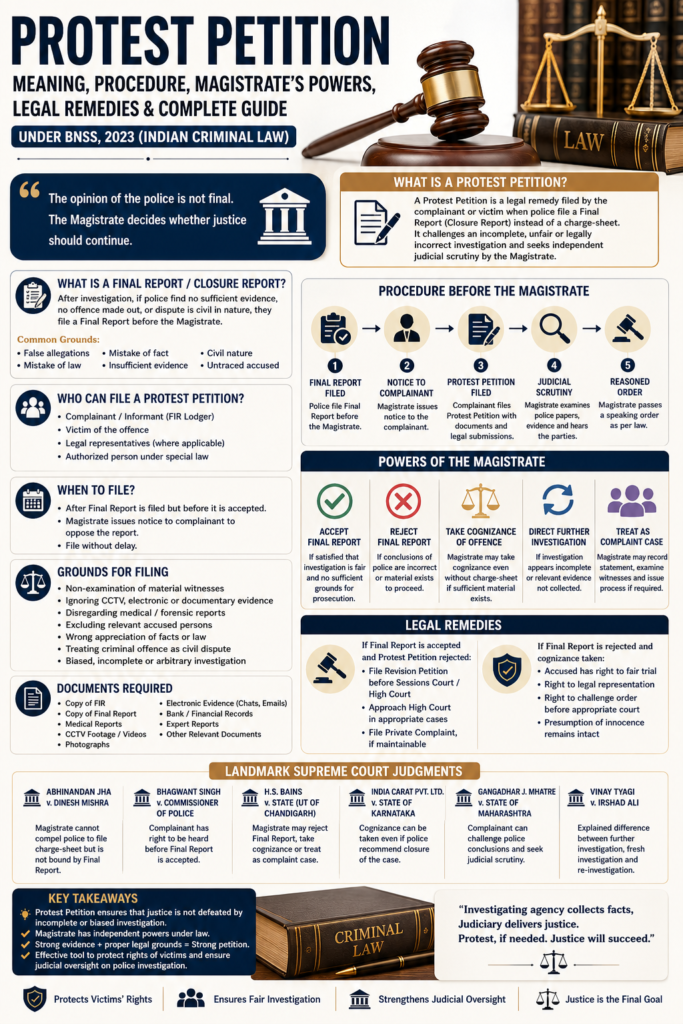
Protest Petition after filing of FR (Final Report) A Protest Petition is a legal remedy available to a complainant, informant, or victim when the police file a Final Report (Closure Report) instead of a charge-sheet after completing the investigation of a criminal case. Through a Protest Petition, the complainant requests the Judicial Magistrate to reject the police’s conclusions and independently examine whether sufficient material exists to proceed against the accused. In Indian criminal law, a Protest Petition plays a crucial role in ensuring that justice is not denied because of an incomplete, unfair, or legally incorrect police investigation. Although the Bharatiya Nagarik Suraksha Sanhita, 2023 (BNSS) does not specifically define the term “Protest Petition,” the remedy has been firmly recognized through landmark judgments of the Supreme Court of India and various High Courts. The fundamental principle governing a Protest Petition is simple: the opinion of the investigating officer is not binding upon the Magistrate. The final decision on whether criminal proceedings should continue always rests with the court. Why is a Protest Petition Important? A Protest Petition acts as an important safeguard within the Indian criminal justice system. Police officers investigate criminal offences and submit their findings before the court, but they do not determine whether the accused should ultimately face criminal proceedings. That responsibility belongs exclusively to the Magistrate. Where a complainant believes that the investigating agency has ignored material evidence, failed to examine important witnesses, misapplied the law, or conducted a biased investigation, a Protest Petition provides an opportunity to seek judicial scrutiny of the Final Report. This remedy protects victims against arbitrary investigations, strengthens judicial oversight over police action, reinforces public confidence in the administration of justice, and helps ensure that genuine criminal cases are not closed solely because of an erroneous police opinion. What is a Final Report or Closure Report? After completing the investigation of a cognizable offence, the investigating officer submits a police report before the jurisdictional Magistrate. Where sufficient evidence exists against the accused, the police file a charge-sheet recommending prosecution. Conversely, where the investigating officer concludes that there is insufficient evidence, no offence is disclosed, the allegations are false, or the dispute is civil in nature, a Final Report, also known as a Closure Report or Cancellation Report, is submitted. A Final Report may broadly be based on: False allegations; Mistake of fact; Mistake of law; Civil nature of the dispute; Insufficient evidence; Untraced accused. Importantly, the Final Report is merely the investigating officer’s opinion. The Magistrate is under no legal obligation to accept it. Is a Protest Petition Recognized under BNSS, 2023? Yes. Although the BNSS does not expressly define a Protest Petition, the legal framework governing police investigations, submission of police reports, cognizance by Magistrates, complaint proceedings, and judicial powers fully supports its maintainability. The law relating to Protest Petitions has primarily evolved through judicial precedents, particularly the decisions of the Supreme Court, which consistently hold that the Magistrate possesses independent authority to examine the police report and determine the appropriate course of action. Consequently, the remedy continues to remain fully available under the BNSS, just as it existed under the Code of Criminal Procedure, 1973. Who Can File a Protest Petition? A Protest Petition may ordinarily be filed by: The complainant or first informant who lodged the FIR. The victim of the offence. Legal representatives of the complainant or victim, where appropriate. Any person authorised under a special statute. The accused generally does not file a Protest Petition because the Final Report itself recommends closure of the criminal proceedings in the accused’s favour. When Should a Protest Petition Be Filed? A Protest Petition should ordinarily be filed after the police submit the Final Report but before the Magistrate formally accepts it. Upon receiving the Final Report, the Magistrate generally provides the complainant with an opportunity to oppose the police report before deciding whether to accept or reject it. Although neither the BNSS nor the earlier CrPC prescribes a specific limitation period for filing a Protest Petition, unnecessary delay should be avoided because acceptance of the Final Report may require the complainant to pursue alternative legal remedies before a superior court. Grounds for Filing a Protest Petition A Protest Petition should be based upon specific legal and factual deficiencies in the police investigation rather than mere dissatisfaction with its outcome. Common grounds include: Failure to examine material witnesses. Ignoring CCTV footage or electronic evidence. Failure to collect documentary evidence. Ignoring medical or forensic reports. Excluding important accused persons. Incorrect appreciation of facts. Treating a criminal offence as a purely civil dispute. Biased, incomplete, or arbitrary investigation. Failure to follow mandatory investigative procedures. Every ground should be supported by relevant facts, documents, and legal principles. How to Draft a Protest Petition A professionally drafted Protest Petition should clearly explain why the Final Report deserves to be rejected. A comprehensive Protest Petition generally includes: Details of the Court and parties. FIR number and police station. Brief facts of the case. Details of the Final Report. Deficiencies in the investigation. Evidence ignored by the police. Relevant statutory provisions. Applicable Supreme Court judgments. Supporting documents. Specific prayer seeking appropriate relief. The petition should avoid emotional allegations and instead rely upon documentary evidence, witness statements, and established legal principles. Documents Required with a Protest Petition Although the documents vary according to the facts of each case, the following documents are commonly annexed: Copy of the FIR. Copy of the Final Report. Medical reports. Certified copies of relevant documents. Photographs and videos. CCTV footage. WhatsApp chats, emails, and other electronic evidence. Expert opinions. Bank records or financial documents, where relevant. Identity documents and authorisations, where necessary. Strong documentary evidence significantly strengthens the credibility of a Protest Petition. Procedure Before the Magistrate The procedure generally follows these stages: The police complete the investigation and submit a Final Report before the Magistrate. The court examines the police papers and ordinarily issues notice to the complainant. The complainant then files a Protest Petition challenging the police report along
Rajasthan High Court: No Concept of Criminal Writ Petition Under the Constitution
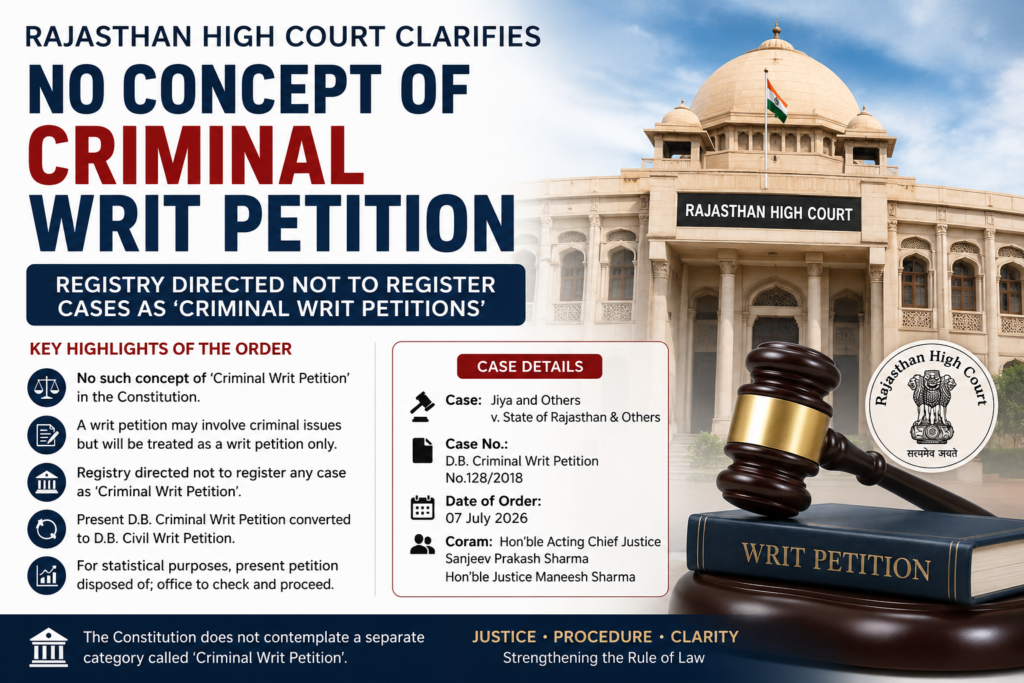
Rajasthan High Court: No Concept of Criminal Writ Petition Under the Constitution In a significant procedural ruling, the Rajasthan High Court, Jaipur Bench, has clarified that there is no separate concept of a “Criminal Writ Petition” under the Constitution of India. The Court directed the Registry not to register any case under the category of “Criminal Writ Petition” in the future. The Division Bench observed that although a writ petition may raise issues connected with a criminal matter, its criminal subject matter does not convert it into a separate constitutional category called a “Criminal Writ Petition.” Such proceedings are to be registered simply as writ petitions, while the Court may examine their nature for placement before the appropriate roster or Bench. The ruling in Jiya and Others v. State of Rajasthan and Others provides important guidance regarding the classification, registration and listing of writ petitions involving criminal law issues before the Rajasthan High Court. Case: Jiya and Others v. State of Rajasthan and OthersCourt: Rajasthan High Court, Jaipur BenchCase No.: D.B. Criminal Writ Petition No. 128/2018Date of Order: 07 July 2026Coram: Hon’ble Acting Chief Justice Mr. Sanjeev Prakash Sharma and Hon’ble Mr. Justice Maneesh Sharma Background of the Case The petition was instituted before the Rajasthan High Court as D.B. Criminal Writ Petition No. 128/2018. The Registry had also entertained and registered the matter as a criminal writ petition. While considering the matter, the Division Bench examined whether the Constitution recognises “Criminal Writ Petition” as an independent category of legal proceeding. The Court noted that the petition had earlier been adjourned sine die without any plausible reason. While dealing with its procedural status, the Court addressed the broader issue concerning the registration of cases as criminal writ petitions. No Concept of “Criminal Writ Petition” Under the Constitution The principal observation made by the Rajasthan High Court was that the Constitution does not provide for a separate category known as a “Criminal Writ Petition.” The Court observed: “A writ petition can be filed for raising the issues which may also relate to a criminal matter but the same would not be treated as a ‘Criminal Writ Petition’ and the same can only be registered as a writ petition alone.” This clarification distinguishes the nature of the issue raised in a writ petition from the constitutional character of the proceeding. A writ petition may involve issues such as: Police inaction; Illegal detention; Protection of life and personal liberty; Unlawful exercise of police powers; Failure to register an FIR; Improper criminal investigation; Violation of fundamental rights during criminal proceedings; or Illegal or arbitrary action by law-enforcement authorities. However, merely because the subject matter relates to criminal law does not create a separate constitutional proceeding called a “Criminal Writ Petition.” Registry Directed Not to Register Criminal Writ Petitions The Rajasthan High Court issued a clear direction that, henceforth, the Registry shall not register any case as a “Criminal Writ Petition.” The Court clarified that it is for the Court to examine the nature of a case and determine its placement before the appropriate roster. The Registry’s role is to register the proceeding as a writ petition rather than create a separate classification based solely on whether the dispute involves a criminal issue. This direction is likely to bring greater procedural consistency in the registration and classification of writ petitions before the Rajasthan High Court. Existing Criminal Writ Petition Converted into Civil Writ Petition In the present matter, the Court directed the Registry to treat the existing D.B. Criminal Writ Petition as a D.B. Civil Writ Petition. The Court further stated that, for statistical purposes, the D.B. Criminal Writ Petition would stand disposed of. However, the office was directed to check the matter and proceed further. Therefore, the order appears to deal primarily with the procedural classification of the petition rather than deciding the substantive rights or claims raised by the petitioners. Does the Judgment Bar Writ Petitions in Criminal Matters? No. The judgment does not prohibit a person from approaching the High Court through a writ petition merely because the dispute relates to a criminal matter. The Court expressly recognised that a writ petition may raise issues connected with criminal law. The ruling concerns the nomenclature and registration category of such petitions. Accordingly, where a person alleges a violation of fundamental or legal rights arising from police action, investigation, detention or another criminal-law-related issue, an appropriate writ petition may still be maintainable, subject to the facts of the case and applicable legal principles. The effect of the ruling is that such a petition should not be separately classified or registered as a “Criminal Writ Petition.” Difference Between a Criminal Writ Petition and a Writ Petition Involving Criminal Issues Following this judgment, the distinction may be understood as follows: Particular Position Clarified by the Rajasthan High Court Criminal Writ Petition as a separate category Not contemplated under the Constitution Writ petition involving a criminal issue May be filed in an appropriate case Registration by the High Court Registry To be registered as a writ petition Nature of dispute May still involve criminal law or police action Placement before the appropriate Bench To be examined according to the Court’s roster Existing petition in the present case Directed to be treated as a D.B. Civil Writ Petition Practical Impact of the Rajasthan High Court Judgment The judgment may have important procedural implications for advocates, litigants and the Rajasthan High Court Registry. First, petitions involving criminal issues may continue to invoke the constitutional writ jurisdiction of the High Court where legally maintainable. However, such petitions should not be treated as belonging to a separate constitutional category merely because the underlying dispute relates to criminal law. Second, the Registry has been expressly directed not to register future matters as criminal writ petitions. Third, the Court retains the authority to examine the nature of the dispute and determine the appropriate roster or Bench before which the matter should be placed. Fourth, advocates filing writ petitions concerning police action, personal
Chargesheet vs FR (Final Report): What Happens After Filing of an FIR?
Chargesheet vs FR (Final Report): What Happens After Filing of an FIR? When an FIR (First Information Report) is registered, many complainants and accused persons are unaware of what happens next. One of the most important stages after investigation is the filing of either a Chargesheet or an FR (Final Report/Closure Report) by the police before the Magistrate. The future of the criminal case largely depends upon which report is filed. This article explains the entire process after the registration of an FIR, the difference between a Chargesheet and an FR, the rights of the complainant and accused, and the powers of the Court under the Bharatiya Nagarik Suraksha Sanhita, 2023 (BNSS). What is an FIR? An FIR is the first information recorded by the police regarding the commission of a cognizable offence. It sets the criminal law machinery into motion and authorizes the police to investigate the allegations. However, registration of an FIR does not mean that the accused is guilty. It merely initiates the investigation process. What Happens After an FIR is Filed? 1. Investigation Begins After registration of the FIR, the Investigating Officer (IO) starts collecting evidence, which may include: Recording witness statements Collecting documents Obtaining CCTV footage Conducting forensic examinations Recovering articles related to the offence Arresting accused persons where necessary The objective is to determine whether sufficient evidence exists to prosecute the accused. 2. Police Evaluate the Evidence Once the investigation is completed, the police arrive at one of two conclusions: Sufficient evidence exists against the accused. No sufficient evidence exists to proceed. Based on this conclusion, the police submit either a Chargesheet or an FR before the Court. What is a Chargesheet? A Chargesheet is a report filed by the police before the Magistrate stating that evidence collected during investigation establishes a prima facie case against the accused. It is filed when the investigating agency believes that the accused should face trial. Contents of a Chargesheet A Chargesheet generally contains: FIR details Names of accused persons Nature of offences alleged Witness statements Documentary evidence Medical reports Forensic reports Seizure memos List of exhibits Opinion of the Investigating Officer What Happens After a Chargesheet is Filed? Court Takes Cognizance The Magistrate examines the Chargesheet and accompanying material. The Court may: Take cognizance of the offence. Summon the accused. Issue warrants where necessary. Commit the matter to the Sessions Court if required. Framing of Charges After hearing both sides, the Court determines whether sufficient grounds exist to proceed. If yes, charges are framed and the criminal trial begins. Trial Stage The trial typically includes: Prosecution evidence Cross-examination Statement of accused Defence evidence (if any) Final arguments Judgment What is an FR (Final Report)? An FR, commonly known as a Closure Report, is filed when the police conclude that there is insufficient evidence to prosecute the accused. An FR does not automatically end the matter. The Court has the final authority to decide whether the report should be accepted. Types of Final Reports 1. FR True but Undetected The offence appears to have occurred, but the offender could not be identified. Example:A theft occurred, but the police could not determine who committed it. 2. FR False The allegations are found to be false or fabricated. 3. FR Mistake of Fact The incident occurred due to misunderstanding or incorrect factual assumptions. 4. FR Civil Nature The dispute is primarily civil and does not disclose criminal liability. This category is common in: Property disputes Partnership disputes Business transactions Contractual disagreements 5. FR Lack of Evidence The allegations cannot be substantiated due to insufficient evidence. What Happens After an FR is Filed? The Magistrate is not bound by the police opinion. The Court may: Option 1: Accept the FR If satisfied with the investigation, the Court may accept the report and close the case. Option 2: Reject the FR If the Court finds sufficient material on record, it may reject the Final Report and take cognizance against the accused. Option 3: Order Further Investigation The Court may direct the police to conduct further investigation and submit a supplementary report. Option 4: Treat Protest Petition as Complaint The complainant can challenge the FR through a Protest Petition. The Magistrate may treat the Protest Petition as a private complaint and proceed independently. Rights of the Complainant When FR is Filed A complainant is not helpless after submission of an FR. The complainant can: Obtain a copy of the Final Report. File objections against the FR. Submit a Protest Petition. Produce additional evidence. Request further investigation. Challenge acceptance of the FR before higher courts where permissible. Rights of the Accused After Chargesheet Once a Chargesheet is filed, the accused enjoys important legal rights, including: Right to obtain copies of all relied-upon documents. Right to legal representation. Right to seek discharge. Right to apply for bail. Right to cross-examine witnesses. Right to fair and speedy trial. Can a Chargesheet Be Filed Against Some Accused and FR Against Others? Yes. The police may conclude that evidence exists against certain individuals while no evidence exists against others. In such situations: Chargesheet may be filed against some accused. FR may be filed regarding others. The Court can still summon persons excluded by the police if sufficient material exists on record. Can the Police File a Supplementary Chargesheet? Yes. Even after filing the initial Chargesheet, the police can continue investigation and submit a supplementary Chargesheet if new evidence emerges. Examples include: New witness statements Forensic reports Recovery of incriminating material Arrest of absconding accused Time Limit for Filing Chargesheet The investigation must ordinarily be completed within statutory periods prescribed under law. In many cases: 60 days for offences punishable with imprisonment below certain thresholds. 90 days for serious offences carrying higher punishment. Failure to file the Chargesheet within the prescribed period may entitle the accused to default bail, subject to legal conditions. Chargesheet vs FR: Key Differences Particulars Chargesheet Final Report (FR) Police Opinion Evidence exists Evidence insufficient Purpose Prosecution of accused Closure of
FIR under PCPNDT Act: Can Police Register FIR under PCPNDT Act?
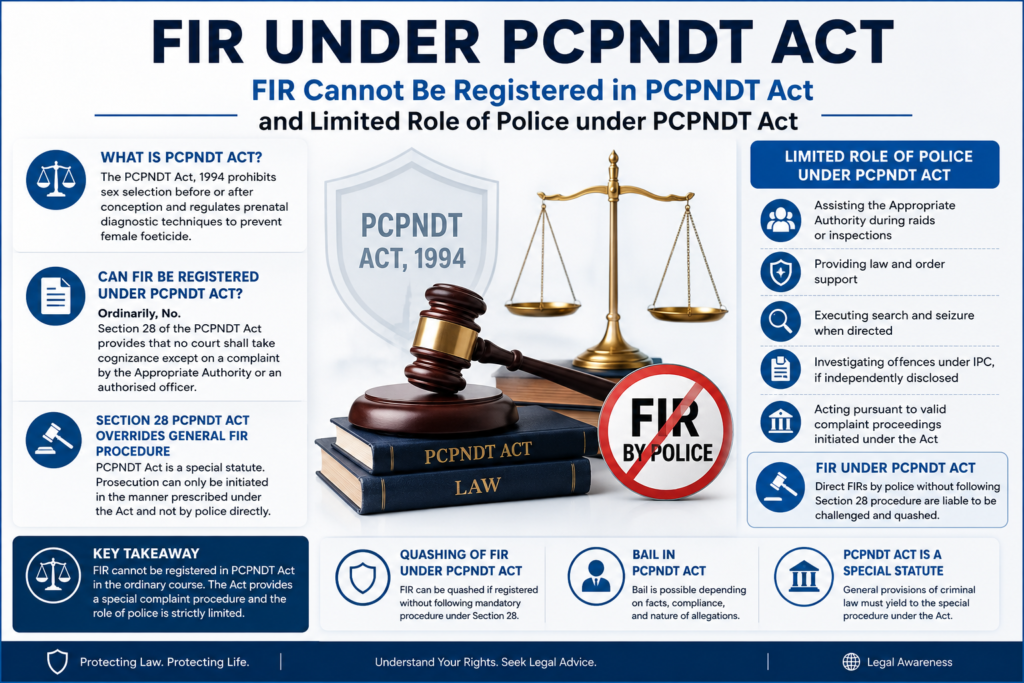
FIR under PCPNDT Act: Can Police Register FIR under PCPNDT Act? Limited Role of Police Explained The Pre-Conception and Pre-Natal Diagnostic Techniques (Prohibition of Sex Selection) Act, 1994, commonly known as the PCPNDT Act, is one of the most stringent legislations enacted to prohibit sex selection and female foeticide in India. However, a significant legal issue repeatedly arises in courts across the country — Can police directly register an FIR under PCPNDT Act? This question becomes extremely important for doctors, radiologists, ultrasound centres, IVF clinics, laboratory owners, and medical professionals facing criminal prosecution under the PCPNDT Act. In several cases, courts have clarified that the PCPNDT Act is a self-contained code, and prosecution under the Act can only be initiated in the manner prescribed under the statute itself. The role of police under PCPNDT Act is therefore highly limited. What is PCPNDT Act? The PCPNDT Act was enacted to prevent misuse of prenatal diagnostic techniques for sex determination leading to female foeticide. The Act regulates: Genetic counselling centres Genetic laboratories Genetic clinics Ultrasound clinics Imaging centres IVF and fertility-related procedures involving prenatal diagnostics The Act prohibits: Sex selection before or after conception Communication of sex of foetus Advertisement relating to sex determination Operation of unregistered ultrasound clinics The law provides strict punishments including imprisonment, cancellation of medical registration, sealing of ultrasound machines, and criminal prosecution. Can FIR be Registered under PCPNDT Act? The short answer is: Ordinarily, No. The PCPNDT Act contains a specific provision regarding cognizance and prosecution. Section 28 of the Act clearly states that no court shall take cognizance of an offence under the PCPNDT Act except upon a complaint made by: The Appropriate Authority; or An officer authorised by the Appropriate Authority; or A person who has given notice in the prescribed manner. This provision substantially restricts the ordinary powers of police to directly initiate criminal prosecution by registration of FIR under the PCPNDT Act. Section 28 PCPNDT Act Overrides General FIR Procedure Section 28 of the PCPNDT Act reads in substance that prosecution can only commence through a statutory complaint mechanism. This creates a departure from the normal criminal law procedure under the Code of Criminal Procedure, 1973 where police can ordinarily register FIRs for cognizable offences. Since the PCPNDT Act prescribes a special procedure, courts have repeatedly held that: The Act is a complete code in itself; Complaint procedure under Section 28 is mandatory; Police cannot assume unrestricted jurisdiction under general criminal law. Thus, mere registration of FIR by police without involvement of the Appropriate Authority often becomes legally vulnerable. Limited Role of Police under PCPNDT Act The role of police under the PCPNDT Act is generally confined to: Assisting the Appropriate Authority during raids or inspections; Providing law and order support; Executing search and seizure when directed; Investigating offences under IPC, if independently disclosed; Acting pursuant to valid complaint proceedings initiated under the Act. Police do not become primary prosecuting authority under the PCPNDT Act merely because allegations are made regarding sex determination or record maintenance violations. The statutory scheme intentionally vests primary control with the “Appropriate Authority” constituted under the Act. Why FIR under PCPNDT Act is Legally Challengeable In many cases, FIRs are mechanically registered by local police stations without following the mandatory requirements under Section 28 of the PCPNDT Act. Such FIRs may be challenged on grounds including: Lack of jurisdiction; Violation of mandatory statutory procedure; Absence of complaint by Appropriate Authority; Abuse of criminal process; Non-compliance with statutory safeguards. Courts have repeatedly emphasized that when a special statute prescribes a particular method for prosecution, authorities must strictly follow that procedure. Quashing of FIR under PCPNDT Act A petition for Quashing of FIR under PCPNDT Act can be filed before the jurisdictional High Court under Section 482 CrPC / Section 528 BNSS seeking exercise of inherent powers. Grounds commonly taken include: FIR registered by unauthorized police officer; No complaint under Section 28 PCPNDT Act; Violation of mandatory provisions; Malafide prosecution; Abuse of process of law; Lack of ingredients constituting offence. Several High Courts have quashed criminal proceedings where police bypassed the statutory mechanism prescribed under the PCPNDT Act. However, each case depends upon: Nature of allegations; Whether IPC offences are also invoked; Role of Appropriate Authority; Stage of proceedings; Nature of investigation conducted. Bail in PCPNDT Act Cases Obtaining Bail in PCPNDT Act matters depends upon the facts of the case, nature of allegations, and stage of prosecution. Courts generally consider: Whether allegations relate to technical violations or actual sex determination; Previous compliance history; Whether records were maintained; Whether accused cooperated in investigation; Whether prosecution itself is legally sustainable. Where prosecution suffers from jurisdictional defects, it strengthens the case for anticipatory bail or regular bail. PCPNDT Act is a Special Statute The Supreme Court and various High Courts have consistently held that where a special statute creates: specific offences, designated authorities, and a special procedure, the general provisions of criminal law must yield to the special enactment. The PCPNDT Act carefully creates a regulatory mechanism controlled by the Appropriate Authority. Permitting unrestricted police prosecution would defeat the legislative framework of the Act. Important Legal Position on FIR under PCPNDT Act The settled legal position emerging from various judicial precedents is: PCPNDT Act provides a special complaint procedure; Appropriate Authority plays central role; Police powers are not absolute under the Act; Direct FIRs by police may be challengeable; Criminal proceedings initiated contrary to Section 28 may be liable to quashing. Frequently Asked Questions (FAQs) What is PCPNDT Act? The PCPNDT Act is a law enacted to prohibit sex selection and regulate prenatal diagnostic techniques to prevent female foeticide. Can police register FIR under PCPNDT Act? Ordinarily, prosecution under the PCPNDT Act must be initiated through complaint procedure prescribed under Section 28 by the Appropriate Authority or authorised officer. Can FIR under PCPNDT Act be quashed? Yes. High Courts can quash FIRs and proceedings if statutory procedure under the Act is violated or prosecution is initiated without jurisdiction. Is bail possible
How to Oppose Quashing of FIR in High Court

How to Oppose Quashing of FIR in High Court When an accused files a petition for quashing of FIR before the High Court under Section 482 CrPC or Section 528 BNSS, the complainant and prosecution have a strong legal right to oppose the quashing petition. Many victims believe that once a quashing petition is filed, the FIR will automatically be cancelled. However, the law is clear that quashing of FIR is an exceptional remedy and the High Court must exercise this power very cautiously. Understanding how to oppose quashing of FIR is extremely important for complainants, victims, lawyers, and investigating agencies. A properly drafted reply and strong legal arguments can prevent the accused from getting relief. In this detailed guide, we explain how to oppose quashing of FIR, the best legal grounds, important Supreme Court judgments, practical courtroom strategy, and mistakes to avoid. What is Quashing of FIR? Quashing of FIR means cancellation of a criminal case by the High Court by using its inherent powers under Section 482 CrPC or Section 528 BNSS. The accused usually files a quashing petition claiming that the FIR is false, malicious, civil in nature, settled between parties, or does not disclose any offence. The High Court can interfere only in rare situations where continuation of criminal proceedings would amount to abuse of process of law. The Supreme Court in the landmark case of State of Haryana v. Bhajan Lal laid down strict principles regarding quashing of FIR. How to Oppose Quashing of FIR Effectively A complainant must understand that opposing a quashing petition requires both factual and legal preparation. Merely denying allegations is not enough. The complainant must show that the FIR discloses a prima facie offence and investigation or trial should continue. Below are the most effective methods regarding how to oppose quashing of FIR. Show Prima Facie Offence in the FIR The strongest way to oppose quashing of FIR is to show that the FIR clearly discloses commission of a cognizable offence. The High Court generally does not conduct a mini trial while deciding a quashing petition. If allegations prima facie disclose ingredients of an offence, the FIR quashing in High Court should normally be rejected. The complainant should specifically point out: Exact allegations in the FIR Role of each accused Supporting documents Witness statements Medical evidence Electronic evidence Circumstantial evidence The Supreme Court has repeatedly held that disputed questions of fact cannot be examined in Section 482 CrPC proceedings. Argue That Investigation is Still Pending Another important method regarding how to oppose quashing of FIR is to argue that investigation is incomplete. If investigation is at an early stage, courts are generally reluctant to interfere unless the case falls within exceptional categories. The complainant should argue that: Police is collecting evidence Statements are yet to be recorded Electronic evidence is under examination Recovery proceedings are pending Forensic reports are awaited Courts have repeatedly observed that premature interference in investigation should be avoided. Oppose Quashing Petition by Showing Disputed Facts One of the best arguments against a quashing petition is that the accused is raising disputed questions of fact. Under Section 482 CrPC, the High Court does not decide: Reliability of witnesses Truthfulness of allegations Admissibility of evidence Contradictions in statements Defence of accused These issues are decided only during trial. Therefore, while opposing quashing of FIR, the complainant should argue that the accused is trying to convert Section 482 CrPC proceedings into a full-fledged trial. Section 482 CrPC and Limited Scope of High Court Section 482 CrPC gives inherent powers to the High Court to prevent abuse of process and secure ends of justice. However, the Supreme Court has consistently held that Section 482 CrPC powers must be exercised sparingly and with great caution. The Court cannot conduct appreciation of evidence while deciding FIR quashing in High Court. Important principles under Section 482 CrPC include: High Court should not act as a trial court Defence of accused cannot ordinarily be considered Allegations in FIR must be presumed true at initial stage Criminal proceedings should continue if offence is disclosed Detailed examination of evidence is not permissible These principles are extremely important while opposing quashing of FIR. Important Supreme Court Judgments on Quashing of FIR State of Haryana v. Bhajan Lal This is the leading judgment regarding quashing of FIR. The Supreme Court held that quashing powers should be exercised only in rare cases. If allegations disclose commission of an offence, criminal proceedings should continue. The judgment also laid down limited categories where FIR quashing in High Court may be allowed. Neeharika Infrastructure v. State of Maharashtra The Supreme Court held that courts should not interfere in criminal investigation at the initial stage. The Court specifically observed that: Police has statutory right to investigate Courts should not stay investigation routinely Quashing petition should be decided cautiously FIR should be read as a whole This judgment is extremely useful while opposing quashing of FIR. State of Madhya Pradesh v. Laxmi Narayan The Supreme Court held that serious offences affecting society should not be quashed merely because parties have settled disputes. This judgment is important in: Serious assault cases Economic offences Cases involving public interest Offences against society Heinous offences Amit Kapoor v. Ramesh Chander The Supreme Court held that courts should not examine sufficiency of evidence while deciding a quashing petition. The Court further held that if allegations disclose ingredients of offence, proceedings should continue. Best Grounds to Oppose Quashing Petition FIR Clearly Discloses Offence The complainant must show that all ingredients of the offence are clearly mentioned. This is one of the strongest grounds to oppose quashing petition. Serious Nature of Allegations If allegations involve: Violence Fraud Cheating Forgery Sexual offences SC/ST offences Economic offences Public interest then FIR quashing in High Court should not ordinarily be allowed. Evidence Requires Trial The complainant should argue that evidence must be tested during trial through: Cross examination Documentary proof Expert reports Witness testimony The High Court cannot appreciate evidence under Section 482
Jaipur High Court on Power of High Court Under Section 311 CrPC / Section 348 BNSS to Summon Material Witness
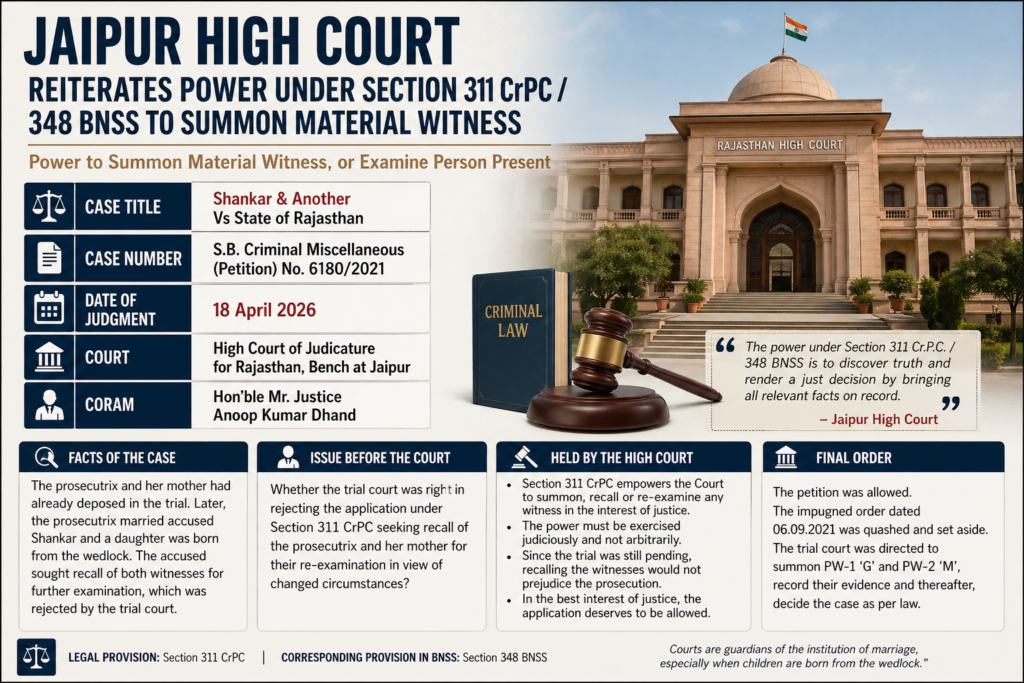
Jaipur High Court on Power of High Court Under Section 311 CrPC / Section 348 BNSS to Summon Material Witness In an important ruling concerning the power of High Court under Section 311 CrPC / Section 348 BNSS, the Jaipur High Court reaffirmed that criminal courts possess wide authority to summon any material witness, recall witnesses already examined, or examine any person present before the court whenever such evidence is necessary for a just decision. The judgment was delivered in Shankar & Anr. Vs State of Rajasthan, S.B. Criminal Miscellaneous (Petition) No. 6180/2021, decided on 18/04/2026 by Hon’ble Mr. Justice Anoop Kumar Dhand. Case Title, Number and Date of Judgment Case Title: Shankar & Another Vs State of RajasthanCase Number: S.B. Criminal Miscellaneous (Petition) No. 6180/2021Court: High Court of Judicature for Rajasthan, Bench at JaipurDate of Judgment: 18 April 2026 Facts Considered by Jaipur High Court The accused persons were facing trial for offences under Sections 376, 363 and 366 IPC along with provisions of the POCSO Act. During trial, statements of the prosecutrix and her mother had already been recorded. Later, a changed circumstance arose when the prosecutrix married one of the accused, namely Shankar, and from the marriage a daughter was born. Thereafter, the accused moved an application seeking recall of the prosecutrix and her mother for fresh examination in view of subsequent events. The trial court rejected the application on 06.09.2021, which was challenged before the Jaipur High Court. Power to Summon Material Witness or Examine Person Present The Jaipur High Court held that the object of Section 311 CrPC is to enable the court to discover truth and render a just decision after bringing all relevant facts on record. The Court observed that this power must be exercised judiciously and not arbitrarily. It further clarified that the provision cannot be used merely to fill lacunae in prosecution or defence, but can certainly be invoked where fresh evidence is necessary in the interest of justice. Section 311 CrPC / Section 348 BNSS: Court may summon, recall, or re-examine witnesses in the interest of justicetext{Section 311 CrPC / Section 348 BNSS: Court may summon, recall, or re-examine witnesses in the interest of justice}Section 311 CrPC / Section 348 BNSS: Court may summon, recall, or re-examine witnesses in the interest of justice The High Court specifically noted that since the trial was still pending, recalling the prosecutrix and her mother would not prejudice the prosecution. Rather, their further statements could assist the court in properly adjudicating the matter after considering changed circumstances. Jaipur High Court Set Aside Trial Court Order Allowing the petition, the Jaipur High Court quashed the order dated 06.09.2021 and directed the trial court to summon PW-1 and PW-2 again, record their evidence, and thereafter decide the case strictly in accordance with law. This judgment is a significant precedent on the power to summon material witness, or examine person present, showing that courts can revisit evidence where justice so requires. Legal Significance Under BNSS After replacement of CrPC by BNSS, the corresponding provision is Section 348 BNSS. Therefore, the principle laid down by the Jaipur High Court remains highly relevant even today. Courts continue to retain authority to summon any witness, recall witnesses already examined, and secure the best available evidence for a fair trial. Bhuvnesh Kumar GoyalAdvocate in Jaipur
 Call: 7300056080
 Email: advocatebhuvneshgoyal@gmail.com
 Office: 109, Fortune Heights, Ahinsa Circle, C-Scheme, Jaipur-302001