
Rajasthan High Court Plea of Alibi Not Considerable at Section 319 CrPC Stage
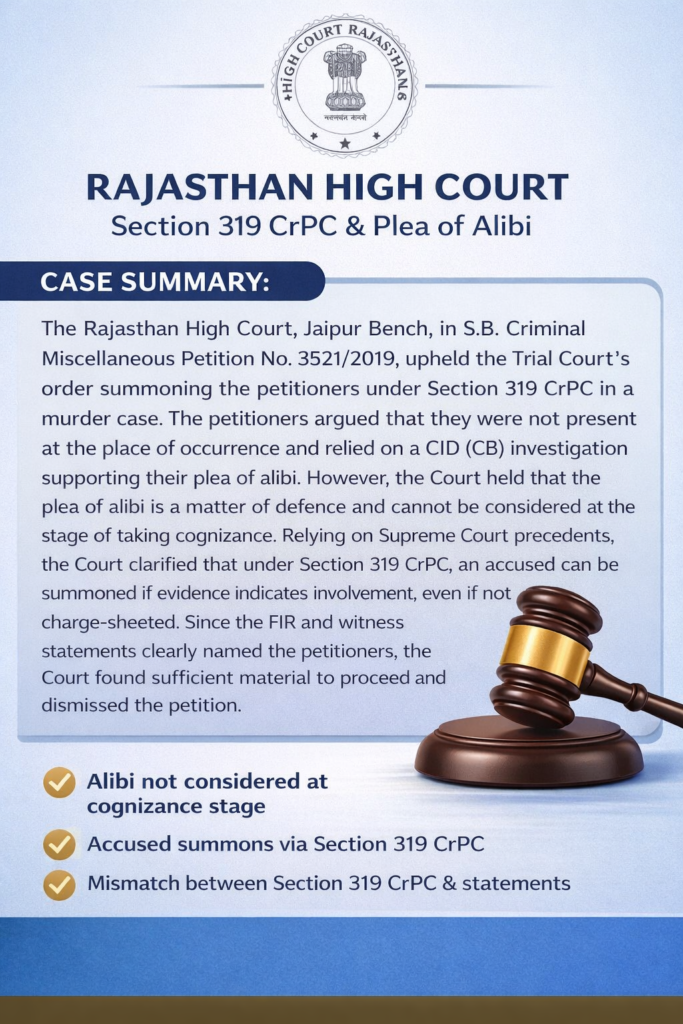
The Rajasthan High Court, Jaipur Bench, in S.B. Criminal Miscellaneous Petition No. 3521/2019, through reportable order dated 25.03.2026, upheld the Trial Court’s order summoning the petitioners under Section 319 CrPC in a murder case. The petitioners argued that they were not present at the place of occurrence and relied on a CID (CB) investigation supporting their plea of alibi. However, the Court held that the plea of alibi is a matter of defence and cannot be considered at the stage of taking cognizance. Relying on Supreme Court precedents, the Court clarified that under Section 319 CrPC, an accused can be summoned if evidence indicates involvement, even if not charge-sheeted. Since the FIR and witness statements clearly named the petitioners, the Court found sufficient material to proceed and dismissed the petition.
Prelude: Supreme Court Directions and Background of the Case
The Rajasthan High Court, Jaipur Bench, in S.B. Criminal Miscellaneous Petition No. 3521/2019, dealt with an important issue concerning the scope of Section 319 CrPC and the plea of alibi. The matter came up before the Court pursuant to directions issued by the Supreme Court in Vijay Kumar & Ors. vs State of Rajasthan, wherein High Courts were directed to prioritise long-pending criminal matters, especially where interim orders had stalled trials involving serious offences like murder and rape.
In compliance with these directions, the High Court took up the present petition, which challenged an order passed by the Additional District & Sessions Judge, Ajmer, allowing an application under Section 319 CrPC and summoning the petitioners as additional accused.
Challenge to Section 319 CrPC Cognizance Order
The petitioners challenged the order dated 15.01.2019 whereby the Trial Court had taken cognizance against them under various IPC provisions including Sections 147, 148, 302, 307, and 120B.
The case arose from an incident dated 10.11.2016, followed by an FIR lodged the next day by the wife of the deceased, wherein the petitioners were named along with other accused persons. However, during investigation, the CID (CB) found that the petitioners were not present at the place of occurrence. One petitioner was stated to be 5 km away, while the other was in Pushkar, approximately 15 km away. Based on this, an application under Section 169 CrPC was filed, and the Magistrate ordered their release.
Despite this, during trial, based on the statement of PW-4 (wife of the deceased), the Trial Court exercised its powers under Section 319 CrPC and summoned the petitioners.
Arguments of Parties: Alibi vs Evidentiary Threshold
The petitioners high court lawyer in jaipur argued that the Trial Court failed to consider the CID (CB) investigation which supported their plea of alibi. They relied on Supreme Court judgments such as Brijendra Singh v. State of Rajasthan and Jogendra Yadav v. State of Bihar, contending that more than a prima facie case is required under Section 319 CrPC and that relevant investigative material must be considered.
On the other hand, the Public Prosecutor and the complainant argued that the FIR and statements under Section 161 CrPC clearly named the petitioners with specific overt acts. They contended that at the stage of cognizance, the Court is not required to evaluate the defence or test the credibility of evidence. Reliance was placed on Sandeep Kumar v. State of Haryana and Hardeep Singh v. State of Punjab, emphasizing that courts have the power to summon additional accused if evidence indicates their involvement.
Court’s Analysis: Scope of Section 319 CrPC and Plea of Alibi
The High Court undertook a detailed analysis of Section 319 CrPC and reiterated that the provision empowers the Court to summon any person who appears, from the evidence, to have committed an offence, even if not charge-sheeted by the police.
A crucial issue before the Court was whether the plea of alibi could be considered at the stage of taking cognizance. The Court categorically held that alibi is a defence that must be proved during trial and cannot be examined at the stage of summoning under Section 319 CrPC. It relied on the Supreme Court judgment in Harjinder Singh v. State of Punjab (2025), which clarified that unproven defence material cannot override prosecution evidence at the threshold stage.
The Court further observed that the standard under Section 319 CrPC is higher than a mere prima facie case but does not require proof beyond reasonable doubt. If evidence such as eyewitness testimony indicates involvement, the Court is justified in summoning the accused.
Conclusion: Petition Dismissed, Alibi to Be Tested at Trial Stage
The Rajasthan High Court concluded that there was sufficient material on record, including FIR and witness statements, to justify summoning the petitioners under Section 319 CrPC. It held that the defence of alibi cannot be considered at this stage and must be tested during trial.
Accordingly, the criminal miscellaneous petition was dismissed, and the order of the Trial Court was upheld. However, considering that the petitioners had earlier been released under Section 169 CrPC, the Court granted relief by directing that petitioner No. 2 shall not be arrested if he appears before the Trial Court and furnishes bail bonds.
The Court also clarified that its observations are limited to the adjudication under Section 319 CrPC and shall not affect the final appreciation of evidence during trial.

 Call: 7300056080
 Email: advocatebhuvneshgoyal@gmail.com
 Office: 109, Fortune Heights, Ahinsa Circle, C-Scheme, Jaipur-302001