Jaipur High Court on Transfer of Nursing Mothers: Infant Welfare and Article 21
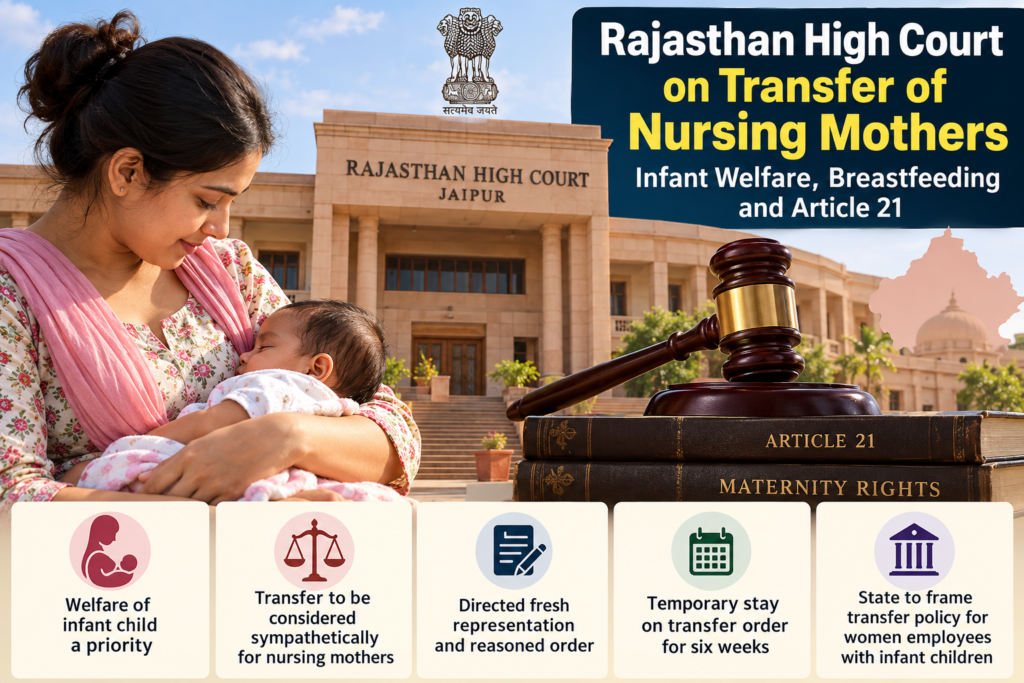
Jaipur High Court on Transfer of Nursing Mothers: Infant Welfare and Article 21 Can a government transfer a woman employee to a distant location when she has recently given birth and is caring for a two-month-old infant? Should administrative requirements take precedence over the welfare of a newborn child who depends on the mother for breastfeeding, nutrition and emotional care? These important questions came before the Rajasthan High Court, Jaipur Bench, in Suman Meena v. State of Rajasthan & Others, S.B. Civil Writ Petition No. 19649/2026. In its order dated 29 September 2026, Justice Anoop Kumar Dhand addressed the difficulties faced by a government schoolteacher who had been transferred shortly after childbirth. The Court emphasized the importance of infant welfare, maternal care, breastfeeding and a humane approach by the State when dealing with the transfer of a nursing mother. The Court directed the competent authority to reconsider the employee’s case sympathetically, ordered a temporary stay on the transfer and highlighted the need for an appropriate government transfer policy or legislation addressing the circumstances of recently delivered women employees. The judgment brings attention to an important aspect of public employment: administrative decisions involving women employees with newborn children may require consideration of the rights and welfare of both the mother and the infant. 1. Background of the Rajasthan High Court Case The case concerned Suman Meena, a Senior Teacher working at PM Shri Government Senior Secondary School, Gangapur City, District Sawai Madhopur, Rajasthan. She was transferred to Government Girls Senior Secondary School, Masalpur, District Karauli, through a transfer order dated 7 July 2026. The employee had given birth to a child on 13 May 2026, approximately two months before the transfer order was issued. The transfer created practical difficulties for the employee because her newborn child was still at an early stage of development and dependent on her for breastfeeding and maternal care. The employee challenged the transfer before the Rajasthan Civil Services Appellate Tribunal, Jaipur. However, the Tribunal rejected her appeal through an order dated 15 September 2026. Aggrieved by the Tribunal’s decision, she approached the Rajasthan High Court by filing a writ petition under its constitutional jurisdiction. The principal concern before the High Court was whether the circumstances surrounding the newborn child and the mother’s need to provide care warranted a more sensitive consideration of the transfer. 2. Why Was the Employee’s Maternity Leave Dispute Relevant? An important aspect of the case was the employee’s maternity leave history. The petitioner had previously availed maternity leave on two occasions: First maternity leave: 2 July 2020 to 28 December 2020. Second maternity leave: 13 July 2021 to 8 January 2022. During the first maternity leave period, she had given birth to a child who unfortunately passed away shortly after birth, on 2 July 2020. When she gave birth again in May 2026, her maternity leave was reportedly not granted on the technical ground that she had already availed maternity leave twice. The petitioner’s counsel argued that the earlier loss of a child and the circumstances of her latest childbirth required a compassionate assessment rather than a purely technical approach. The Court took note of the circumstances and the difficulties arising from the transfer of a recently delivered mother who was caring for an infant. It is important to distinguish the issue of maternity leave from the transfer dispute. The High Court’s operative directions concerned reconsideration of the transfer representation and temporary protection against the transfer order. The judgment did not expressly grant maternity leave or finally adjudicate the employee’s entitlement to such leave. 3. Rajasthan High Court’s Observations on Transfer of Nursing Mothers The Rajasthan High Court acknowledged the established principle that transfer is ordinarily an incident of service and that courts generally exercise restraint in interfering with administrative transfer decisions. However, the Court observed that administrative exigencies cannot be treated as an absolute justification in every circumstance. Where a transfer results in extreme hardship, particularly involving the critical care needs of an infant child, the circumstances may call for judicial consideration. The Court emphasized that the welfare of a child must receive paramount consideration when an infant’s interests are directly involved. It also observed that, as far as possible, a woman employee having an infant below one year should not be disturbed and that her case should be considered sympathetically. These observations underline the importance of examining the individual circumstances of a nursing mother before implementing a transfer that may significantly affect her ability to care for a newborn. At the same time, the Court expressly clarified that its decision was based on the peculiar facts and circumstances of the case and should not be treated as a binding precedent establishing an absolute exemption from transfer for every employee with an infant. 4. Article 21 and the Constitutional Protection of Motherhood and Infant Welfare One of the central aspects of the judgment was its discussion of Article 21 of the Constitution of India. Article 21 guarantees the right to life and personal liberty. The Court connected the welfare of the infant, maternal care, breastfeeding and the child’s development with the constitutional protection afforded by this provision. The Court observed that the right of a newborn child to receive maternal care, nutrition and development is implicit in Article 21. It also referred to Article 15(3), which enables the State to make special provisions for women and children. The judgment recognized that the relationship between a mother and a newborn infant involves more than a biological connection. It includes emotional bonding, breastfeeding, physical care and the child’s need for security during infancy. The Court further referred to the importance of the first six months of exclusive breastfeeding, recognizing the significance of this period for a child’s physical, mental and emotional development. In the circumstances before it, the Court considered that transferring the mother to a distant place could create serious difficulties for the infant and the mother. The judgment thus highlights how constitutional principles relating to dignity, motherhood and child welfare
Delayed Written Statement Under Order 8 Rule 1 CPC – Condonation Upheld – Jaipur Rajasthan High Court
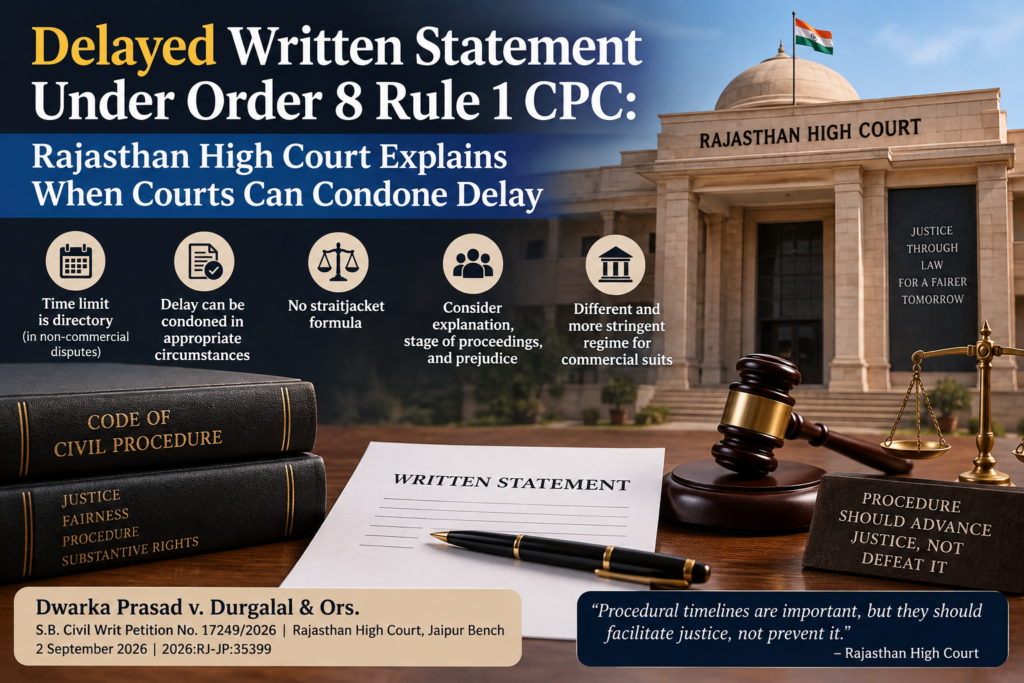
Delayed Written Statement Under Order 8 Rule 1 CPC – Condonation Upheld – Jaipur Rajasthan High Court The question of whether a civil court can accept a written statement filed beyond the prescribed period under Order 8 Rule 1 of the Code of Civil Procedure, 1908 (CPC) continues to arise frequently in civil litigation. A recent reportable judgment of the Rajasthan High Court, Jaipur Bench, has once again examined this issue and clarified that, particularly in non-commercial disputes, the court retains jurisdiction to condone delay and take a belated written statement on record, provided there is a satisfactory justification or explanation for the delay. The judgment was delivered by Hon’ble Mr. Justice Sudesh Bansal on 2 September 2026 in Dwarka Prasad v. Durgalal & Ors., S.B. Civil Writ Petition No. 17249/2026. The judgment is particularly important because it discusses the interplay between Order 8 Rule 1 CPC, procedural timelines, the discretion of the trial court, prejudice to the opposite party, and the distinction between commercial and non-commercial disputes. What Was the Issue Before the Rajasthan High Court? The petitioner had instituted a civil suit for permanent injunction in 2021 against several defendants. The trial court had held service of summons sufficient on the defendants. However, while several defendants appeared through their respective advocates, Defendant No. 3 did not initially appear. Importantly, the trial court did not pass an order proceeding against Defendant No. 3 ex parte, nor did it pass an order forfeiting his right to file a written statement. The litigation continued for several years. Defendant No. 3 eventually entered appearance on 21 January 2026 and filed an application under Order 9 Rule 7 CPC. That application was subsequently withdrawn on 12 March 2026 because there had never been an order directing that he be proceeded against ex parte. Thereafter, Defendant No. 3 filed his written statement on 23 April 2026, accompanied by an application seeking condonation of delay. The trial court accepted the explanation, condoned the delay and permitted the written statement to be taken on record, subject to payment of ₹1,000 as costs to Legal Aid. The plaintiff challenged that order before the Rajasthan High Court under Article 227 of the Constitution of India. What Does Order 8 Rule 1 CPC Say About Filing a Written Statement? Order 8 Rule 1 CPC prescribes the timeline within which a defendant is expected to present a written statement. The provision is intended to prevent unnecessary delay in civil proceedings and to ensure that the defendant’s defence is placed before the court within the prescribed period. However, the important question is: Can a court accept a written statement after expiry of the statutory period? According to the line of Supreme Court judgments considered by the Rajasthan High Court, the answer depends upon the nature of the proceeding and the circumstances of the particular case. In non-commercial disputes, the time schedule under Order 8 Rule 1 CPC has been treated as directory rather than absolutely mandatory, although this does not mean that defendants have an unrestricted right to file written statements whenever they choose. Supreme Court’s Decision in Kailash v. Nanhku The Rajasthan High Court relied upon the landmark Supreme Court judgment in Kailash v. Nanhku & Ors., AIR 2005 SC 2441. The Supreme Court had considered the nature of the time limit prescribed under Order 8 Rule 1 CPC and held that the provision is essentially directory in nature. The objective of prescribing a time limit is to expedite the proceedings and not to scuttle the hearing. The Rajasthan High Court reiterated that the court’s power to extend the time for filing a written statement is not completely taken away by Order 8 Rule 1 CPC. This distinction is crucial. Directory does not mean optional A common misconception is that if Order 8 Rule 1 CPC is directory, a defendant can file a written statement at any stage without consequence. That is not the correct position. The court still has to consider: the length of the delay; the explanation offered for the delay; the circumstances of the case; the stage of the proceedings; prejudice caused to the plaintiff; the purpose behind the procedural timeline; and whether accepting the written statement would frustrate the objective of expeditious disposal. The discretion is therefore judicial discretion, not an automatic entitlement. What Did Atcom Technologies Say? The Rajasthan High Court also referred to the Supreme Court’s decision in Atcom Technologies Ltd. v. Y.A. Chunawala & Co. & Ors., (2018) 6 SCC 639. As noted by the High Court, the Supreme Court considered the period prescribed under Order 8 Rule 1 CPC and held that the proviso permits the court, for sufficient reasons, to extend the initial period of 30 days up to 90 days from the date of service of summons. At the same time, the Supreme Court recognised that the power of the court to accept a written statement beyond the prescribed period had not been completely taken away in non-commercial matters because the provision concerns procedural law. Thus, the law is not simply: 90 days expired = written statement can never be accepted. Rather, in an ordinary civil/non-commercial dispute, the court may still have jurisdiction to consider a belated written statement in appropriate circumstances. What Did Desh Raj v. Balkishan Add? The petitioner in the Rajasthan High Court relied upon the Supreme Court’s decision in Desh Raj v. Balkishan (D) through proposed LR Ms. Rohini, (2020) 2 SCC 708. The High Court observed that Desh Raj followed and reiterated the principles laid down in Kailash and Atcom Technologies. However, the Supreme Court had also cautioned that routine condonation of delay and a cavalier attitude towards procedural timelines should not be encouraged because such conduct can adversely affect the administration of justice. This creates an important balance: Courts have discretion—but discretion must not become routine indulgence. Rajasthan High Court’s Key Finding The Rajasthan High Court summarised the legal position in particularly clear terms. The court held that in a non-commercial dispute, it
Husband Not Liable for Wife’s Dues : Rajasthan High Court on Panchayat Election No-Dues Certificate

Husband Not Liable for Wife’s Dues Rajasthan High Court on Panchayat Election No-Dues Certificate Jaipur, September 2, 2026: The Rajasthan High Court, Jaipur Bench, has held that a husband cannot be compelled to pay an amount recoverable from his wife merely because she is the erstwhile Sarpanch against whom recovery proceedings have been initiated. The Court further held that the authorities cannot deny a No-Dues/No-Objection Certificate to the husband for contesting a forthcoming Panchayati Raj election solely on the ground that an amount is recoverable from his wife. The judgment was delivered by Justice Anoop Kumar Dhand in S.B. Civil Writ Petition No. 11020/2026, Ramlaxman Meena v. State of Rajasthan & Ors., decided on September 2, 2026. The order is marked “Reportable.” Key Takeaway A person’s eligibility to contest a Panchayati Raj election cannot be made dependent upon recovery of dues from a spouse when the person himself is neither a surety nor a guarantor and there is no statutory provision making him liable for those dues. The High Court ultimately directed the authorities to issue the petitioner a No-Dues/No-Objection Certificate forthwith for the purpose of contesting the upcoming Panchayati Raj elections. What Was the Dispute Before the Rajasthan High Court? The petitioner, Ramlaxman Meena, approached the Rajasthan High Court seeking directions to the authorities to issue him a no-dues certificate so that he could contest the upcoming Panchayati Raj election for Gram Panchayat Falenda. The dispute arose because the petitioner’s wife, Laxmi Bai, had earlier served as Sarpanch of Gram Panchayat Falenda during the 1995–2000 tenure. An enquiry had been conducted against her, following which a recovery order was issued. When the amount was not deposited, proceedings for attachment/auction of her property were initiated. She challenged those proceedings before the High Court in S.B. Civil Writ Petition No. 11544/2009. An interim order dated September 16, 2009 restrained the authorities from auctioning her property, and that petition remained pending for adjudication. The petitioner subsequently sought to contest the forthcoming Panchayati Raj election. However, the authorities refused to issue him the required certificate because of the amount allegedly recoverable from his wife. Can a Husband Be Made Liable for His Wife’s Government Dues? No, not merely because he is her husband. This was the central legal issue considered by the High Court. The State argued that since the petitioner was the husband of the erstwhile Sarpanch, he was duty-bound to deposit the amount due from his wife. According to the State, until the amount was deposited by either the petitioner or his wife, a no-dues certificate could not be issued and the petitioner could not be permitted to contest the election. The High Court rejected this position. The Court specifically observed that while a surety or guarantor may be liable for the dues of another person, the petitioner in the present case was neither a surety nor a guarantor of his wife in respect of the recovery amount. Therefore, the recovery dispute remained a separate matter between the State and the erstwhile Sarpanch. Husband and Wife Are Separate Legal Entities One of the most significant observations in the judgment concerns the independent legal status of spouses. The Court held that a public representative is personally responsible for his or her own misconduct or disgraceful act. If recovery proceedings arise against that person, that person is responsible for clearing the dues. The Court questioned the basis on which recovery proceedings could be initiated against family members of an erstwhile Sarpanch merely because the Sarpanch had outstanding dues. The judgment expressly states that husband and wife are separate entities and that one spouse cannot ordinarily be held liable for the misconduct or liability of the other merely because of the marital relationship. Importantly, the Court also identified an exception: the husband could potentially be proceeded against if an enquiry established that he had himself been involved in the Panchayat works or had participated in the alleged misconduct. Thus, the judgment does not mean that a spouse can never have liability connected with the other’s conduct. Rather, liability cannot be imposed simply because of the marital relationship when there is no independent legal basis for doing so. What Did the Court Say About the Panchayati Raj Act, 1994? The petitioner had argued that failure of his wife to deposit the disputed amount could not disqualify him from contesting the election under Section 19(m) of the Panchayati Raj Act, 1994. The High Court’s reasoning focused on the absence of any provision authorising recovery of the wife’s dues from her family members. The Court observed that neither the Panchayati Raj Act, 1994, nor the Panchayati Raj Rules, 1996, contained a provision authorising recovery of such an amount from family members of the Sarpanch merely because the Sarpanch had failed to pay the amount. This absence of statutory authority was central to the Court’s decision. Can Authorities Deny a No-Dues Certificate Because of a Spouse’s Dues? In the circumstances of this case, the Rajasthan High Court said no. The Court considered whether the authorities could: force the petitioner to deposit the amount allegedly due from his wife; or deny the petitioner a no-dues/no-objection certificate required for contesting the Panchayati Raj election. The Court found that the authorities could not make the petitioner pay his wife’s dues when he had not undertaken liability as a surety or guarantor and there was no statutory provision making him responsible for those dues. The Court described the action of requiring the petitioner to pay the amount owed by his wife in order to obtain the certificate as an example of “non-application of mind” and held that such action was unwarranted. Rajasthan High Court’s Final Order The High Court allowed the writ petition. The respondents were directed to issue the petitioner a No-Dues/No-Objection Certificate forthwith for the purpose of contesting the forthcoming Panchayati Raj elections. The Court also disposed of the stay application and all pending applications, if any. Frequently Asked Questions 1. Can a husband be forced to pay his
Government Can Transfer Employees, But Transfer Orders Must Be Fair, Lawful and Free From Arbitrariness – Jaipur High Court

Government Can Transfer Employees, But Transfer Orders Must Be Fair, Lawful and Free From Arbitrariness – Jaipur High Court The Rajasthan High Court, Jaipur Bench, in a significant judgment pronounced on 17 August 2026, has laid down a structured mechanism for dealing with grievances arising from government and institutional transfer orders. The judgment was delivered by Hon’ble Mr. Justice Sameer Jain in S.B. Civil Writ Petition No. 14009/2026, Dr. Mahesh Meena v. State of Rajasthan, which was treated as the lead matter for a large batch of connected writ petitions. The Court clarified that its decision would apply to the connected petitions on a mutatis mutandis basis. The judgment is important because the Court has attempted to strike a balance between the State’s administrative power to transfer employees and the requirement that such power be exercised lawfully, fairly, transparently and without arbitrariness. Importantly, the Court did not hold that government employees have a right to remain posted at a particular station. Instead, it created a time-bound mechanism through which individual transfer grievances are to be reconsidered by the competent authorities. What did the Rajasthan High Court decide on transfer orders? The Rajasthan High Court held that transfer is ordinarily an incident of service and an employee has no vested right to remain posted at a particular place. However, the State’s power to transfer is not absolute and remains subject to statutory provisions, applicable policies, constitutional principles of fairness and judicial review where the decision is affected by illegality, mala fides, arbitrariness or other recognised grounds. This distinction is the central principle running through the judgment: The existence of the power to transfer and the legality of exercising that power are two different questions. The Court accepted the settled principle that courts ordinarily should not substitute their own view for that of the competent administrative authority regarding where an employee should be posted. At the same time, judicial review remains available where the transfer is shown to involve circumstances such as: violation of a mandatory statutory provision; lack of jurisdiction or an incompetent authority; mala fide exercise of power; extraneous considerations; colourable exercise of power; patent arbitrariness; non-application of mind; or disregard of relevant and compelling circumstances. Why did the transfer dispute reach the Rajasthan High Court? The batch involved transfer orders affecting employees across various government departments, Boards, Corporations, Discoms, local authorities and other establishments. The petitioners raised several common grievances. These included allegations of blanket, premature and repeated transfers, failure to consider individual circumstances, violation of departmental transfer guidelines, lack of sanctioned posts at transferred locations, political or extraneous interference, and transfers allegedly being used for punitive or other impermissible purposes. The Court also noted that transfer litigation had become a recurring feature of its service-law docket. A significant institutional problem identified by the Court was the functioning of the Rajasthan Civil Services Appellate Tribunal (RCSAT). According to material placed before the Court, vacancies and non-availability or non-sitting of requisite Members had contributed to delays in adjudication. The statistics reproduced in the judgment are particularly striking. According to the RCSAT data recorded by the Court, the Tribunal disposed of 4,094 out of 5,290 appeals in 2025, a disposal rate of 77.39%. For 2026, the figures recorded were 1,027 disposed out of 3,467 appeals, leaving 2,440 pending, with a disposal rate of 29.62%. The Court therefore treated the issue as extending beyond individual transfer disputes and into the larger question of administrative and institutional reform. Does a government employee have a right to stay at a particular posting? No. The judgment expressly reiterates that a government employee holding a transferable post does not have an indefeasible or vested right to remain posted at a particular station. The State must retain reasonable latitude to deploy its human resources to ensure administrative efficiency, continuity of public service and implementation of governmental policies. The Court relied upon established Supreme Court jurisprudence, including Shilpi Bose, S.L. Abbas, Rajendra Singh, Gobardhan Lal and other decisions dealing with judicial interference in transfer matters. However, this does not mean that the administration possesses an unrestricted power of transfer. The Court specifically observed that administrative power, however wide, remains subject to law and constitutional governance. Can an employee challenge a transfer order on medical, spouse or family grounds? Such circumstances can certainly be placed before the competent authority, but they do not automatically create a legal right to a particular posting. The Court specifically considered: spouse-related circumstances; serious medical conditions; disability; proximity to retirement; family hardship; dependent family members; previous service in difficult or remote areas; and other compelling personal circumstances. The Court held that these circumstances may justify sympathetic and reasoned administrative consideration, but, in the absence of a statutory mandate or binding provision, they do not themselves create an absolute legal right to remain at a particular station. This is an important distinction: A personal hardship may be a ground for representation without necessarily being a ground for judicially quashing a transfer. What if a transfer violates a statutory rule? That is different. The Court made a clear distinction between violation of a non-statutory administrative guideline and violation of a mandatory statutory provision. A mere departure from an executive instruction or administrative guideline does not automatically give an employee an enforceable right to have a transfer order quashed. But where the alleged violation concerns a statutory rule or mandatory condition governing the exercise of the transfer power, the issue becomes amenable to judicial review. The judgment specifically referred to Rule 20 of the Rajasthan Service Rules and Section 89(8)(ii) of the Rajasthan Panchayati Raj Act, 1994 as examples of statutory provisions whose violation may have legal consequences. What did the High Court say about “administrative exigency”? The State argued that administrative exigency could arise from several circumstances, including: administrative restructuring; manpower rationalisation; vacancy position; functional requirements; public interest; efficiency of administration; reorganisation of work; and other circumstances that may not always be capable of being fully disclosed in an individual transfer order. The Court accepted
Rajasthan High Court Examines JDA’s Withdrawal of OTS Flyover EPC Contract and Re-Tendering of DPR Work
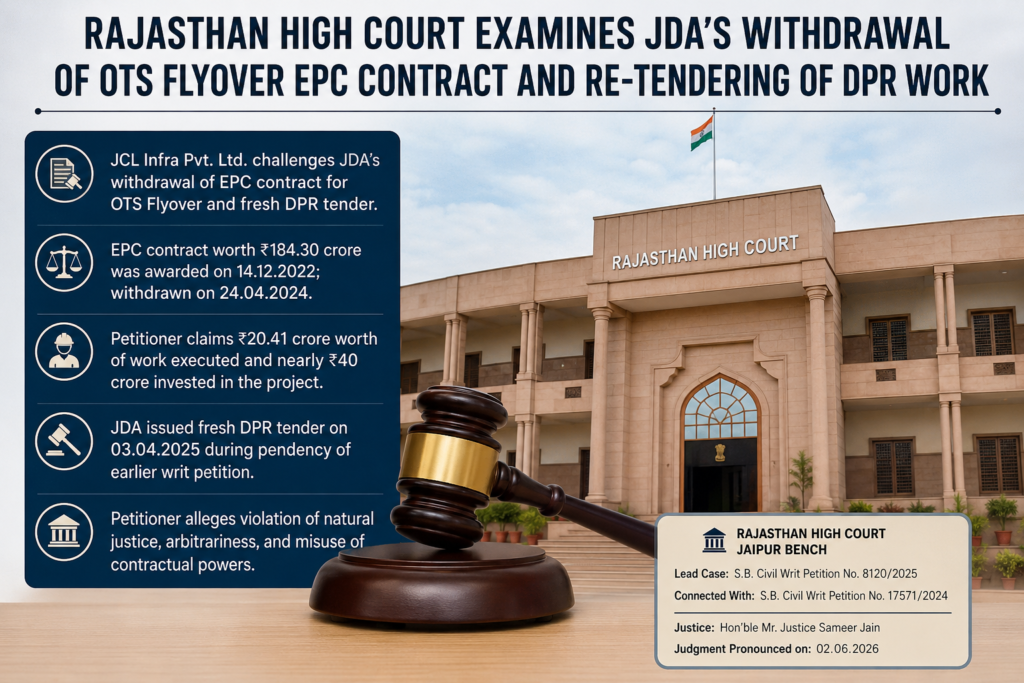
Rajasthan High Court Examines JDA’s Withdrawal of OTS Flyover EPC Contract and Re-Tendering of DPR Work The Rajasthan High Court, Jaipur Bench, in a batch of writ petitions led by JCL Infra Private Limited v. Jaipur Development Authority, examined the legality of Jaipur Development Authority’s actions relating to the OTS Flyover project at JLN Marg, Jaipur. The dispute concerns the withdrawal of an Engineering, Procurement and Construction (EPC) contract previously awarded to JCL Infra and the subsequent issuance of a fresh tender for preparation of a Detailed Project Report (DPR) for the same project. Background of the Dispute The OTS Crossing project was conceived as a traffic improvement and beautification initiative aimed at easing congestion at one of Jaipur’s busiest intersections. The project included construction of a flyover and associated infrastructure works. According to the petitioner, JDA had earlier engaged consultants for preparation of the DPR, which subsequently formed the basis for the EPC tender. Pursuant to the tender process, JCL Infra was awarded the EPC contract through a Letter of Acceptance dated 14 December 2022, followed by execution of a formal contract agreement on 27 December 2022. The contract related to traffic improvement and beautification works at OTS Crossing, JLN Marg, Jaipur, and was valued at approximately ₹184.30 crore. Petitioner’s Case JCL Infra contended that after execution of the contract, it mobilized manpower, machinery, and financial resources and commenced work in accordance with contractual requirements. The company asserted that: Multiple drawings, designs, survey reports and engineering documents were submitted to JDA during 2023. Necessary approvals and site clearances were repeatedly sought from the authority. Despite continuous correspondence, approvals required for execution of the project were allegedly not granted. Work worth approximately ₹20.41 crore had already been executed. Investments of nearly ₹40 crore had been made in the project. The petitioner further argued that repeated representations seeking approvals and release of payments did not receive appropriate responses from JDA. Extension of Time and Subsequent Withdrawal A significant aspect of the dispute relates to the extension of the project period. The petitioner pointed out that JDA extended the project completion timeline up to 30 April 2024. According to JCL Infra, this extension reflected acknowledgment of the subsisting contract and ongoing execution of work. However, shortly thereafter, JDA withdrew the awarded work through a communication dated 24 April 2024 by invoking Clause 32 of the contract. The petitioner challenged this withdrawal, alleging that: The action was arbitrary and illegal. No opportunity of hearing was provided. No adequate reasons were supplied. Clause 32 did not permit withdrawal of the entire contract in the manner adopted by JDA. Fresh DPR Tender and Challenge Before the Court During the pendency of the earlier writ proceedings challenging the withdrawal, JDA issued a fresh Notice Inviting Bid dated 3 April 2025 for consultancy services relating to preparation of a DPR for the proposed elevated road and OTS Flyover project. JCL Infra argued that re-tendering DPR consultancy work for the OTS Flyover was unjustified because: A DPR had already been prepared earlier. The EPC contract had already been awarded on the basis of that DPR. Significant work and investment had already been undertaken. The petitioner characterized the fresh tender as an attempt to restart the project despite the existence of an earlier DPR and a concluded EPC contract. Legal Grounds Raised by the Petitioner The petitioner relied upon several legal principles, including: 1. Violation of Natural Justice JCL Infra contended that withdrawal of the contract was undertaken without affording an opportunity of hearing, contrary to the principles of natural justice. 2. Arbitrary Exercise of Power It was argued that the withdrawal notice lacked sufficient reasons and was therefore arbitrary and unsustainable. 3. Promissory Estoppel and Legitimate Expectation The petitioner claimed that it had acted upon JDA’s representations and contractual commitments by mobilizing resources and investing substantial amounts. Consequently, withdrawal of the project allegedly caused severe prejudice. 4. State Obligation to Act Fairly The petitioner emphasized that JDA, being a public authority, was obligated to act fairly, transparently and reasonably even in contractual matters. Respondents’ Stand JDA opposed the petitions and raised objections regarding maintainability as well as merits. The respondents contended that: The petitions were not instituted by a duly authorized person on behalf of the company. Material facts had allegedly been suppressed. The dispute arose from contractual obligations involving disputed questions of fact. Such issues should be adjudicated through appropriate civil or commercial proceedings rather than writ jurisdiction. On merits, JDA maintained that the withdrawal of work was within the powers available under Clause 32 of the contract and that the Engineer-in-Charge possessed authority to take such action. The respondents also asserted that multiple communications and meetings had been conducted regarding delays and deficiencies in execution. Key Issues Before the High Court The proceedings raised several important legal questions: Whether JDA was justified in withdrawing the EPC contract awarded to JCL Infra. Whether the withdrawal complied with contractual provisions and principles of natural justice. Whether re-inviting bids for preparation of a DPR concerning the OTS Flyover was legally sustainable. Whether the dispute could be examined under Article 226 of the Constitution despite arising from a contractual relationship. Whether the petitioner had established arbitrariness in the actions of the public authority. Conclusion The litigation concerning the OTS Flyover project highlights the intersection of public procurement, infrastructure development, contractual obligations and administrative fairness. The dispute revolves around JCL Infra’s allegation that substantial work, investment and contractual commitments were disregarded through withdrawal of the EPC contract and subsequent re-tendering of DPR consultancy services, while JDA maintains that its actions were contractually justified and undertaken in public interest. The Rajasthan High Court examined these competing claims while considering questions of contractual interpretation, natural justice, public law principles and judicial review of governmental decisions in infrastructure projects.
Jaipur High Court Sets Aside RTI Second Appeal Order: Major Relief in RTI Matter Against Rajasthan State Information Commission, Jaipur
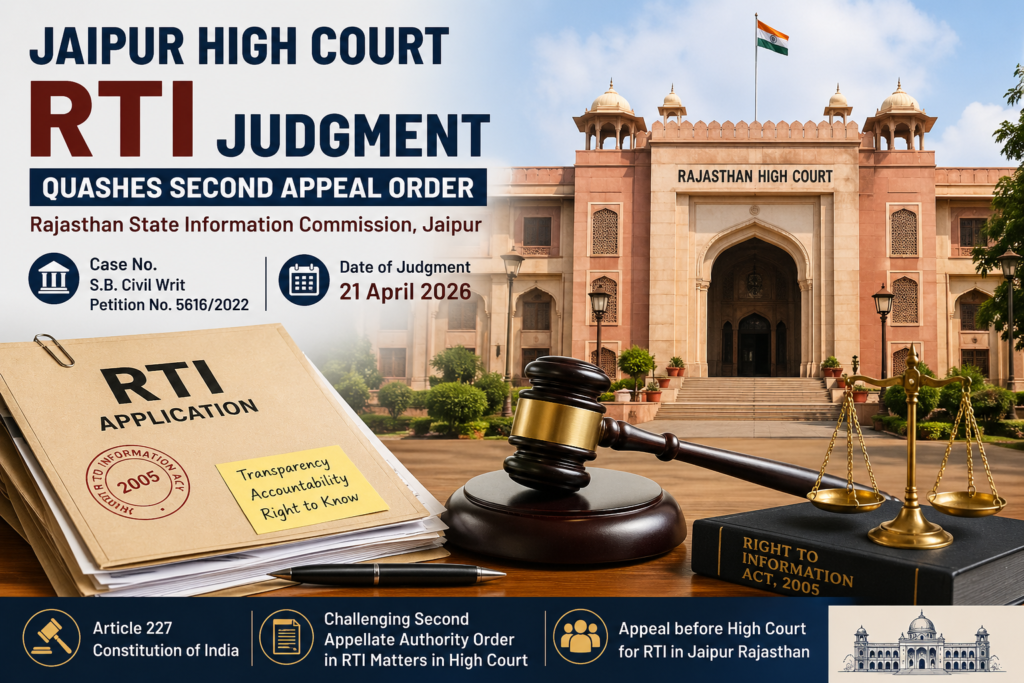
Jaipur High Court Sets Aside RTI Second Appeal Order: Major Relief in RTI Matter Against Rajasthan State Information Commission, Jaipur In an important judgment for transparency and citizens’ rights, the Jaipur High Court has quashed an order passed by the Rajasthan State Information Commission, Jaipur, holding that information under the RTI Act cannot be denied merely because the records relate to events more than twenty years old. The Court clarified that Section 8(3) of the Right to Information Act actually supports disclosure after twenty years rather than blocking it. This ruling is highly relevant for anyone considering challenging second appellate authority order in RTI matters in High Court or filing an appeal before High Court for RTI in Jaipur Rajasthan. Case Title, Date of Judgment and Case Number Case Title: Dr. Mahipal Singh Sihag vs State Public Information Officer Cum Commissioner & AnotherCase Number: S.B. Civil Writ Petition No. 5616/2022Court: High Court of Judicature for Rajasthan, Bench at JaipurJudge: Hon’ble Mr. Justice Sameer JainDate of Judgment: 21 April 2026 Background of the RTI Dispute The petitioner had filed an RTI application seeking service-related information regarding a third-party public servant, including joining date, retirement date, office orders and note sheets. The Public Information Officer rejected the request stating that the matter related to a third party and concerned events more than twenty years old. The first appeal was dismissed, and thereafter the Rajasthan State Information Commission, Jaipur, acting as the second appellate authority, also rejected the appeal on 18.12.2021. Aggrieved by this, the petitioner approached the Jaipur High Court under Article 227 of the Constitution. Jaipur High Court Findings on RTI Law The Jaipur High Court strongly criticised the reasoning adopted by the appellate authorities. The Court held that Section 8(3) of the RTI Act is a “sunset clause”, meaning that after twenty years most exemptions lose force and disclosure should ordinarily be allowed. Therefore, using the twenty-year rule as a ground to deny information was legally incorrect. The Court further observed that where third-party information is involved, the authority must follow the procedure under Section 11 of the RTI Act by issuing notice to the concerned third party and balancing privacy rights with public interest. The second appellate authority failed to follow this mandatory legal process. Final Order Passed by High Court The Jaipur High Court quashed the order dated 18.12.2021 passed by the second appellate authority. The Court directed the competent authority to supply the requested information to the petitioner within sixty days. It also directed the Registrar (Judicial) to send a copy of the judgment to the Rajasthan State Information Commission, Jaipur for compliance. Why This Judgment is Important for RTI Applicants in Rajasthan This judgment is a strong precedent for citizens seeking transparency. It confirms that when an unjust order is passed by the Information Commission, parties may consider challenging second appellate authority order in RTI matters in High Court. It also strengthens the legal route of filing an appeal before High Court for RTI in Jaipur Rajasthan where statutory authorities misinterpret the RTI Act. For litigants and advocates dealing with RTI disputes, this ruling from the Jaipur High Court sends a clear message that authorities must act according to law and cannot reject applications on arbitrary grounds Bhuvnesh Kumar GoyalAdvocate in Jaipur
Section 153C Proceedings & Taxability of Agricultural Land
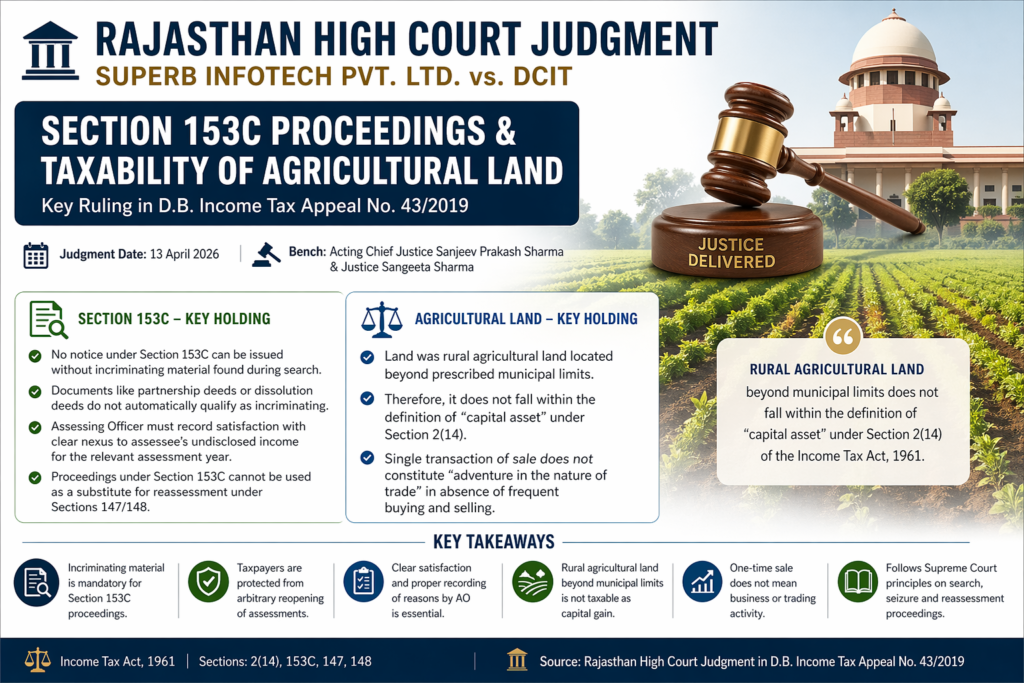
Section 153C Proceedings & Taxability of Agricultural Land The Rajasthan High Court, in Superb Infotech Pvt. Ltd. vs. DCIT (D.B. Income Tax Appeal No. 43/2019), has delivered a significant ruling clarifying the scope of Section 153C of the Income Tax Act, 1961 and the taxability of agricultural land transactions. This judgment reinforces that reassessment proceedings under Section 153C cannot be initiated casually and must strictly comply with legal prerequisites, especially the existence of incriminating material discovered during a valid search. The Court held that merely finding documents such as partnership deeds or dissolution deeds during a search on a third party does not automatically justify invoking Section 153C. There must be a clear nexus between the seized material and undisclosed income of the assessee for the relevant assessment year. In this case, the Assessing Officer failed to establish such linkage, and no incriminating material relating to the assessee’s income for A.Y. 2007–08 was found. Therefore, the entire reassessment proceeding was declared invalid. Another crucial aspect addressed was whether profit from the sale of agricultural land could be taxed as business income or capital gains. The Court observed that the land in question was rural agricultural land located beyond prescribed municipal limits, and hence did not fall within the definition of a “capital asset” under Section 2(14). It further clarified that a single transaction of sale does not amount to an “adventure in the nature of trade,” especially in the absence of frequent buying and selling activities. Importantly, the judgment reiterates the principle laid down by the Supreme Court that no addition can be made in completed assessments without incriminating material found during search proceedings. It also emphasizes that Section 153C cannot be used as a substitute for reassessment under Sections 147/148 when no new evidence is available. In conclusion, this ruling strengthens taxpayer protection by ensuring that tax authorities follow due process before reopening assessments. It also provides clarity on the tax treatment of rural agricultural land, confirming that such transactions, when meeting statutory conditions, remain outside the scope of capital gains taxation. Bhuvnesh Kumar GoyalAdvocate in Jaipur
Jaipur High Court: RIICO Cannot Claim Better Title Than State of Rajasthan, 3 Bigha 4 Biswa Land Remains with Khatedar
Jaipur High Court RIICO Cannot Claim Better Title Than State of Rajasthan, 3 Bigha 4 Biswa Land Remains with Khatedar In a significant judgment, the Jaipur Bench of the Rajasthan High Court clarified an important principle in land acquisition law—RIICO (Rajasthan State Industrial Development & Investment Corporation) cannot claim a better title than the State of Rajasthan itself. The Court held that where acquisition notifications and awards covered only a specific extent of land, any excess land—here 3 bigha 4 biswa—would continue to remain with the original khatedar (landholder). Background of the Case The dispute revolved around agricultural land situated in Khasra Nos. 203 and 204 in Jaipur district. The key controversy was regarding the actual extent of land and ownership rights after acquisition. Key Facts The plaintiffs (khatedars) filed a revenue suit claiming that: Total land measured 22 bigha 8 biswa, but It was wrongly recorded as 19 bigha 4 biswa during settlement. The State of Rajasthan itself admitted that the correct measurement was 22 bigha 8 biswa. The Revenue Appellate Authority (RAA) eventually: Declared the plaintiffs as khatedar tenants, and Recognised their rights over 3 bigha 4 biswa of land. This finding was upheld by: Board of Revenue Single Judge of the High Court RIICO’s Argument RIICO contended that: Entire land in Khasra Nos. 192, 203, and 204 had been acquired Possession was taken in 1982 and handed over to RIICO Therefore, no portion of land remained with the khatedars RIICO further argued: Acquisition attaches to the entire khasra number, not just part of it Even if actual area is larger, entire land should vest in the State/RIICO Stand of the Khatedars The landholders argued that: Only 19 bigha 4 biswa was acquired as per notification and award The remaining 3 bigha 4 biswa was never acquired No compensation was paid and possession was never taken for that portion They further emphasized: The State never challenged earlier revenue findings Hence, the declaration in favour of khatedars had attained finality Key Legal Issues The Court examined the following core questions: Whether acquisition of a khasra number means acquisition of the entire land irrespective of area Whether excess land (beyond notified area) automatically vests in the State Whether RIICO can claim ownership beyond what the State acquired Validity of earlier revenue court findings Findings of the High Court 1. Acquisition Limited to Notified Area The Court held: Acquisition is confined to the land specifically mentioned in the notification and award Any additional land beyond that cannot be treated as acquired Thus: If only part of a khasra is acquired, the remaining land continues with the khatedar 2. Entire Khasra Does Not Automatically Vest Rejecting RIICO’s argument, the Court clarified: Mention of a khasra number does not mean the entire land is acquired Only the measured and notified portion vests in the State 3. Reliance on Supreme Court Precedents The Court relied on key rulings: DDA vs. Samey Singh (2005) – Land not included in Section 6 declaration cannot be treated as acquired State of UP vs. Abdul Ali (2017) – No acquisition is valid without proper notification These rulings reinforced that acquisition must strictly follow statutory procedure. 4. RIICO Cannot Have Better Title Than State The Court made a crucial observation: RIICO is only an agency of the State Ownership remains with the State Therefore: RIICO cannot claim a better title than the State of Rajasthan 5. Finality of Revenue Proceedings The Court noted: Earlier findings of RAA and Board of Revenue had attained finality The State did not challenge them RIICO could not reopen settled issues after long delay Final Judgment The Division Bench held: Acquisition covered only 19 bigha 4 biswa Remaining 3 bigha 4 biswa was never acquired Therefore, it continues to remain with the khatedars The Court concluded: RIICO has no right over the remaining land and cannot claim ownership beyond what was acquired by the State. Legal Significance of the Judgment This judgment lays down important principles: Strict Interpretation of Acquisition Land acquisition must strictly follow: Section 4 notification Section 6 declaration Award details No Automatic Expansion of Acquisition Additional land cannot be presumed acquired Measurement errors do not enlarge acquisition Limited Rights of Development Authorities Bodies like RIICO act as agents of the State They cannot claim independent or superior title Protection of Landowners Any land not legally acquired remains with original owners Conclusion The Jaipur High Court has reaffirmed a fundamental rule—the State can only acquire what it legally notifies and compensates for. By holding that RIICO cannot claim better title than the State, the Court protected the rights of khatedars and prevented overreach in land acquisition matters. This judgment will have wide implications in disputes involving: Industrial land allotments Revenue record corrections Partial land acquisitions By Bhuvnesh Kumar GoyalAdvocate in Jaipur High Court
JDA vs Sai Darshan Hotels (2026): Rajasthan HC Upholds 15% Developed Land in Lieu of Compensation
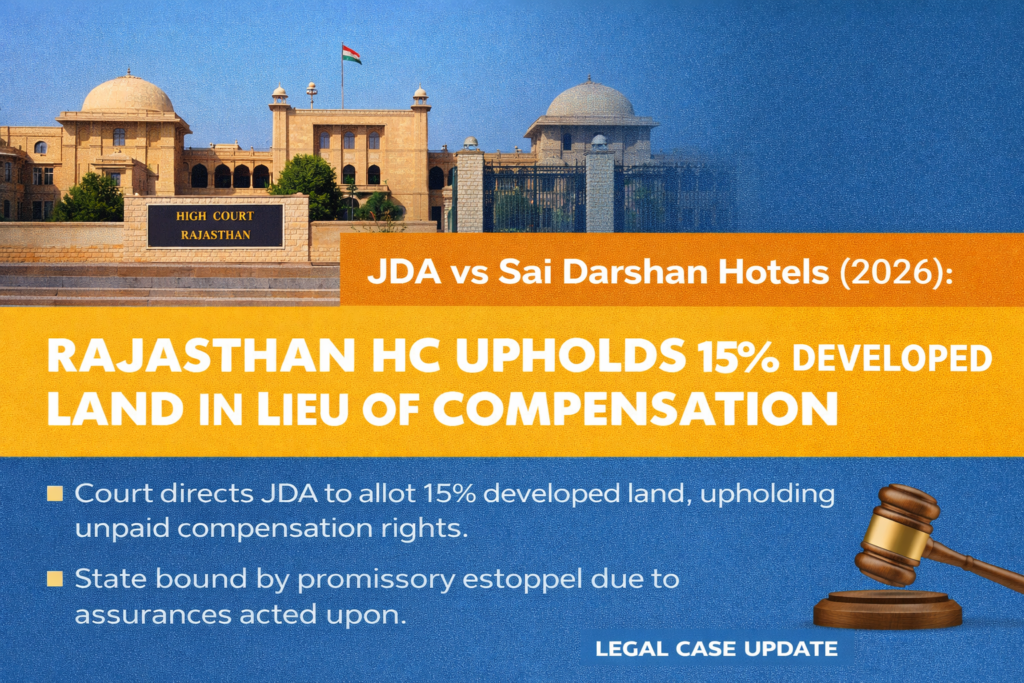
JDA vs Sai Darshan Hotels (2026): Rajasthan HC Upholds 15% Developed Land in Lieu of Compensation The Rajasthan High Court, Jaipur Bench, in D.B. Civil Special Appeal (Writ) No. 658/2010 decided a significant dispute concerning land acquisition compensation and the right to allotment of developed land in lieu of such compensation. The case arose from acquisition proceedings initiated in 1969 for land situated in Village Chainpura, Sanganer, Jaipur, culminating in an award dated 09.04.1981 granting monetary compensation to the original khatedars. Although the amount was determined and even deposited, it was never actually paid to the landowners, and possession of the land was taken over by the Jaipur Development Authority (JDA) in 1983. Over the years, multiple challenges to the acquisition proceedings were made by the original khatedars and subsequent stakeholders, all of which were dismissed up to the level of the Supreme Court. Thereafter, the respondent company, having acquired rights from earlier landholders, applied to the State Government in 2003 seeking allotment of 15% developed land in lieu of compensation under the prevailing State policy. This policy, particularly the circular dated 13.12.2001 (as amended in 2002), permitted such allotment subject to surrender of rights and withdrawal of litigation. Acting upon this, the respondent withdrew all pending cases, including proceedings before the Supreme Court, and complied with the conditions stipulated by the State. Pursuant to the policy, the State Government issued orders dated 12.05.2003 and 19.05.2003 directing allotment of Plot No. 7 admeasuring 9000 square meters at Airport Plaza, Jaipur, to the respondent. However, these orders were subsequently kept in abeyance by an order dated 23.06.2009, which led to the filing of a writ petition. The learned Single Judge allowed the petition and quashed the abeyance order, holding that the State was bound by the principle of promissory estoppel since the respondent had already acted upon the assurance by withdrawing litigation. In appeal, the JDA contended that the respondent had no valid claim to such allotment, alleging irregularities and asserting that the land had already been acquired and possession taken, leaving no scope for further benefits. It was also argued that the allotment caused financial loss to JDA and was based on improper actions by State authorities. However, the Division Bench, after examining the entire record and affidavits, found that neither the original compensation nor the enhanced compensation awarded by the Reference Court in 1990 had been paid or properly deposited. The Court relied on the Supreme Court judgment in Indore Development Authority v. Manoharlal to reiterate that mere deposit of compensation does not amount to payment, and therefore, the right to compensation survives. The Court further held that the respondent, as an assignee of the original khatedars, was entitled to claim compensation in accordance with the State policy. Since the respondent had fulfilled all conditions, including withdrawal of litigation, the State Government was bound to honour its promise. The action of keeping the allotment order in abeyance was found to be arbitrary, amounting to giving with one hand and taking away with the other, which is impermissible in law. The Court also observed that the policy providing 15% developed land had already been upheld by the Supreme Court and was binding on the authorities, including JDA. Rejecting the objections raised by JDA, the Court held that the allotment orders had attained finality and could not be questioned on vague allegations. It was further clarified that earlier proceedings did not attract the doctrine of merger or res judicata, as observed by the Supreme Court, and therefore the matter could be examined independently on merits. Ultimately, the Division Bench found no illegality in the order of the learned Single Judge and upheld the respondent’s entitlement to 15% developed land. Accordingly, the Special Appeal filed by JDA was dismissed, and the Court directed JDA to implement the State Government’s orders dated 12.05.2003 and 19.05.2003 by allotting Plot No. 7 admeasuring 9000 square meters at Airport Plaza, Jaipur, to the respondent. The judgment reinforces the principles that non-payment of compensation preserves the right of landowners, that government policies must be implemented fairly, and that the doctrine of promissory estoppel applies when a party has altered its position based on governmental assurances. Bhuvnesh Kumar GoyalAdvocate in Jaipur
Cancellation of Sale Deed on Grounds of Fraud or Misrepresentation
Cancellation of Sale Deed on Grounds of Fraud or Misrepresentation When someone signs a sale deed and later finds it was obtained by trickery, false promises, or concealment of important facts, the law gives remedies — one of the most important being a civil suit to cancel the sale deed. This article explains, in simple language, what “cancellation” means, when you can ask a court to cancel a sale deed because of fraud or misrepresentation, what evidence you need, how the courts look at these claims, the time limits you must watch for, and practical steps you can take. I’ve kept legal terms to a minimum and focused on helping a layperson understand what to expect. What “cancellation” of a sale deed means (and what it does not do) Cancellation is a court-ordered declaration that a written instrument — here, a sale deed — is void or voidable and therefore has no effect between the parties. If a sale deed is cancelled, it is treated as though it never passed the title it appeared to pass. Cancellation removes the legal power of that document, but it does not automatically restore possession or resolve every downstream dispute (for example, title issues, mutations, or third-party purchases may require extra steps). The remedy is available when the deed was tainted by defects like fraud, misrepresentation, coercion, undue influence, or a fundamental mistake. The legal grounds: what counts as fraud or misrepresentation Under Indian law, the contract/sale can be avoided if consent was obtained by fraud or misrepresentation. The Indian Contract Act defines fraud to include: false suggestions, active concealment of facts, promises made without intention to perform, or any other act declared fraudulent by law. Misrepresentation is a false statement of fact that induces the other party to enter the contract but without the element of deliberate deceit that fraud has. If a sale deed is executed because of such conduct, the aggrieved party has the option to have the document set aside. Courts treat fraud and misrepresentation seriously — but the allegation must be proved with clear and credible evidence. How courts evaluate claims of fraud or misrepresentation Courts follow a few consistent ideas when deciding whether to cancel a sale deed: Burden of proof: The person seeking cancellation (plaintiff) must prove fraud or misrepresentation. Mere allegations or suspicion are not enough — courts need cogent, admissible evidence. Documentary proof, contemporaneous correspondence, witness testimony, and official records (like registry entries) play a key role. When forgery or impersonation is alleged, courts examine signatures, registration records, and whether the “executant” had the capacity or presence to sign. Nature of the defect: There’s a difference between a deed that is void (invalid from the start) and one that is voidable (valid until set aside). Fraud generally makes the contract voidable at the option of the victim. If fraud is established, the court can cancel the deed and restore the parties to their earlier position so far as possible. Considerations of fairness and laches: Courts will also look at whether the plaintiff delayed unreasonably in bringing the claim. If a person knew about the deed and slept on their rights, the court may deny relief. This brings us to the limitation period discussed next. Time limits you cannot ignore (limitation) A crucial practical point: suits for cancellation of instruments or for rescission on grounds such as fraud are generally governed by the limitation framework. In most cases, three years is the relevant limitation period — and it runs from the date on which the plaintiff discovered the fraud (or could, with reasonable diligence, have discovered it). If important documents were concealed, the clock starts when the plaintiff had the means to discover them. Always note the exact date you first discovered the fraud — courts treat that date strictly. Missing the limitation window is a common reason suits fail. Typical evidence that helps prove fraud or misrepresentation If you are thinking of filing, gather focused, early evidence: The original sale deed and all annexures; certified copies from the sub-registrar’s office. Earlier title documents showing ownership before the fraudulent sale (if available). Bank records or receipts proving—or disproving—payment of consideration. If the buyer claims to have paid but there is no bank trail or receipt, that is important. Written correspondence, emails, or SMS that show promises, false statements, or that the seller/agent knew certain facts and hid them. Witness statements (neighbours, relatives, office staff, revenue officials) who can say whether the seller was present, whether the buyer was in possession, or whether unusual steps were taken to obtain signature/registration. Expert evidence (handwriting experts) where forgery or impersonation is alleged. Revenue records or mutation entries showing when the purchaser’s name was entered — sudden mutations after a forged deed are suspicious. Courts prefer contemporaneous, documentary proof; oral tales decades later are weak unless backed by documents or strong corroboration. Procedure — what the case typically looks like, step by step Pre-litigation check: Collect documents, check the registered deed copy at the sub-registrar, obtain title chain, and note dates of mutation/possession. If fraud is obvious (e.g., impersonation), consider an immediate police complaint (for forgery/impersonation) alongside civil action — though civil cancellation and criminal prosecution are separate tracks. File a civil suit for cancellation and/or declaratory relief: The plaint should clearly plead facts — when and how consent was induced by fraud, when the plaintiff discovered the fraud, and why the deed should be declared void and cancelled. Plead the limitation facts: the discovery date and reasons for any delay. Interim relief: If the property is at risk (e.g., imminent sale to a third party), you can ask the court for urgent interim orders — injunctions restraining further transfer, attachment, or mutation. Courts balance equities: interim relief is granted if the plaintiff makes a strong prima facie case and shows irreparable harm. Trial and evidence: Parties exchange documents and examine witnesses. The plaintiff must prove fraud by preponderance (civil standard) and satisfy the court with credible material. If
 Call: 7300056080
 Email: advocatebhuvneshgoyal@gmail.com
 Office: 109, Fortune Heights, Ahinsa Circle, C-Scheme, Jaipur-302001