Rajasthan High Court Upholds Acquittal in Murder Case Due to Contradictory Circumstantial Evidence and Unexplained FIR Delay
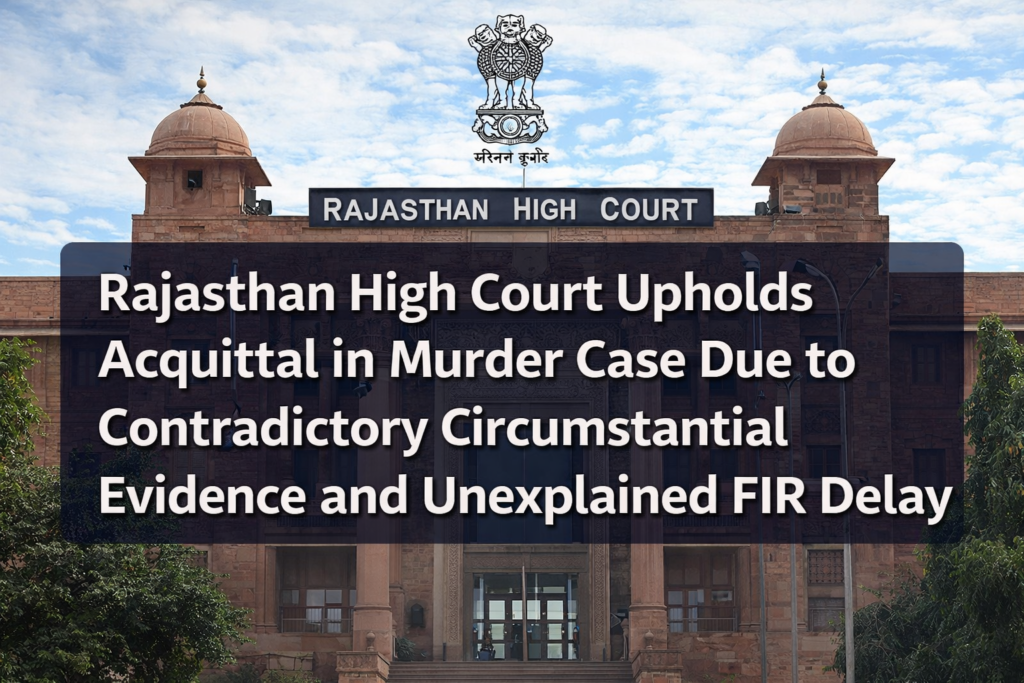
Rajasthan High Court Upholds Acquittal in Murder Case Due to Contradictory Circumstantial Evidence and Unexplained FIR Delay State of Rajasthan v. Sampat & Anr., D.B. Criminal Appeal No. 363/2002, decided on 25 February 2026 (Raj HC, Jaipur Bench), reported in 2026:RJ-JP:8788-DB, per Mahendar Kumar Goyal & Sameer Jain, JJ. (Connected with: Kalyan Ram v. Sampat Singh & Anr., D.B. Criminal Revision Petition No. 674/2001) The Rajasthan High Court, Jaipur Bench, in D.B. Criminal Appeal No. 363/2002 and connected Criminal Revision Petition No. 674/2001, delivered its judgment on 25.02.2026, dismissing both the appeal filed by the State and the revision petition filed by the complainant. The case arose from Sessions Case No. 23/1999 decided by the Additional District and Sessions Judge, Kishangarh, District Ajmer, wherein the accused persons were acquitted of the charge under Section 302 read with Section 34 IPC. The prosecution case was based on a written report dated 05.03.1999 submitted by Kalyan Ram, on the basis of which FIR No. 31/1999 was registered at Police Station Rupangarh, District Ajmer, for offences under Sections 302 and 34 IPC. It was alleged that the accused had committed the murder of Rupa Ram. After investigation, a charge-sheet was filed and charges were framed. However, after trial, the learned trial court acquitted the accused, leading to the present appeal and revision before the High Court. Before the High Court, the State and the complainant argued that the trial court had failed to properly appreciate the circumstantial evidence and that the chain of circumstances clearly established the guilt of the accused. It was submitted that the postmortem report showed an ante-mortem head injury and that a lathi was recovered on the disclosure statement of one of the accused. It was also contended that the delay in lodging the FIR was not fatal to the prosecution case. On the other hand, the counsel for the accused supported the acquittal and argued that the prosecution evidence was contradictory and unreliable. The High Court carefully examined the evidence on record and noted that the case was entirely based on circumstantial evidence. It found material contradictions in the statements of prosecution witnesses, particularly regarding what the deceased allegedly told them about the incident and who was responsible. The Court also observed that although the family members claimed to have known about the incident on the same night, the FIR was lodged after a delay of two days by a person who was neither a close family member nor a resident of the same village. No satisfactory explanation for this delay was provided. Further, the medical evidence did not fully support the prosecution version, as only a swelling on the skull was found and there were inconsistencies regarding the alleged dragging of the deceased. Importantly, the medical evidence suggested the possibility that the deceased might have suffered the fatal injury due to a fall, especially as there was evidence indicating consumption of alcohol. The Court held that the prosecution failed to establish beyond reasonable doubt that the fatal injury was caused by the accused. In view of these findings, the High Court concluded that the trial court’s judgment of acquittal did not suffer from any perversity, illegality, or infirmity warranting interference in appellate or revisional jurisdiction. Accordingly, both the criminal appeal and the revision petition were dismissed, and the acquittal of the accused was upheld. By Bhuvnesh Kumar GoyalAdvocate in Jaipur High Court
Rajasthan HC Rejects Sentence Suspension in POCSO Appeal Case
Rajasthan HC Rejects Sentence Suspension in POCSO Appeal Case Date of Order: 13.02.2026 The Rajasthan High Court, Jaipur Bench, recently dealt with a significant suspension of sentence application filed by an accused convicted under the Protection of Children from Sexual Offences (POCSO) Act. The case arose from D.B. Criminal Misc. Suspension of Sentence Application No. 2047/2024, filed along with a criminal appeal by the accused Vishnu @ Vikram, who had been sentenced to life imprisonment by the Special Court, POCSO Act, Dausa. The conviction was primarily under Sections 5(l)(m)/6 of the POCSO Act, along with alternative provisions of the Indian Penal Code, for serious allegations involving a minor victim. The applicant approached the High Court seeking suspension of sentence during the pendency of the appeal. The defence argued that the trial court had wrongly treated the victim as being below eleven years of age without sufficient evidence, and further contended that the allegations of rape were not medically corroborated. It was also submitted that there existed prior enmity between the parties, which allegedly resulted in false implication. On these grounds, the counsel requested the Court to grant relief and suspend the sentence until the appeal was decided. The State strongly opposed the plea, emphasizing the seriousness of the offence and the material evidence available on record. Upon hearing both sides, the Division Bench carefully examined the trial court judgment dated 20.03.2024. The Court noted that the victim’s age had been determined based on the birth certificate (Exhibit P-16), which showed that she was below eleven years at the time of the offence. Further, the victim’s testimony as PW-2 contained specific allegations of repeated sexual assault. Importantly, forensic evidence played a crucial role, as the DNA profile obtained from semen found on the victim’s clothing matched with the DNA sample of the accused, strengthening the prosecution’s case. Considering the gravity of the accusations, the age of the victim, and the supporting forensic material, the High Court held that this was not a fit case for granting suspension of sentence. The Bench observed that the nature of evidence and seriousness of the offence weighed against the applicant. Consequently, the application for suspension of sentence was dismissed, and the accused was directed to continue serving the sentence awarded by the trial court. This order highlights the cautious approach adopted by courts in cases involving offences against children, especially where strong testimonial and scientific evidence is available. It reiterates that suspension of sentence in serious POCSO convictions is not granted as a matter of routine and depends heavily on the strength of the prosecution’s evidence and the overall circumstances of the case.
Rajasthan High Court Allows Re-Medical Examination in Police Telecommunication Operator Recruitment Due to Weight Discrepancy
Rajasthan High Court Allows Re-Medical Examination in Police Telecommunication Operator Recruitment Due to Weight Discrepancy The Rajasthan High Court, Jaipur Bench, in S.B. Civil Writ Petition No. 1612/2026, dealt with an important issue concerning recruitment eligibility and medical assessment in the police telecommunication operator recruitment process. The petitioner, Anushka Sonwal, had applied for the post of Constable Police Telecommunication Operator under the Rajasthan Police Subordinate Service Rules, 1989, pursuant to an advertisement dated 09.04.2025. She claimed that she had secured a suitable position in the merit list and belonged to the SC Female category, fulfilling all required qualifications for the post. However, during the Physical Measurement Test, she was declared ineligible on the ground that her recorded weight was 43.30 kg, which was below the prescribed minimum requirement of 47.5 kg. The petitioner challenged the disqualification by producing a health certificate issued shortly after the rejection by a Medical Officer from a Government Hospital at Jhalana Doongri, Jaipur, which certified her weight as 48 kg. The petitioner argued that there was a clear discrepancy between the weight measurements taken by two different authorities, and therefore she sought an opportunity for re-medical examination by an independent medical board. The counsel submitted that a fresh assessment by experts at AIIMS would help resolve the factual dispute regarding her eligibility. While considering the matter, the High Court observed that writ jurisdiction is generally not invoked in cases involving disputed questions of fact, particularly those related to physical measurements or medical fitness. Nevertheless, the Court took note of the special circumstances of the case, namely that a government medical officer had issued a certificate indicating that the petitioner met the prescribed weight requirement within a short span of time after she was declared ineligible. Taking a balanced approach, the Court granted liberty to the petitioner to undergo a fresh medical examination by a Medical Board to be constituted by AIIMS, Jodhpur. The order directed that the petitioner must submit an application within seven days along with a demand draft of Rs. 10,000 in favour of the Superintendent of AIIMS, Jodhpur, following which the medical board would assess her weight within a stipulated period. The Court further clarified that if the AIIMS medical experts certify that the petitioner’s weight is 48 kg or more, she would be entitled to submit a representation before the concerned recruitment authorities, who must then consider her case strictly in accordance with law. Importantly, the Court emphasized that it had not expressed any opinion on the merits of the recruitment dispute and had only provided a procedural remedy to resolve the factual inconsistency. Consequently, the writ petition was disposed of with these directions, leaving the final decision to the competent authorities based on the outcome of the medical examination.
Section 17-B Industrial Disputes Act: Rajasthan High Court Clarifies Workman Entitlement to Last Drawn Wages, Not Minimum Wages During Pendency
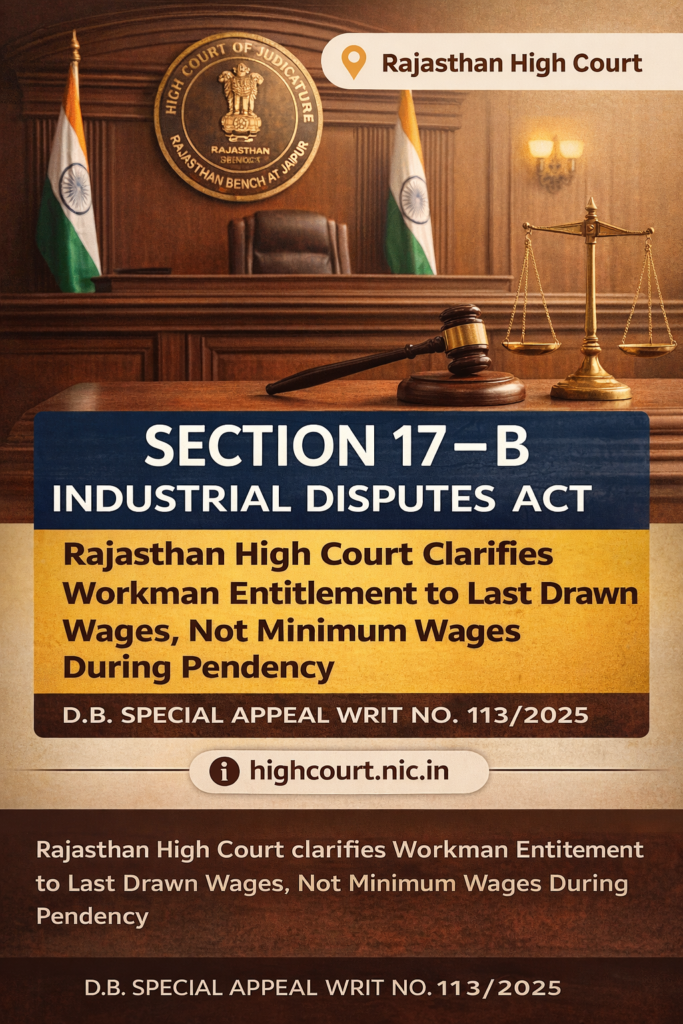
Section 17-B Industrial Disputes Act: Rajasthan High Court Clarifies Workman Entitlement to Last Drawn Wages, Not Minimum Wages During Pendency The Division Bench of the Rajasthan High Court at Jaipur, in D.B. Special Appeal Writ No. 113/2025, delivered an important ruling clarifying the scope of Section 17-B of the Industrial Disputes Act, 1947 and the entitlement of a workman to wages during the pendency of litigation. The case arose from a dispute involving the University of Rajasthan and a workman, where the primary issue was whether a workman is entitled to minimum wages or only the last drawn wages while the employer’s challenge to a Labour Court award is pending before the High Court. The Court examined earlier precedents and statutory provisions to determine the correct interpretation of the law. The Bench observed that the controversy was no longer res integra because earlier Division Bench decisions had already settled that during the pendency of proceedings, the workman is entitled to wages based on the last drawn salary rather than revised pay scales or enhanced minimum wages. The Court relied on prior judgments, including cases relating to Gram Panchayat Manoharpura and other authorities, which held that the purpose of Section 17-B is to provide subsistence support to the workman so that he does not suffer financial hardship while defending litigation. This payment acts as a safeguard against starvation but does not create a right to increased or revised wages. While the respondent argued that minimum wages fixed by the State should be treated as maintenance allowance, the Court rejected this interpretation. Referring to judicial precedents, the Bench clarified that Section 17-B grants a statutory right to receive “full wages last drawn,” and although constitutional courts may in exceptional circumstances grant a higher amount in the interest of justice, such directions remain outside the strict framework of Section 17-B. Therefore, equating minimum wages with maintenance allowance was found to be inconsistent with the statutory scheme. A significant aspect of the judgment was the Court’s interpretation of the Minimum Wages Act, 1948. The Bench held that minimum wages apply only to persons who are actually employed and working in an industry. A workman whose termination is under challenge and who is not presently in service cannot claim minimum wages merely because litigation is pending. Instead, during this period of non-employment, the legal mechanism available is subsistence allowance under Section 17-B of the Industrial Disputes Act. This distinction was crucial in setting aside the Single Judge’s direction that required payment of minimum wages during the pendency of the writ petition. Consequently, the Division Bench partly allowed the appeal and modified the earlier order. It ruled that the employer must continue to pay the workman the full wages last drawn, along with any admissible maintenance allowance, until the main petition is finally decided. However, payment of revised minimum wages or increments during this period was held to be beyond the scope of Section 17-B. The Court also requested expeditious disposal of the pending petition before the Single Judge to ensure timely resolution of the dispute. Overall, the judgment reinforces a consistent judicial approach that Section 17-B is a protective provision intended to sustain a workman during litigation but not to enhance his financial entitlement beyond the last drawn wages. By distinguishing between subsistence allowance and minimum wages, the Rajasthan High Court clarified the limits of judicial discretion and ensured that the statutory framework of the Industrial Disputes Act is interpreted strictly while still balancing the interests of both employers and employees. Bhuvnesh Kumar GoyalAdvocate in Jaipur High Court
Claim of Maintenance by a Divorced Wife
Claim of maintenance by a divorced wife A divorced wife has a statutory right to claim maintenance under Section 125 of the Code of Criminal Procedure, 1973. Every divorced wife, if otherwise eligible and unable to maintain herself, is entitled to the benefit of maintenance allowance. Divorce by itself does not extinguish the right of maintenance, and the obligation of the husband continues unless specifically discharged in accordance with law. Where the husband fails to prove that he was actually paying maintenance to the divorced wife, and merely contends that she forfeited her right due to divorce or an earlier consent decree, the essential condition of “neglect or refusal to maintain” stands satisfied. In such circumstances, a divorced wife is not required to plead or prove that she was not living separately by mutual consent. This principle has been clearly laid down by the Supreme Court in Bai Tahira v. Ali Hussain Fissalli (1979 Cr LJ 151 SC) and reaffirmed by the Kerala High Court in Kamalakshi v. Sankaran (AIR 1979 Ker 116). Under Section 127(3)(b) of the CrPC, a husband can seek absolution from his obligation under Section 125 towards a divorced wife only on proof that he has paid a sum in accordance with customary or personal law, and that such sum is reasonably sufficient to substitute the maintenance allowance. Mere assertion of divorce or settlement is not enough. This legal position was authoritatively settled in Bai Tahira v. Ali Hussain Fissalli (1979 Cr LJ 151 SC) and followed in Kamalakshi v. Sankaran (AIR 1979 Ker 116). The right of a divorced wife to receive maintenance flows directly from her status as a divorced wife. This right does not depend upon any further condition once divorce is established and inability to maintain herself is shown, as held in M. Nanu v. Vasantha (1986 Cr LJ 652). After divorce, the husband cannot insist that the wife should live with him, and consequently, the divorced wife is under no obligation to prove sufficient cause for living separately. This principle has been upheld in Velukutti v. Prasanna Kumar (1985 Cr LJ 1558 Ker) and Hari Singh v. Gulab Devi II (1989) DMC 439 (Raj). Even where the marriage has been dissolved by mutual consent, the divorced wife, if unable to maintain herself, is entitled to claim maintenance until she remarries. This position was clearly recognized in Sadasivam Pillai v. Vijaya Lakshmi (1989 Cr LJ 765). It is now a well-settled proposition of law that even where there is a valid decree of divorce, the wife remains entitled to claim maintenance under Section 125 of the CrPC. A decree of divorce cannot be used as a ground to deny maintenance, as held in Chandrakant v. Sulochana (1997 Cr LJ 520 Bom). Further, even when a decree of divorce is passed against the wife on the ground of desertion, she is not barred from claiming maintenance against her former husband from the date of the decree. This legal position has been affirmed in Jashelal v. Pushpabati (1998 Cr LJ 4740) and Harish v. Kabita Bai (2007 Cr LJ (NOC) 724 MP). Similarly, where a decree for restitution of conjugal rights had been passed prior to divorce, such decree loses all relevance once the marriage stands dissolved. After divorce, the earlier decree for restitution of conjugal rights ceases to have any legal significance, and the divorced wife cannot be denied maintenance under Section 125 CrPC. This principle was upheld in Koli Gomiben Shyamji v. Koli Laxman Premji (1998 Cr LJ 429 Guj). The Supreme Court has categorically held that a woman, after divorce, is entitled to claim maintenance from her former husband if she is unable to maintain herself and so long as she does not remarry. The ex-husband continues to remain under a statutory duty and legal obligation to provide maintenance to his divorced wife. This authoritative declaration of law is found in Rohtash Singh v. Ramendri (AIR 2000 SC 952). The fact that at the time of an initial compromise the wife did not claim maintenance, or that she did not seek maintenance at the disposal of the matrimonial suit, does not bar her from claiming maintenance at a subsequent stage. Any agreement or understanding whereby a wife relinquishes her right to future maintenance has no legal sanction, being opposed to public policy. This position has been reiterated in Bishnupriya Bhuniya v. Jhumi Banik (AIR 2007 NOC 657 Gau). By Advocate Bhuvnesh Kumar GoyalAdvocate in Jaipur High Court
Alimony in Hindu Marriage Act & Section 141 BNSS Maintenance
Alimony under the Hindu Marriage Act, 1955 and Maintenance under Section 125 CrPC (Now Section 141 BNSS) Even where alimony pendente lite is granted by the civil court in matrimonial proceeding under s. 24 of the Hindu Marriage Act in favour of the wife alone, the Magistrate under s. 125, CrPC/141 BNSS can grant higher maintenance for wife and children (Ramesh Chandra v Veena Kaushal 1979 Cr LJ 3 (SC)). However, the quantum of maintenance awarded under s. 125, CrPC /141 BNSS is adjustable with the award of alimony pendente lite granted by the Matrimonial Court (Sudip Chaudhary v Radha Chowdhury 1999 Cr LJ 466 (SC). When the plea of adjustment was not raised then the maintenance ordered under s. 125, CrPC/141 BNSS and alimony pendente lite ordered under s. 24 of the Hindu Marriage Act are payable to the wife and both the orders are required to be complied with till the final decision is rendered by the civil court. After the civil court passes the final order of alimony, the husband can apply for cancellation or variation of the order passed under s. 125, CrPC/141 BNSS (T.Rajinder Singh v Maya Devi 1996 Cr LJ 2384 (AP). Only because a proceeding under the Hindu Marriage Act 1955 is pending, an application under s. 125, CrPC/141 BNSS cannot be dismissed summarily (Balan v Pankojakhy 1992 Ker LJ 778). Even refusal of granting pendente lite maintenance by the civil court is not binding on the criminal court and the Magistrate can grant maintenance under s. 125, CrPC/141 BNSS in spite of such refusal (Ashok Nath Singh v Upasama Panwar 1994 Cr LJ 998 (H.P). In case of dismissal of husband’s petition under any one of the ss. 9 to 14 of the Hindu Marriage Act 1955, alimony under the Hindu Marriage Act cannot be granted. But the wife can maintain a petition under s. 125, CrPC (Now 141 BNSS) – Chand Dhawan v Jawaharlal Dhawan (1993)3 SCC 406; 1993 Cr LJ 2930 Petition for nullity of marriage pending Even if a petition for nullity of marriage is pending under the Hindu Marriage Act 1955, this will be no ground for refusal of maintenance to the wife under s. 125, CrPC, but in such petition for nullity of marriage, no interim direction has been given Manoj v M. Sindhi 2007 Cr LJ (NOC) 2 (Ker). Civil Court’s decree is binding on Criminal Court The question arose that if the husband obtained a decree for divorce on the ground of desertion by the wife, the petition under s. 125, CrPC cannot be dismissed summarily. The Magistrate has to scrutinize the judgment of the civil court to ascertain as to whether there was really any finding recorded by the civil court or not that the wife was guilty of desertion. However, the civil court decree is binding on the criminal court (Jasholal Agarwal v Pushupati 1994 Cr LJ 185 (Ori). Decree for restitution of conjugal rights However, despite the decree for restitution of conjugal rights passed against the wife, the wife may file an application under s. 125, CrPC unless it is proved that the person, in whose favour the decree was passed, was willing to discharge the obligation as a husband and has not secured the decree in order to frustrate the order of maintenance under s. 125, CrPC (K. NArayan Rao v Bhagyalakshmi 1984 Cr LJ 276 (Kant); Mr Shakal v Shahina Parveen (1987)1 Crima 115 (Del). When, in spite of the decree for restitution of conjugal rights, the wife refused to stay with the husband and the husband obtained a decree for divorce on the ground of desertion, the wife is not entitled to apply for maintenance under s. 125, CrPC (In the matter of Rabindra Nath Ray 1995 Cr LJ 1187 (Cal.) By Bhuvnesh Kumar GoyalAdvocate in Jaipur High Court
Rajasthan High Court Holds That Short Absence Is Not Desertion: CRPF Constable Reinstated
Rajasthan High Court Holds That Short Absence Is Not Desertion: CRPF Constable Reinstated The Rajasthan High Court, Jaipur Bench, has delivered an important judgment clarifying the legal distinction between desertion and unauthorised absence in disciplined forces. In S.B. Civil Writ Petition No. 7778/2006, the Court set aside the removal of a CRPF constable who had been wrongly treated as a deserter for a short period of absence. The judgment reaffirms that temporary absence, followed by voluntary rejoining of duty, does not amount to desertion under the CRPF Act, 1949 The petitioner was appointed as a Constable (GD) in the Central Reserve Police Force in 1995 and had a strong service record. During his tenure, he was repeatedly appreciated for his performance, including sensitive deployments during post-riot duties in Gujarat and rescue and relief operations during the Bhuj earthquake. Despite this, a charge-sheet was issued against him in 2002 alleging desertion from training, unauthorised stay outside the camp, misconduct during training, and habitual indiscipline. Based on these allegations, the disciplinary authority imposed the extreme penalty of removal from service, which was later upheld in appeal and revision. The core issue before the High Court was whether the petitioner’s absence for about twenty days, which was supported by medical evidence and followed by voluntary resumption of duty, could legally be treated as desertion. The Court examined the scheme of the CRPF Act, 1949, particularly Sections 9 and 10, and observed that the law makes a clear distinction between desertion and absence without leave. Desertion is classified as a more heinous offence and requires animus deserendi, meaning a deliberate and permanent intention to abandon service. Absence without leave, on the other hand, is a lesser offence and does not automatically become desertion. The Court noted that the charge-sheet itself admitted that the petitioner rejoined duty on his own within a short period. This admitted fact completely negated any intention to permanently abandon service. The Court held that once voluntary rejoining is established, the essential ingredient of desertion is missing, rendering the charge legally unsustainable. Branding such a short absence as desertion was held to be a clear case of non-application of mind. The High Court also found serious procedural lapses in the departmental enquiry. Despite repeated requests, the petitioner was not supplied with relied-upon documents, and he was denied an effective opportunity to examine defence witnesses. The Enquiry Officer ignored unimpeachable medical records showing that the petitioner was suffering from acute renal pain and had undergone hospital treatment during the relevant period. The illness of his wife was also supported by documentary evidence, yet these mitigating circumstances were brushed aside without reasons. Further, the allegation that the petitioner stayed outside the camp without permission was found to be completely false, as the respondents’ own records showed that written permission had been granted to him earlier. The charge relating to misconduct during training was also unsupported by evidence, as training records reflected good conduct and high performance. The Court observed that earlier minor punishments could not be used to label the petitioner as habitually indisciplined so as to justify removal from service. The High Court strongly criticised the appellate and revisional authorities for passing cryptic and non-speaking orders. It held that statutory remedies lose their purpose if authorities fail to apply independent mind and merely endorse earlier decisions mechanically. The punishment of removal from service was held to be shockingly disproportionate, especially when imposed on a constable with a proven record of dedication and gallantry, and where the alleged misconduct arose largely from medical exigencies. Ultimately, the Rajasthan High Court allowed the writ petition and quashed the removal order along with all consequential appellate and revisional orders. The respondents were directed to reinstate the petitioner with continuity of service and seniority. However, the Court limited the relief to notional benefits and denied actual back wages for the intervening period. The entire exercise was directed to be completed within sixty days from receipt of the judgment. This judgment is significant for service jurisprudence in uniformed forces. It reinforces that every unauthorised absence is not desertion, that intention to permanently abandon service is the decisive factor, and that disciplinary authorities must strictly follow statutory safeguards. The ruling serves as a reminder that while discipline is vital, it cannot be enforced at the cost of fairness, proportionality, and the rule of law. Advocate Bhuvnesh Kumar Goyal
JVVNL Forcing Plot Owners to buy electricity from builder is illegal : Rajasthan High Court, Jaipur Bench
JVVNL Forcing Plot Owners to buy electricity from builder is illegal : Rajasthan High Court, Jaipur Bench Janak Singh Hada Vs State of Rajasthan & Others and Connected Matters D.B. Civil Writ Petition Number 7445/2025 Date of Judgment : 07.01.2026 In a significant judgment protecting the rights of homeowners, the Jaipur Bench of the Rajasthan High Court has granted relief to plot owners of Vatika Infotech City who were denied individual electricity connections for years. The case arose from a long-standing dispute where residents of a JDA-approved colony were forced to purchase electricity from private developer-linked companies instead of receiving direct domestic electricity connections from Jaipur Vidyut Vitran Nigam Limited (JVVNL). The High Court’s order dated 07 January 2026 has clarified the legal position on single point electricity connections, private monopoly, and the statutory duty of distribution companies. Vatika Infotech City is a large residential township in Jaipur with more than 3,500 plots approved by the Jaipur Development Authority. Despite residents owning freehold plots and having constructed houses on their own land, JVVNL consistently refused to provide individual electricity connections. Instead, residents were compelled to buy electricity through sub-meters installed by private companies associated with the builder, which were operating without any licence under the Electricity Act, 2003. This practice continued for more than fifteen years, causing serious hardship to residents. Aggrieved plot owners, including Janak Singh Hada and other similarly placed residents, approached the Rajasthan High Court by filing writ petitions under Article 226 of the Constitution of India. The petition challenged Regulation 6.3 of the Rajasthan Electricity Regulatory Commission (Electricity Supply Code and Connected Matters) Regulations, 2021, alleging that it was being misused to justify an illegal monopoly of electricity distribution by non-licensee private companies. The petitioners also challenged the refusal letter dated 17.11.2023 by JVVNL, which directed residents to obtain electricity from the developer instead of granting direct connections. The petitioners argued that under Section 43 of the Electricity Act, 2003, every distribution licensee has a statutory duty to supply electricity to an owner or occupier of premises upon application. They further contended that Regulation 6.3 itself contains a proviso that clearly protects the right of an individual consumer to demand direct electricity supply from the distribution licensee. Despite this, JVVNL continued to deny connections, citing reasons such as “single point connection” and “non-electrification of the colony,” while simultaneously allowing private companies to sell electricity within the same colony. After examining the pleadings, documents, and the connected writ petitions, the Rajasthan High Court made crucial observations. The Court held that JVVNL, being a distribution licensee under the Electricity Act, cannot shift its statutory responsibility onto a private developer. The Court found that Regulation 6.3 does not prohibit individual electricity connections and, in fact, mandates release of direct connections when demanded by eligible applicants. The practice of forcing residents to buy electricity from a builder through a single point connection was held to be arbitrary, unreasonable, and contrary to law. The High Court further recognised that electricity is an essential service and forms an integral part of the right to life under Article 21 of the Constitution of India. Denial of electricity to residents who have complied with all requirements and are willing to pay applicable charges was found to be a clear violation of constitutional and statutory rights. The Court rejected the argument that the colony was not electrified, observing that such a stand was neither fair nor justified when electricity was already being supplied through private intermediaries. By its final order, the Rajasthan High Court directed Jaipur Vidyut Vitran Nigam Limited to issue independent electricity connections to the petitioners after completion of necessary formalities and payment of applicable charges. The Court ordered that such connections must be released within a period of two months from the date of the order. While the challenge to the constitutional validity of Regulation 6.3 was kept open for consideration in an appropriate case, the Court granted substantial relief to the residents by enforcing their right to direct electricity supply. This judgment is extremely important for plot owners and residents living in private colonies across Rajasthan. It sends a clear message that developers cannot run parallel electricity distribution systems without a licence and that distribution companies cannot abdicate their statutory duties. The decision also curbs the practice of creating illegal monopolies over essential services like electricity and strengthens consumer rights in urban residential colonies. In conclusion, the Rajasthan High Court’s decision in the Vatika Infotech City electricity case reaffirms that electricity is not a privilege controlled by builders but a legal right guaranteed under law. Distribution licensees are bound to serve consumers directly, and regulatory provisions cannot be misused to deny citizens access to basic necessities. This judgment will serve as a strong precedent for similar disputes involving denial of electricity connections in developer-led townships across the state. Counsel for the Petitioners Bhuvnesh Kumar GoyalAdvocate in Jaipur High Court
Rajasthan’s Anti-Conversion Law
Rajasthan’s Anti-Conversion Law Rajasthan recently enacted a comprehensive law to prohibit what the state calls “unlawful conversions of religion.” The law—tabled and passed in 2025—creates new criminal offences, sets out administrative procedures (including mandatory declarations and district-magistrate inquiries), and prescribes harsh penalties including long prison terms and non-bailable offences. It has quickly become the subject of intense public debate and multiple court challenges. Below I explain, in plain language, what the law does, why people are worried, the constitutional arguments likely to be raised before the Supreme Court, and the practical effects it may have on ordinary people. I have kept the language simple so a lay reader can follow the legal issues without legalese. What the Rajasthan law says (short summary) The statute criminalizes conversions obtained by force, fraud, misrepresentation, undue influence, allurement, marriage or by any fraudulent means, and it also addresses “online solicitation.” It requires the person intending to convert (and sometimes the convertor) to make declarations to the District Magistrate; the DM must conduct an inquiry and invite objections before permitting a conversion to proceed. The law allows certain third parties (relatives and others) to lodge complaints, makes many offences non-bailable, and prescribes severe punishments including long terms of imprisonment. Some provisions permit seizure of property and even demolition in certain situations. Short political and social background Several Indian states have enacted similar laws in recent years; Rajasthan’s law follows a broader pattern where state governments say these statutes are needed to stop “forceful and fraudulent” conversions, often citing protection of vulnerable persons. Critics — civil-society organizations, religious minorities’ bodies and human-rights groups — argue that these laws are drafted too broadly and that they are being used to harass minority communities, NGOs and individuals in inter-faith relationships. The law quickly attracted public protests and litigation; petitions challenging it were filed and the Supreme Court has issued notices in one or more petitions. How this sits with existing Supreme Court law (the legal precedent) The landmark decision most often cited in this area is Rev. Stanislaus v. State of Madhya Pradesh (1977). In that case the Supreme Court drew a distinction between the right to “propagate” one’s religion (which Article 25 protects) and the right to convert another. The Court held that the right to propagate does not include the right to convert someone by force, fraud or allurement; accordingly, it has upheld some state laws that criminalise forcible or fraudulent conversions. But Stanislaus is old and its reasoning and scope are frequently debated today—especially about how state law may interact with basic rights like equality, personal liberty and privacy. Recent laws (including Rajasthan’s) extend much broader administrative and penal controls than earlier statutes, raising fresh constitutional questions. Main legal challenges likely to be raised in court Below are the core constitutional arguments that petitioners (and many commentators) are raising against the Rajasthan law. These are the arguments a senior lawyer would press before the Supreme Court. Vagueness and over-breadth — Terms like “allurement,” “undue influence,” “misrepresentation” and “online solicitation” are wide and not always defined precisely. Vague criminal laws can criminalise ordinary, everyday social and religious activity (for example, offering food at a community event, giving social service or expressing religious beliefs). This raises due-process concerns and may make the law void for vagueness. Violation of Article 25 (Freedom of religion) and Article 19 (Expression/association) — Even if forced conversions can be restricted, a law that chills genuine, voluntary propagation, social welfare work by religious bodies, or benign inter-religious dialogue risks infringing the right to practice and propagate religion and the freedoms to associate and speak. Petitioners will say the law goes beyond preventing force and sweeps within its net perfectly lawful activities. Equal protection (Article 14) — Many critics note that some laws or their implementation appear to treat conversions to certain religions differently from reconversion to others. If the statute operates in a way that advantages or protects conversions to one religion but not another, that unequal treatment will be challenged as arbitrary and discriminatory. Personal liberty and privacy (Article 21) — Mandatory prior declarations to the DM, inquiries into private religious choices, and criminal penalties for intimate choices (including inter-faith marriages) raise serious privacy and liberty concerns. The law’s intrusion into the autonomy of an adult to decide their religion and spouse can be presented as an unconstitutional invasion of personal liberty. Property and procedural safeguards — Provisions permitting seizure of property or demolition on allegations of conversion may be challenged as violative of property rights and lacking adequate procedural safeguards (right to fair hearing, independent adjudication, judicial oversight). Petitioners may argue these are punitive administrative steps without proper judicial process. Who may complain / criminalisation of social work — Allowing broad classes of persons to lodge FIRs and making many offences non-bailable may encourage frivolous or politically motivated complaints against NGOs, social workers, missionaries, and marginalized individuals. This practical risk is part of the constitutional critique. Practical problems in enforcement (and why critics worry) Chilling effect on social services and medical/educational work. Many religious organizations run schools, health-camps and relief work. If their assistance can be labelled “allurement,” they may stop providing services for fear of prosecution. Surveillance and intrusive inquiries. Prior notice to the District Magistrate and public objections invite public scrutiny of intimate decisions. That can humiliate converts and chill voluntary choice. Selective targeting. Law-enforcement discretion (who investigates, which complaints are registered) can lead to selective enforcement against minorities or dissenting groups. Several minority bodies and civil-liberties groups have highlighted this risk. How the Courts will probably approach these challenges Textual and doctrinal balancing. The Supreme Court will revisit Stanislaus’s core holding: while states can curb conversions obtained by coercion or fraud, any law must be narrowly tailored and accompanied by adequate safeguards. If provisions go beyond preventing force and criminalise legitimate persuasion or voluntary adult choice, the Court may strike those parts down. Scrutiny of procedural powers. Powers such as property seizure and demolition will be examined
Corruption Conviction Quashed as Jaipur High Court Finds No Proof of Bribe Demand or Recovery
Corruption Conviction Quashed as Jaipur High Court Finds No Proof of Bribe Demand or Recovery In a detailed and reasoned judgment, the Rajasthan High Court at Jaipur, while deciding S.B. Criminal Appeal No. 1498/2023, examined the legality of the conviction recorded by the Special Judge, Prevention of Corruption Act Cases, Jaipur Metropolitan-II, against three officials of the Railway Protection Force. The appeal arose out of a judgment dated 29.05.2023 whereby the appellants were convicted under Sections 7 and 13(1)(d) read with Section 13(2) of the Prevention of Corruption Act, 1988, along with Section 120-B of the Indian Penal Code, and sentenced to one year’s rigorous imprisonment with fine. The prosecution case was founded on allegations that the appellants demanded and accepted a bribe of ₹5,000 for deleting the complainant’s name from a criminal case registered under the Railways Act. According to the complaint, an initial amount of ₹2,000 was allegedly paid, and a trap was later laid for the remaining ₹3,000, during which one of the appellants was claimed to have been caught red-handed. The High Court undertook a meticulous reappraisal of the entire oral and documentary evidence, including the testimonies of prosecution witnesses, trap proceedings, forensic reports, and sanction orders. The Court reiterated the settled legal position that, for an offence under the Prevention of Corruption Act, the prosecution must prove beyond reasonable doubt the three essential ingredients, namely a clear and specific demand of illegal gratification, acceptance or recovery of the bribe amount, and pendency of work with the accused. On an exhaustive scrutiny of the record, the Court found that the prosecution had failed to establish these foundational requirements. The alleged demand on the initial date was unsupported by any independent evidence, was not corroborated by contemporaneous recordings, and was contradicted by official duty records showing that one of the appellants was not even present at the place of occurrence. With regard to the trap proceedings, the Court noted that the currency notes were not recovered from the conscious possession of the accused and were instead found scattered on the floor. The phenolphthalein test did not yield the expected result, and several prosecution witnesses themselves admitted that the accused had not accepted the money. The presence of independent witnesses, including the Railway Magistrate, at the spot was acknowledged, yet none were examined by the prosecution, which further weakened the case. The High Court also examined the voice recordings and their transcriptions relied upon by the prosecution and found that they did not disclose any explicit or unequivocal demand for bribe. On the contrary, the conversations reflected vague and ambiguous exchanges, insufficient in law to constitute a demand. The Court emphasised that demand of illegal gratification is sine qua non for attracting the offences under the Act and cannot be inferred from conjectures or incomplete conversations. Serious infirmities were also found in the grant of prosecution sanction. The sanction orders were found to be stereotyped, mechanically issued, and lacking any indication of proper application of mind to the distinct role attributed to each accused. The evidence showed that the alleged work of the complainant was not pending with the appellants at the relevant time, as the file had already been forwarded for approval prior to the trap. In view of these cumulative deficiencies, the High Court concluded that the findings recorded by the trial court were unsustainable and based on misappreciation of evidence. Holding that the prosecution had failed to prove the charges beyond reasonable doubt, the Court allowed the criminal appeal, set aside the judgment of conviction and order of sentence dated 29.05.2023, and acquitted all the appellants of the offences alleged against them
 Call: 7300056080
 Email: advocatebhuvneshgoyal@gmail.com
 Office: 109, Fortune Heights, Ahinsa Circle, C-Scheme, Jaipur-302001