Chargesheet vs FR (Final Report): What Happens After Filing of an FIR?
Chargesheet vs FR (Final Report): What Happens After Filing of an FIR? When an FIR (First Information Report) is registered, many complainants and accused persons are unaware of what happens next. One of the most important stages after investigation is the filing of either a Chargesheet or an FR (Final Report/Closure Report) by the police before the Magistrate. The future of the criminal case largely depends upon which report is filed. This article explains the entire process after the registration of an FIR, the difference between a Chargesheet and an FR, the rights of the complainant and accused, and the powers of the Court under the Bharatiya Nagarik Suraksha Sanhita, 2023 (BNSS). What is an FIR? An FIR is the first information recorded by the police regarding the commission of a cognizable offence. It sets the criminal law machinery into motion and authorizes the police to investigate the allegations. However, registration of an FIR does not mean that the accused is guilty. It merely initiates the investigation process. What Happens After an FIR is Filed? 1. Investigation Begins After registration of the FIR, the Investigating Officer (IO) starts collecting evidence, which may include: Recording witness statements Collecting documents Obtaining CCTV footage Conducting forensic examinations Recovering articles related to the offence Arresting accused persons where necessary The objective is to determine whether sufficient evidence exists to prosecute the accused. 2. Police Evaluate the Evidence Once the investigation is completed, the police arrive at one of two conclusions: Sufficient evidence exists against the accused. No sufficient evidence exists to proceed. Based on this conclusion, the police submit either a Chargesheet or an FR before the Court. What is a Chargesheet? A Chargesheet is a report filed by the police before the Magistrate stating that evidence collected during investigation establishes a prima facie case against the accused. It is filed when the investigating agency believes that the accused should face trial. Contents of a Chargesheet A Chargesheet generally contains: FIR details Names of accused persons Nature of offences alleged Witness statements Documentary evidence Medical reports Forensic reports Seizure memos List of exhibits Opinion of the Investigating Officer What Happens After a Chargesheet is Filed? Court Takes Cognizance The Magistrate examines the Chargesheet and accompanying material. The Court may: Take cognizance of the offence. Summon the accused. Issue warrants where necessary. Commit the matter to the Sessions Court if required. Framing of Charges After hearing both sides, the Court determines whether sufficient grounds exist to proceed. If yes, charges are framed and the criminal trial begins. Trial Stage The trial typically includes: Prosecution evidence Cross-examination Statement of accused Defence evidence (if any) Final arguments Judgment What is an FR (Final Report)? An FR, commonly known as a Closure Report, is filed when the police conclude that there is insufficient evidence to prosecute the accused. An FR does not automatically end the matter. The Court has the final authority to decide whether the report should be accepted. Types of Final Reports 1. FR True but Undetected The offence appears to have occurred, but the offender could not be identified. Example:A theft occurred, but the police could not determine who committed it. 2. FR False The allegations are found to be false or fabricated. 3. FR Mistake of Fact The incident occurred due to misunderstanding or incorrect factual assumptions. 4. FR Civil Nature The dispute is primarily civil and does not disclose criminal liability. This category is common in: Property disputes Partnership disputes Business transactions Contractual disagreements 5. FR Lack of Evidence The allegations cannot be substantiated due to insufficient evidence. What Happens After an FR is Filed? The Magistrate is not bound by the police opinion. The Court may: Option 1: Accept the FR If satisfied with the investigation, the Court may accept the report and close the case. Option 2: Reject the FR If the Court finds sufficient material on record, it may reject the Final Report and take cognizance against the accused. Option 3: Order Further Investigation The Court may direct the police to conduct further investigation and submit a supplementary report. Option 4: Treat Protest Petition as Complaint The complainant can challenge the FR through a Protest Petition. The Magistrate may treat the Protest Petition as a private complaint and proceed independently. Rights of the Complainant When FR is Filed A complainant is not helpless after submission of an FR. The complainant can: Obtain a copy of the Final Report. File objections against the FR. Submit a Protest Petition. Produce additional evidence. Request further investigation. Challenge acceptance of the FR before higher courts where permissible. Rights of the Accused After Chargesheet Once a Chargesheet is filed, the accused enjoys important legal rights, including: Right to obtain copies of all relied-upon documents. Right to legal representation. Right to seek discharge. Right to apply for bail. Right to cross-examine witnesses. Right to fair and speedy trial. Can a Chargesheet Be Filed Against Some Accused and FR Against Others? Yes. The police may conclude that evidence exists against certain individuals while no evidence exists against others. In such situations: Chargesheet may be filed against some accused. FR may be filed regarding others. The Court can still summon persons excluded by the police if sufficient material exists on record. Can the Police File a Supplementary Chargesheet? Yes. Even after filing the initial Chargesheet, the police can continue investigation and submit a supplementary Chargesheet if new evidence emerges. Examples include: New witness statements Forensic reports Recovery of incriminating material Arrest of absconding accused Time Limit for Filing Chargesheet The investigation must ordinarily be completed within statutory periods prescribed under law. In many cases: 60 days for offences punishable with imprisonment below certain thresholds. 90 days for serious offences carrying higher punishment. Failure to file the Chargesheet within the prescribed period may entitle the accused to default bail, subject to legal conditions. Chargesheet vs FR: Key Differences Particulars Chargesheet Final Report (FR) Police Opinion Evidence exists Evidence insufficient Purpose Prosecution of accused Closure of
Rajasthan High Court Examines JDA’s Withdrawal of OTS Flyover EPC Contract and Re-Tendering of DPR Work
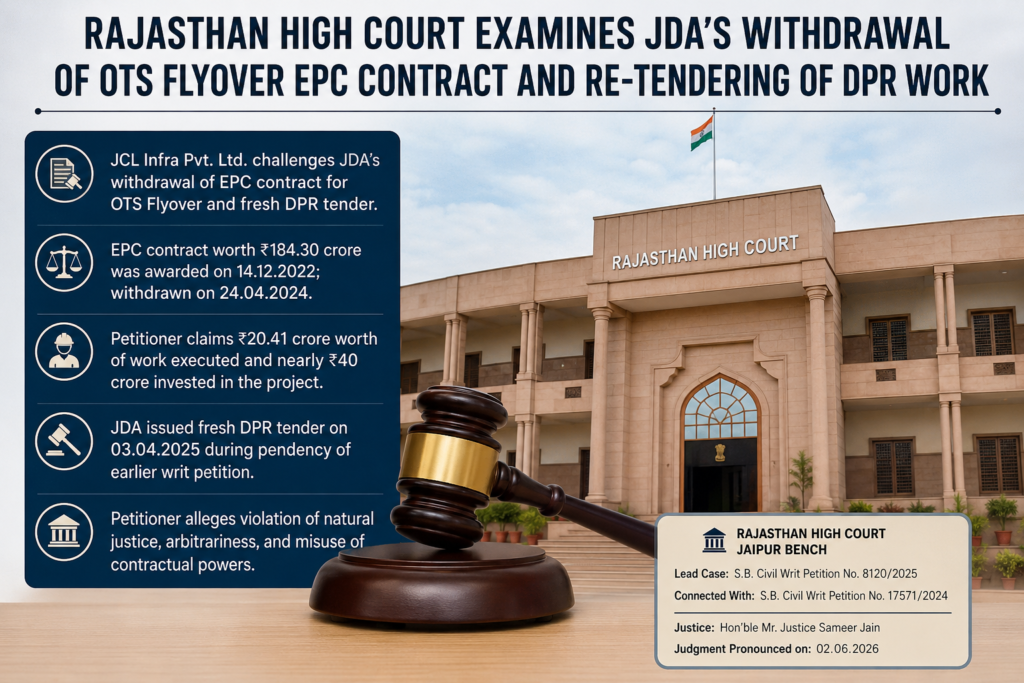
Rajasthan High Court Examines JDA’s Withdrawal of OTS Flyover EPC Contract and Re-Tendering of DPR Work The Rajasthan High Court, Jaipur Bench, in a batch of writ petitions led by JCL Infra Private Limited v. Jaipur Development Authority, examined the legality of Jaipur Development Authority’s actions relating to the OTS Flyover project at JLN Marg, Jaipur. The dispute concerns the withdrawal of an Engineering, Procurement and Construction (EPC) contract previously awarded to JCL Infra and the subsequent issuance of a fresh tender for preparation of a Detailed Project Report (DPR) for the same project. Background of the Dispute The OTS Crossing project was conceived as a traffic improvement and beautification initiative aimed at easing congestion at one of Jaipur’s busiest intersections. The project included construction of a flyover and associated infrastructure works. According to the petitioner, JDA had earlier engaged consultants for preparation of the DPR, which subsequently formed the basis for the EPC tender. Pursuant to the tender process, JCL Infra was awarded the EPC contract through a Letter of Acceptance dated 14 December 2022, followed by execution of a formal contract agreement on 27 December 2022. The contract related to traffic improvement and beautification works at OTS Crossing, JLN Marg, Jaipur, and was valued at approximately ₹184.30 crore. Petitioner’s Case JCL Infra contended that after execution of the contract, it mobilized manpower, machinery, and financial resources and commenced work in accordance with contractual requirements. The company asserted that: Multiple drawings, designs, survey reports and engineering documents were submitted to JDA during 2023. Necessary approvals and site clearances were repeatedly sought from the authority. Despite continuous correspondence, approvals required for execution of the project were allegedly not granted. Work worth approximately ₹20.41 crore had already been executed. Investments of nearly ₹40 crore had been made in the project. The petitioner further argued that repeated representations seeking approvals and release of payments did not receive appropriate responses from JDA. Extension of Time and Subsequent Withdrawal A significant aspect of the dispute relates to the extension of the project period. The petitioner pointed out that JDA extended the project completion timeline up to 30 April 2024. According to JCL Infra, this extension reflected acknowledgment of the subsisting contract and ongoing execution of work. However, shortly thereafter, JDA withdrew the awarded work through a communication dated 24 April 2024 by invoking Clause 32 of the contract. The petitioner challenged this withdrawal, alleging that: The action was arbitrary and illegal. No opportunity of hearing was provided. No adequate reasons were supplied. Clause 32 did not permit withdrawal of the entire contract in the manner adopted by JDA. Fresh DPR Tender and Challenge Before the Court During the pendency of the earlier writ proceedings challenging the withdrawal, JDA issued a fresh Notice Inviting Bid dated 3 April 2025 for consultancy services relating to preparation of a DPR for the proposed elevated road and OTS Flyover project. JCL Infra argued that re-tendering DPR consultancy work for the OTS Flyover was unjustified because: A DPR had already been prepared earlier. The EPC contract had already been awarded on the basis of that DPR. Significant work and investment had already been undertaken. The petitioner characterized the fresh tender as an attempt to restart the project despite the existence of an earlier DPR and a concluded EPC contract. Legal Grounds Raised by the Petitioner The petitioner relied upon several legal principles, including: 1. Violation of Natural Justice JCL Infra contended that withdrawal of the contract was undertaken without affording an opportunity of hearing, contrary to the principles of natural justice. 2. Arbitrary Exercise of Power It was argued that the withdrawal notice lacked sufficient reasons and was therefore arbitrary and unsustainable. 3. Promissory Estoppel and Legitimate Expectation The petitioner claimed that it had acted upon JDA’s representations and contractual commitments by mobilizing resources and investing substantial amounts. Consequently, withdrawal of the project allegedly caused severe prejudice. 4. State Obligation to Act Fairly The petitioner emphasized that JDA, being a public authority, was obligated to act fairly, transparently and reasonably even in contractual matters. Respondents’ Stand JDA opposed the petitions and raised objections regarding maintainability as well as merits. The respondents contended that: The petitions were not instituted by a duly authorized person on behalf of the company. Material facts had allegedly been suppressed. The dispute arose from contractual obligations involving disputed questions of fact. Such issues should be adjudicated through appropriate civil or commercial proceedings rather than writ jurisdiction. On merits, JDA maintained that the withdrawal of work was within the powers available under Clause 32 of the contract and that the Engineer-in-Charge possessed authority to take such action. The respondents also asserted that multiple communications and meetings had been conducted regarding delays and deficiencies in execution. Key Issues Before the High Court The proceedings raised several important legal questions: Whether JDA was justified in withdrawing the EPC contract awarded to JCL Infra. Whether the withdrawal complied with contractual provisions and principles of natural justice. Whether re-inviting bids for preparation of a DPR concerning the OTS Flyover was legally sustainable. Whether the dispute could be examined under Article 226 of the Constitution despite arising from a contractual relationship. Whether the petitioner had established arbitrariness in the actions of the public authority. Conclusion The litigation concerning the OTS Flyover project highlights the intersection of public procurement, infrastructure development, contractual obligations and administrative fairness. The dispute revolves around JCL Infra’s allegation that substantial work, investment and contractual commitments were disregarded through withdrawal of the EPC contract and subsequent re-tendering of DPR consultancy services, while JDA maintains that its actions were contractually justified and undertaken in public interest. The Rajasthan High Court examined these competing claims while considering questions of contractual interpretation, natural justice, public law principles and judicial review of governmental decisions in infrastructure projects.
 Call: 7300056080
 Email: advocatebhuvneshgoyal@gmail.com
 Office: 109, Fortune Heights, Ahinsa Circle, C-Scheme, Jaipur-302001