
Rajasthan High Court Grants Bail to 19-Year-Old Accused under Section 309(4) BNS Analysis of Dhan Singh Faujdar v. State of Rajasthan
Background of the Case
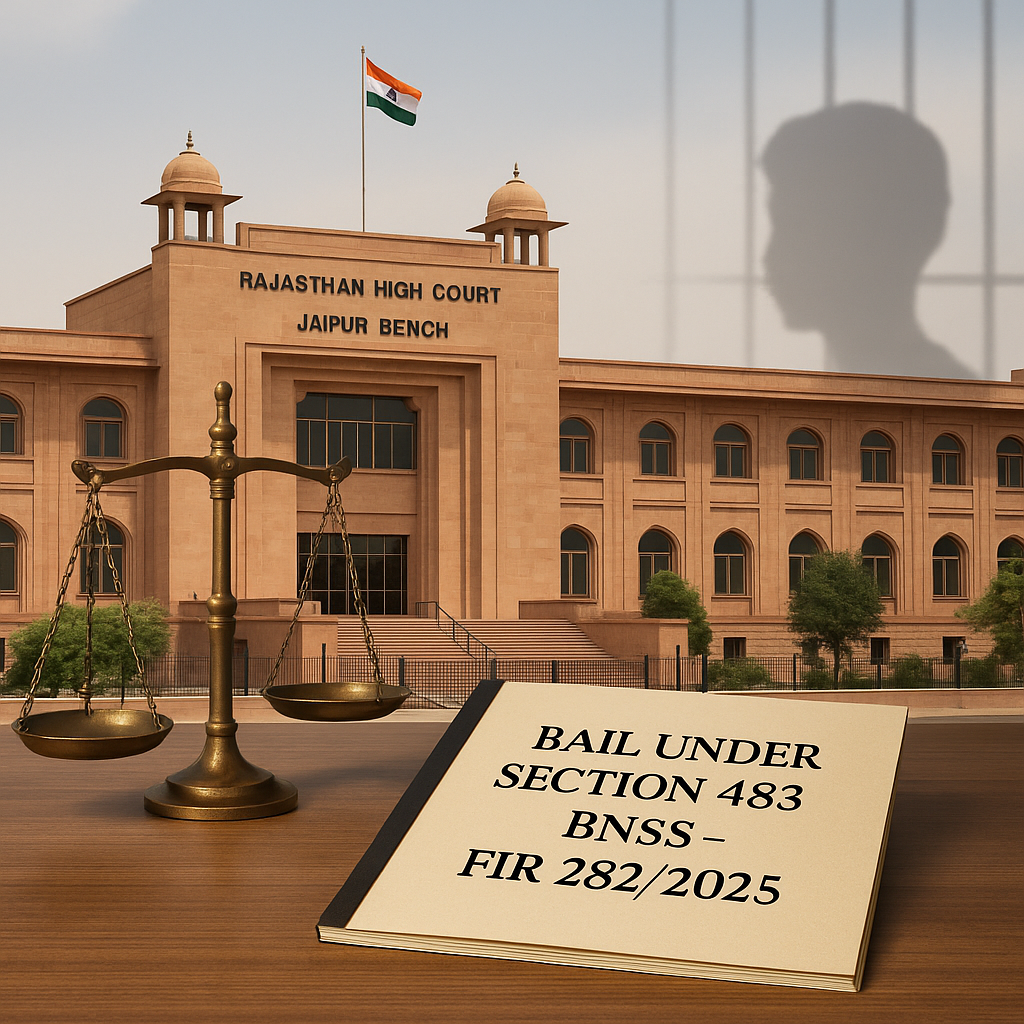
The present order has been passed by the Rajasthan High Court, Jaipur Bench, in S.B. Criminal Miscellaneous Bail Application No. 13411/2025, titled Dhan Singh Faujdar v. State of Rajasthan, decided on 01.12.2025 by Hon’ble Mr. Justice Sameer Jain.
The accused-applicant, Dhan Singh Faujdar, aged about 19 years, was arrested in connection with FIR No. 282/2025 registered at Police Station Kotwali, District Bharatpur, for offences under Section 309(4) of the Bharatiya Nyaya Sanhita (BNS). He has been in judicial custody since 15.08.2025 and is presently lodged in Central Jail, Bharatpur. The application before the High Court was filed under Section 483 of the Bharatiya Nagarik Suraksha Sanhita (BNSS) seeking regular bail.
Notably, the prosecution record also showed five criminal antecedents against the applicant, in which he had already been acquitted in four cases, with one case apparently still subsisting.
Defence Submissions
On behalf of the accused-applicant, it was argued that he is a young boy of 19 years and continued incarceration at this formative age would cause irreparable harm to his future. The defence pointed out that the co-accused in the same FIR had already been enlarged on bail by the learned trial Court, and therefore the principle of parity required that the present applicant also be given similar relief.
Counsel submitted that the applicant has been in custody since 15.08.2025, and the investigating agency has already filed the charge-sheet. Hence, the investigation is complete and his further detention is no longer necessary for the purposes of investigation. It was further emphasized that out of the five criminal antecedents, the applicant stands acquitted in four, indicating that earlier allegations did not withstand judicial scrutiny.
Another important plank of the defence was the likely delay in conclusion of trial. Considering the usual pace of criminal trials, it was argued that the proceedings are likely to take a long time and no useful purpose would be served by keeping a 19-year-old behind bars for an uncertain period when the presumption of innocence still operates in his favour.
Stand of the Prosecution
The learned Public Prosecutor opposed the bail application and vehemently resisted the plea for release. Though the order does not detail every argument of the State, the opposition indicates that the prosecution considered either the nature of the offence, the antecedents, or the gravity of allegations as sufficient to deny bail.
However, despite this opposition, the Court weighed the competing interests and applied settled principles governing grant of bail, ultimately tilting the balance in favour of personal liberty, subject to conditions.
Judicial Reasoning and Findings
After hearing both sides, the Court considered the following key factors:
First, the Court took note of the age of the accused-applicant — only 19 years. Juvenile or near-juvenile age has consistently been treated by courts as a relevant consideration while dealing with bail, as incarceration at a young age can severely impact rehabilitation and reintegration into society.
Second, the Court relied on the factor of parity. The co-accused in the same case had already been granted bail by the trial court. When multiple accused are similarly placed on facts and law, denying bail to one while granting it to others is generally seen as unjustified unless there is some distinguishing material. No such strong distinguishing factor was shown against Dhan Singh.
Third, the Court recorded that the accused-applicant has been in custody since 15.08.2025 and that the charge-sheet has been filed. Once investigation is complete and the accused is no longer required for custodial interrogation, the continued detention largely serves the purpose of securing his presence at trial, which can often be adequately ensured by appropriate conditions and sureties.
Fourth, the Court noted the criminal antecedents but simultaneously acknowledged that in four out of the five earlier cases, the accused has already been acquitted. This shows that mere pendency of previous cases or existence of past FIRs, without resulting conviction, cannot by itself be a ground to deny bail, especially when the accused is a young adult.
Lastly, keeping in view the overall facts and circumstances and the material on record, the Court concluded that further incarceration would serve no useful purpose while the trial is likely to take time. At the same time, the Court consciously refrained from making any comment on the merits or demerits of the prosecution case to ensure that the trial remains uninfluenced.
Operative Order
In light of these considerations, the High Court allowed the bail application under Section 483 BNSS. The accused-applicant, Dhan Singh Faujdar S/o Ramu Singh, was ordered to be released on bail subject to the following conditions:
He shall furnish a personal bond of ₹50,000/- along with two sureties of ₹25,000/- each to the satisfaction of the learned trial Judge. He is required to appear before the concerned Court on all dates of hearing as and when called upon to do so.
The order thus restores the applicant’s liberty but keeps sufficient safeguards in place to ensure his presence during trial.
Legal Significance of the Judgment
This order, though brief, is significant in the context of the new criminal procedure regime under the BNSS. It demonstrates that while statutory provisions have changed nomenclature and structure, the core constitutional principles governing bail remain intact:
Presumption of innocence continues to be the foundational principle. Pre-trial detention cannot be used as a form of punishment.
Bail, not jail remains the rule, especially where investigation is complete, the accused is a young person, and there is no concrete material to show that he will abscond or tamper with evidence.
Parity among co-accused is reaffirmed; once co-accused have obtained bail and stand on a similar footing, courts are inclined to extend similar benefit unless there is a clear reason to differentiate.
Long custody and delay in trial are recognised as strong grounds in favour of bail, preventing an accused from effectively undergoing a sentence even before guilt is established.
For practitioners, this judgment is a useful precedent for bail matters under the BNSS where young accused, with partial or weak antecedents, have been in custody post-charge-sheet and co-accused are already on bail.
Practical Takeaways for Bail Strategy
From an advocacy standpoint, the following aspects emerge as crucial while drafting and arguing bail applications in similar matters:
Emphasising the young age of the accused and the likely impact of prolonged incarceration on his future prospects can significantly influence the Court’s discretion.
Highlighting parity with co-accused who have already been granted bail remains a strong ground; placing the trial court’s bail orders of co-accused on record is strategically important.
Pointing out that charge-sheet has been filed, and that there is no need for further custodial interrogation, helps to demonstrate that pre-trial detention has outlived its investigative purpose.
Clarifying the status of antecedents, particularly where the applicant stands acquitted in earlier cases, can neutralise the prosecution’s argument based merely on previous FIRs.
Conclusion
The decision in Dhan Singh Faujdar v. State of Rajasthan is a clear reaffirmation that under the BNSS framework, High Courts will continue to balance societal interests with individual liberty, especially in cases involving young accused. By granting bail under Section 483 BNSS to a 19-year-old who had already spent months in custody after filing of charge-sheet, and where co-accused were already on bail, the Rajasthan High Court has sent a consistent message: the law may change in form, but the constitutional commitment to fair trial and humane treatment of undertrials remains unchanged.


 Call: 7300056080
 Email: advocatebhuvneshgoyal@gmail.com
 Office: 109, Fortune Heights, Ahinsa Circle, C-Scheme, Jaipur-302001