POCSO Case Procedure: FIR to Trial & Judgment
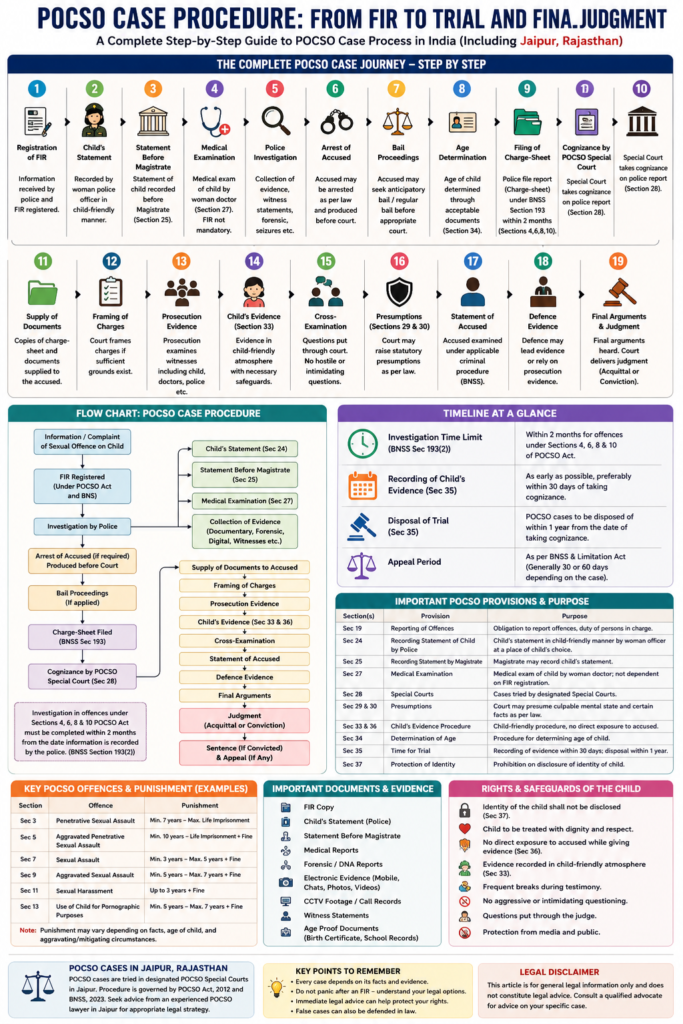
POCSO Case Procedure: FIR to Trial & Judgment A POCSO case can be significantly different from an ordinary criminal case because the Protection of Children from Sexual Offences Act, 2012 (POCSO Act) provides special procedures for reporting, investigation, recording of the child’s statement, medical examination, trial and protection of the child’s identity. If an FIR is registered under the POCSO Act, the accused and the victim’s family should understand the complete legal process—from registration of FIR and police investigation to arrest, bail, filing of the charge-sheet, framing of charges, evidence, cross-examination, final arguments and judgment. This article explains the POCSO case procedure in India, including the procedure followed before POCSO Special Courts in Jaipur, Rajasthan, and other parts of the country. Important: The procedural law applicable to criminal investigations and trials has changed with the introduction of the Bharatiya Nagarik Suraksha Sanhita, 2023 (BNSS). For cases governed by the new criminal laws, relevant BNSS provisions apply alongside the POCSO Act. What Is a POCSO Case? The POCSO Act is a special legislation enacted to protect children below the age of 18 years from sexual assault, sexual harassment and pornography-related offences. The Act covers offences including: Penetrative sexual assault under Section 3 Aggravated penetrative sexual assault under Section 5 Sexual assault under Section 7 Aggravated sexual assault under Section 9 Sexual harassment under Section 11 Use of a child for pornographic purposes under Section 13 Abetment and attempt of POCSO offences The Act also establishes a special procedure intended to make the investigation and trial more child-friendly. Sections 24 to 40 of the Act deal extensively with recording of statements, medical examination, Special Courts, presumptions, trial procedure and protection of the child during evidence. POCSO Case Procedure: Step-by-Step The broad procedure in a POCSO case can be understood as follows: Complaint/Information → FIR → Child’s Statement → Medical Examination → Investigation → Arrest/Bail → Collection of Evidence → Charge-Sheet → Cognizance → Supply of Documents → Framing of Charges → Prosecution Evidence → Cross-Examination → Statement of Accused → Defence Evidence → Final Arguments → Judgment → Appeal Stage What Happens Important Point 1. FIR Police register information regarding alleged offence POCSO + BNS sections may be invoked 2. Child’s Statement Statement recorded in child-friendly manner Section 24 POCSO 3.Magistrate Statement Statement may be recorded before Magistrate Section 25 POCSO / applicable BNSS provision 4. Medical Examination Child medically examined Section 27 POCSO 5. Investigation Police collect documentary, forensic, digital and oral evidence Investigation strategy is critical 6. Arrest Accused may be arrested depending on facts and law Arrest and FIR are separate issues 7. Bail Accused can seek appropriate bail remedy Depends on offence and stage 8. Age Determination Court determines whether victim was below 18 Extremely important in many cases 9. Charge-sheet Police submit investigation report Section 193 BNSS 10. Special Court POCSO Special Court proceeds with case Section 28 POCSO 11. Charges Court determines offences for trial Defence can challenge prosecution case where legally permissible 12. Prosecution Evidence Prosecution examines witnesses Includes child, doctors, police, forensic witnesses etc. 13. Cross-examination Defence tests prosecution evidence Subject to child-protection safeguards 14. Accused Statement Accused is examined regarding circumstances appearing against him Applicable BNSS procedure 15. Defence Evidence Defence may produce evidence Not mandatory in every case 16. Final Arguments Both sides present their case Evidence is analysed as a whole 17. Judgment Court acquits or convicts Reasons must be recorded 18. Sentence Sentence considered after conviction Depends on applicable POCSO offence 19. Appeal Aggrieved party may pursue statutory appellate remedy Forum and limitation depend on applicable law Each stage is explained below. 1. Registration of FIR in a POCSO Case A POCSO case ordinarily begins when information regarding an alleged sexual offence against a child reaches the police. Section 19 of the POCSO Act imposes obligations relating to reporting of offences. Once information discloses a cognizable offence, the police can register an FIR and commence investigation. Under the present criminal procedure framework, Section 173 of the BNSS deals with information relating to cognizable offences. The FIR may contain allegations attracting provisions of both: POCSO Act; and Bharatiya Nyaya Sanhita, 2023 (BNS). For example, depending upon the allegations and facts, a case may involve POCSO provisions along with provisions relating to rape, kidnapping, criminal intimidation or other offences under the BNS. Can a POCSO FIR be quashed? In appropriate cases, an accused may approach the High Court seeking quashing of the FIR or criminal proceedings. However, the availability of such a remedy depends heavily upon the facts, evidence, statutory provisions and the stage of the proceedings. A mere settlement between the accused and the victim’s family does not automatically terminate a POCSO prosecution. 2. Recording of the Child’s Statement One of the most important stages in a POCSO case is recording the statement of the child. Section 24 of the POCSO Act lays down special requirements for recording the child’s statement. The objective is to ensure that the child is not unnecessarily exposed to a hostile or intimidating environment. The law requires that the statement be recorded in a child-sensitive manner. The statement should, as far as practicable, be recorded: at the residence of the child or another place where the child ordinarily resides; by a woman police officer not below the rank prescribed by law; without bringing the child into contact with the accused; in a manner that does not cause unnecessary distress to the child. The law also contemplates recording through audio-video means wherever possible. 3. Statement Before the Magistrate The child’s statement may also be recorded before a Magistrate under the applicable procedural law. Under the POCSO framework, Section 25 specifically deals with recording of the statement of a child by a Magistrate. Under the current criminal procedure regime, Section 183 BNSS deals with recording of confessions and statements by a Magistrate. This statement can become an important piece of the prosecution case. However, it is important to understand that a statement recorded during investigation is not
Sexting Between Teenagers – Is It a POCSO Offence?
Sexting Between Teenagers – Is It a POCSO Offence in India? Sexting generally refers to sending, receiving or exchanging sexually explicit messages, intimate photographs, videos or other sexual content through mobile phones, WhatsApp, Instagram, Snapchat or other digital platforms. Among teenagers, sexting may sometimes occur between two people who are in a relationship and may even be mutually consensual. However, Indian law takes a particularly strict approach when a person below the age of 18 is involved. The Protection of Children from Sexual Offences Act, 2012 (POCSO Act) defines a child as a person below 18 years of age and contains specific provisions dealing with sexual harassment, sexual exploitation and pornographic material involving children. Therefore, an important question arises: Is sexting between two teenagers a POCSO offence even when both of them consent? The answer depends substantially on what was exchanged, the ages of the persons involved, the nature of the communication, whether photographs or videos were involved, and the surrounding circumstances. What Does “Sexting” Mean? Indian statutes do not specifically use the word “sexting.” The term is generally used to describe digital communication having a sexual nature. It can include: Sexually explicit text messages Sexual conversations through social media Sending intimate or nude photographs Sending sexually explicit videos Asking another person to send intimate photographs Taking or creating intimate images for another person Forwarding or sharing intimate images Threatening to circulate intimate images Sharing sexual content involving a child Sexting can therefore cover conduct ranging from sexual conversations to the creation and distribution of sexually explicit images. Government and child-protection materials recognise that sexting can involve both sexual conversations and the creation or sharing of intimate images by children. Is Sexting Between Teenagers a POCSO Offence? Not every instance of teenage communication can automatically be labelled a POCSO offence. However, certain forms of sexting can clearly fall within provisions of the POCSO Act. This distinction is important. For example, there is a significant legal difference between: Two teenagers exchanging ordinary romantic messages; Two teenagers having sexually explicit conversations; One teenager repeatedly sending sexually explicit messages to another; A teenager asking another minor to send an intimate photograph; A minor sending an intimate photograph to another minor; A person storing or forwarding sexually explicit material depicting a child; and An adult engaging in sexual communication with a minor. The applicable legal provision may differ depending upon the facts. Who Is a “Child” Under POCSO? Under Section 2(1)(d) of the POCSO Act, a child means any person below 18 years of age. This means that the law does not make a distinction between: a 10-year-old, a 15-year-old, a 17-year-old, or two teenagers who are only a few months apart in age. For purposes of the statutory definition, all persons below 18 are children. This becomes particularly important in cases involving teenage relationships. Sexting Through Sexual Messages – Can Section 11 POCSO Apply? Section 11 of the POCSO Act deals with sexual harassment of a child. Among other things, the provision covers certain conduct involving sexual words, sounds, gestures, objects and communication. It also specifically recognises following, watching or contacting a child through electronic, digital or other means in circumstances involving sexual intent. Therefore, digital communication can potentially come within the scope of Section 11. For example, depending upon the facts, conduct may raise a POCSO issue where a person: repeatedly contacts a child with sexual intent; sends sexually explicit material to a child; asks a child to display his or her body; attempts to obtain sexual photographs from a child; threatens to use a sexual depiction of a child; or entices a child for pornographic purposes. Section 12 provides punishment for sexual harassment under Section 11, which may extend to three years’ imprisonment and fine. Important point The mere fact that two teenagers exchanged messages does not, by itself, answer the legal question. The content of the messages, the intention behind the communication and the surrounding circumstances matter. What If Teenagers Exchange Nude or Intimate Photographs? This is considerably more serious. The POCSO Act specifically contains provisions dealing with the use of children for pornographic purposes. Section 13 provides that using a child in any form of media, including electronic or computer technology, for sexual gratification can constitute an offence. The provision expressly covers preparation, production, offering, transmitting, publishing, facilitating and distributing pornographic material involving a child. Consequently, the fact that a photograph was: voluntarily taken, voluntarily sent, exchanged privately, or created by the child himself or herself does not automatically remove the photograph from the legal framework concerning child sexual abuse material. The legal consequences can become particularly serious when such material is forwarded, distributed, published or stored. What About Section 15 of the POCSO Act? Section 15 deals with storage or possession of pornographic material involving a child and provides a graded punishment structure depending upon the circumstances. This is one of the most important provisions when dealing with sexting involving intimate images of minors. The Supreme Court has clarified the scope of Section 15 and the concept of possession in cases involving child sexual abuse material. The Court has explained that possession can include constructive possession where the person exercises the requisite degree of control over the material. It has also recognised the relevance of digital devices and electronic material in this context. Therefore, a teenager should not assume that deleting a photograph from a chat immediately eliminates every possible legal issue. Copies may exist: on the phone, in cloud storage, in backups, in messaging applications, on another person’s device, or elsewhere in digital form. What If Both Teenagers Consented? This is one of the most frequently misunderstood aspects of POCSO law. Consent does not automatically make sexual conduct involving a child lawful. The POCSO Act is designed to protect persons below 18 from sexual offences and pornography. The statutory framework does not create a general exception simply because two teenagers claim that their conduct was consensual. However, “consensual” does not mean that every interaction between two
Rajasthan’s Anti-Conversion Law
Rajasthan’s Anti-Conversion Law Rajasthan recently enacted a comprehensive law to prohibit what the state calls “unlawful conversions of religion.” The law—tabled and passed in 2025—creates new criminal offences, sets out administrative procedures (including mandatory declarations and district-magistrate inquiries), and prescribes harsh penalties including long prison terms and non-bailable offences. It has quickly become the subject of intense public debate and multiple court challenges. Below I explain, in plain language, what the law does, why people are worried, the constitutional arguments likely to be raised before the Supreme Court, and the practical effects it may have on ordinary people. I have kept the language simple so a lay reader can follow the legal issues without legalese. What the Rajasthan law says (short summary) The statute criminalizes conversions obtained by force, fraud, misrepresentation, undue influence, allurement, marriage or by any fraudulent means, and it also addresses “online solicitation.” It requires the person intending to convert (and sometimes the convertor) to make declarations to the District Magistrate; the DM must conduct an inquiry and invite objections before permitting a conversion to proceed. The law allows certain third parties (relatives and others) to lodge complaints, makes many offences non-bailable, and prescribes severe punishments including long terms of imprisonment. Some provisions permit seizure of property and even demolition in certain situations. Short political and social background Several Indian states have enacted similar laws in recent years; Rajasthan’s law follows a broader pattern where state governments say these statutes are needed to stop “forceful and fraudulent” conversions, often citing protection of vulnerable persons. Critics — civil-society organizations, religious minorities’ bodies and human-rights groups — argue that these laws are drafted too broadly and that they are being used to harass minority communities, NGOs and individuals in inter-faith relationships. The law quickly attracted public protests and litigation; petitions challenging it were filed and the Supreme Court has issued notices in one or more petitions. How this sits with existing Supreme Court law (the legal precedent) The landmark decision most often cited in this area is Rev. Stanislaus v. State of Madhya Pradesh (1977). In that case the Supreme Court drew a distinction between the right to “propagate” one’s religion (which Article 25 protects) and the right to convert another. The Court held that the right to propagate does not include the right to convert someone by force, fraud or allurement; accordingly, it has upheld some state laws that criminalise forcible or fraudulent conversions. But Stanislaus is old and its reasoning and scope are frequently debated today—especially about how state law may interact with basic rights like equality, personal liberty and privacy. Recent laws (including Rajasthan’s) extend much broader administrative and penal controls than earlier statutes, raising fresh constitutional questions. Main legal challenges likely to be raised in court Below are the core constitutional arguments that petitioners (and many commentators) are raising against the Rajasthan law. These are the arguments a senior lawyer would press before the Supreme Court. Vagueness and over-breadth — Terms like “allurement,” “undue influence,” “misrepresentation” and “online solicitation” are wide and not always defined precisely. Vague criminal laws can criminalise ordinary, everyday social and religious activity (for example, offering food at a community event, giving social service or expressing religious beliefs). This raises due-process concerns and may make the law void for vagueness. Violation of Article 25 (Freedom of religion) and Article 19 (Expression/association) — Even if forced conversions can be restricted, a law that chills genuine, voluntary propagation, social welfare work by religious bodies, or benign inter-religious dialogue risks infringing the right to practice and propagate religion and the freedoms to associate and speak. Petitioners will say the law goes beyond preventing force and sweeps within its net perfectly lawful activities. Equal protection (Article 14) — Many critics note that some laws or their implementation appear to treat conversions to certain religions differently from reconversion to others. If the statute operates in a way that advantages or protects conversions to one religion but not another, that unequal treatment will be challenged as arbitrary and discriminatory. Personal liberty and privacy (Article 21) — Mandatory prior declarations to the DM, inquiries into private religious choices, and criminal penalties for intimate choices (including inter-faith marriages) raise serious privacy and liberty concerns. The law’s intrusion into the autonomy of an adult to decide their religion and spouse can be presented as an unconstitutional invasion of personal liberty. Property and procedural safeguards — Provisions permitting seizure of property or demolition on allegations of conversion may be challenged as violative of property rights and lacking adequate procedural safeguards (right to fair hearing, independent adjudication, judicial oversight). Petitioners may argue these are punitive administrative steps without proper judicial process. Who may complain / criminalisation of social work — Allowing broad classes of persons to lodge FIRs and making many offences non-bailable may encourage frivolous or politically motivated complaints against NGOs, social workers, missionaries, and marginalized individuals. This practical risk is part of the constitutional critique. Practical problems in enforcement (and why critics worry) Chilling effect on social services and medical/educational work. Many religious organizations run schools, health-camps and relief work. If their assistance can be labelled “allurement,” they may stop providing services for fear of prosecution. Surveillance and intrusive inquiries. Prior notice to the District Magistrate and public objections invite public scrutiny of intimate decisions. That can humiliate converts and chill voluntary choice. Selective targeting. Law-enforcement discretion (who investigates, which complaints are registered) can lead to selective enforcement against minorities or dissenting groups. Several minority bodies and civil-liberties groups have highlighted this risk. How the Courts will probably approach these challenges Textual and doctrinal balancing. The Supreme Court will revisit Stanislaus’s core holding: while states can curb conversions obtained by coercion or fraud, any law must be narrowly tailored and accompanied by adequate safeguards. If provisions go beyond preventing force and criminalise legitimate persuasion or voluntary adult choice, the Court may strike those parts down. Scrutiny of procedural powers. Powers such as property seizure and demolition will be examined
Best DRT Advocate in Jaipur – Advocate Bhuvnesh Kumar Goyal 7300056080
Best DRT Advocate in Jaipur – Advocate Bhuvnesh Kumar Goyal 7300056080 Debt Recovery Tribunal (DRT) cases require deep knowledge of banking laws, SARFAESI Act, and recovery procedures. When banks or financial institutions initiate recovery proceedings, borrowers and guarantors need strong legal protection. Advocate Bhuvnesh Kumar Goyal is widely recognised as the best DRT advocate in Jaipur for handling complex recovery disputes with precision and strategy. With extensive litigation experience before DRT Jaipur and appellate forums, he provides reliable representation to individuals, businesses, and companies. Best DRT Advocate in Jaipur for Bank Recovery and SARFAESI Matters As the best DRT advocate in Jaipur, Advocate Bhuvnesh Kumar Goyal regularly appears in cases related to bank recovery actions under the SARFAESI Act. These matters include possession notices, auction proceedings, recovery certificates, and enforcement actions by secured creditors. His approach focuses on examining procedural lapses, illegal possession, improper valuation, and violation of RBI guidelines, ensuring effective relief for borrowers. Best DRT Advocate in Jaipur for Borrowers and Guarantors Borrowers and guarantors often face harsh recovery measures without proper opportunity to be heard. The best DRT advocate in Jaipur, Advocate Bhuvnesh Kumar Goyal, provides strong legal support to protect the rights of borrowers, guarantors, and co-applicants. He handles objections, securitisation applications, stay petitions, and appeals with a clear focus on safeguarding property, assets, and legal rights. Best DRT Advocate in Jaipur for Corporate and Business Loan Disputes Corporate loan defaults and business recovery cases require a clear understanding of financial documents and contractual obligations. Known as the best DRT advocate in Jaipur, Advocate Bhuvnesh Kumar Goyal represents companies, directors, and partners in high-value DRT cases. His litigation strategy is tailored to business realities, ensuring lawful resolution while preventing arbitrary recovery actions by banks and financial institutions. Best DRT Advocate in Jaipur for Appeals Before DRAT Unfavourable DRT orders can be challenged before the Debt Recovery Appellate Tribunal (DRAT). As the best DRT advocate in Jaipur, Advocate Bhuvnesh Kumar Goyal handles DRT appeals and DRAT matters with strong legal drafting and effective oral arguments. His experience helps clients seek interim relief, stay on recovery, and reversal of incorrect orders. Best DRT Advocate in Jaipur with Strong Courtroom Experience What makes Advocate Bhuvnesh Kumar Goyal the best DRT advocate in Jaipur is his litigation-driven approach and thorough preparation. He regularly appears before DRT, High Court, and appellate forums, ensuring seamless legal representation at every stage. Clients benefit from clear advice, honest case assessment, and focused legal action aimed at practical results. Contact Best DRT Advocate in Jaipur📞 Call: 7300056080Advocate Bhuvnesh Kumar Goyal – Trusted name for DRT, SARFAESI, and bank recovery matters in Jaipur.
Best NDPS Advocate in Jaipur – Advocate Bhuvnesh Kumar Goyal 7300056080
Best NDPS Advocate in Jaipur – Advocate Bhuvnesh Kumar Goyal | Call 7300056080 When a case is registered under the NDPS Act, the situation becomes serious from day one. The law is strict, bail is difficult, and even small procedural mistakes can change the outcome of the case. In such matters, choosing the best NDPS advocate in Jaipur is not an option, but a necessity. Advocate Bhuvnesh Kumar Goyal is widely trusted for handling NDPS cases with precision, strategy, and deep legal understanding. Best NDPS Advocate in Jaipur for Bail under NDPS Act Bail under the NDPS Act is governed by strict conditions, especially in cases involving commercial quantity. Advocate Bhuvnesh Kumar Goyal, known as the best NDPS advocate in Jaipur, focuses on legal lapses such as illegal search, non-compliance of Sections 42, 50, and 52A, and defects in seizure and sampling. His approach is strictly based on statutory provisions and binding judgments, ensuring strong bail arguments before the Special Court and the Rajasthan High Court. Best NDPS Advocate in Jaipur for False and Fabricated NDPS Cases Many NDPS cases are based on doubtful recoveries, planted contraband, or procedural shortcuts by the investigating agency. As the best NDPS advocate in Jaipur, Advocate Bhuvnesh Kumar Goyal carefully examines FIRs, seizure memos, FSL reports, and arrest procedures. His defence strategy is rooted in exposing contradictions and violations of mandatory safeguards provided under the NDPS Act. Best NDPS Advocate in Jaipur for Trial and Discharge Matters NDPS trials require deep technical knowledge and courtroom experience. From framing of charges to cross-examination of seizure witnesses and investigating officers, Advocate Bhuvnesh Kumar Goyal handles each stage with clarity and preparation. Being recognised as the best NDPS advocate in Jaipur, he focuses on breaking the prosecution’s chain of custody and questioning the credibility of recovery and possession. Best NDPS Advocate in Jaipur for Commercial Quantity Cases Cases involving commercial quantity carry severe punishment and strict bail restrictions. Advocate Bhuvnesh Kumar Goyal, regarded as the best NDPS advocate in Jaipur, adopts a judgment-based approach, relying on Supreme Court and High Court rulings to challenge conscious possession, compliance failures, and sampling defects. His practice includes handling complex commercial quantity matters before trial courts and appellate forums. Best NDPS Advocate in Jaipur for Appeals and Suspension of Sentence After conviction under the NDPS Act, timely and well-drafted appeals are crucial. Advocate Bhuvnesh Kumar Goyal, a leading best NDPS advocate in Jaipur, regularly handles criminal appeals, suspension of sentence applications, and revisions before the Rajasthan High Court. His focus remains strictly on legal grounds emerging from the trial record and statutory violations. Contact the Best NDPS Advocate in Jaipur📞 Advocate Bhuvnesh Kumar Goyal – 7300056080If you or your family member is facing an NDPS case in Jaipur, early legal intervention can make a critical difference. Choosing an experienced and focused NDPS lawyer ensures your defence is built on law, not assumptions.
Protection of Children from Sexual Offences (POCSO) Act, 2012
Protection of Children from Sexual Offences (POCSO) Act, 2012 India’s Protection of Children from Sexual Offences Act (POCSO), 2012, was supposed to be the steel frame around a fragile child. It set out to define, criminalise and make punishable every form of sexual violence against children — and at the same time to build procedures that keep a child’s dignity intact while the state seeks justice. In practice, POCSO has been both a landmark and a mirror: it exposes not only the uglier impulses of abusers but the gaps in policing, medical care, judicial capacity and social understanding. To judge its success we must look at law on the books, law in action, and the global context from which ideas and responsibilities flow. This article is a lengthy, careful excavation of POCSO — its anatomy, amendments, functioning, friction points, and how it sits amid international standards and other national laws. It draws on the Act itself, government guidelines and recent institutional practice, and situates India’s approach beside major international instruments such as the UN Convention on the Rights of the Child (and its Optional Protocols) and the Council of Europe’s Lanzarote Convention, as well as domestic statutes in the UK and the United States that crowd the same terrain. Wherever authority lets us, we anchor claims to primary sources. 1. Why a separate law for children? For decades, crimes against children were prosecuted under general provisions of the Indian Penal Code (IPC) — sections on assault, rape, obscenity, and so on. Those provisions were rarely tailored to the distinct vulnerabilities of children (physical, psychological, developmental) nor to processes that protect their identity and mental health during investigation and trial. International human rights law — notably the UN Convention on the Rights of the Child (UNCRC) and its protocols — created a moral and legal imperative for states to treat children not as small adults but as rights-holders with special protections. India’s POCSO was born in that global moment and domesticated it for Indian courts. POCSO’s aims were threefold: (a) to create specific and wide-ranging offences (including sexual harassment and child pornography); (b) to streamline procedures so that reporting, recording, medical examination and trial are child-sensitive; and (c) to ensure speedy trial through special courts. Its architecture therefore combines criminal law, child-protection procedures, and administrative rules. 2. A tour of the Act: definitions, offences and procedure Who is a “child”? POCSO defines a child as any person below 18 years of age. This bright-line definition simplifies application but also creates hard questions when age is disputed — for example, in medico-legal examinations and when consent claims surface. The Act treats the age threshold as central to the offence; an act that might be lawful between adults becomes an offence if one participant is below 18. Offences and categories The Act creates several categories of offences: Penetrative sexual assault — broadly analogous to rape but defined to capture any penetration (however slight) of the sexual organs, anus or mouth. Aggravated penetrative sexual assault — uses of weapons, multiple perpetrators, or the involvement of a person in a position of trust (teacher, doctor, guardian) carry heftier punishments. Sexual assault (non-penetrative) — includes groping, forced kissing and similar acts. Sexual harassment — encompasses acts like stalking, making sexually coloured remarks, and showing sexual content. Use of child for pornography — both production and distribution are criminalised. Punishments are severe: imprisonment terms run from several years to life imprisonment, and the 2019 amendments strengthened penalties further for specific aggravating circumstances. The law also allows for fines and compensation directed to child welfare. Procedure designed for children This is where POCSO sought real innovation: Mandatory reporting: Certain categories of professionals and any person who learns of an offence can — and, in some cases, must — report to police or a child welfare agency. Failure to report can attract penalties. Special Juvenile Police Units (SJPU) and Special Courts: The government envisaged trained police and separate trial courts to make the process less traumatic and more expedient. Recording of statement: A child’s statement is to be recorded at the child’s residence or a place of her/his choice; the law recognises the need to avoid repeated courtroom exposure. Medical examination: The Act lays down procedures to ensure a child is examined with consent, dignity, and confidentiality; in many cases, female doctors should be preferred when the victim is a female child. Child-friendly testimony: Courts are permitted to use video testimony and screens to shield a child from seeing the accused, and the courtroom language and processes are to be adapted for the child’s comprehension. Government agencies, including the National Commission for Protection of Child Rights (NCPCR), have issued operational guidelines elaborating these duties and the role of “support persons” to guide child victims through the legal maze. These guidelines also emphasize rehabilitation and tracking via dedicated portals. 3. Realities on the ground: implementation gaps and exemplars Legislation is only as strong as its implementation. On paper, POCSO’s child-centric vision is attractive; in practice, it collides with realities: Police and training Special Juvenile Police Units were envisioned as trained, sensitised wings of the force. But in many districts the SJPU is a small unit with limited training, and front-line officers often lack basic orientation about trauma-informed interviewing, confidentiality norms, or proper medical referral channels. Media and institutional reports repeatedly point to situations where police conduct insensitive cross-examinations, insist on revealing a minor’s identity to hospital staff, or fail to produce the child in court in a timely fashion — all of which re-traumatise the victim. Recent news reports show police pressure on doctors to reveal identities despite legal protections — signaling a persistent knowledge and practice gap. Medical interface Forensic and medical examination is a crucible of controversies. Clinicians must balance timely evidence collection with consent and privacy obligations. While POCSO contemplates child-sensitive exams, hospitals often lack trained pediatric forensic teams, and practices vary between urban tertiary centres and rural clinics. The Supreme Court has issued guidance on
Suspension of Sentence
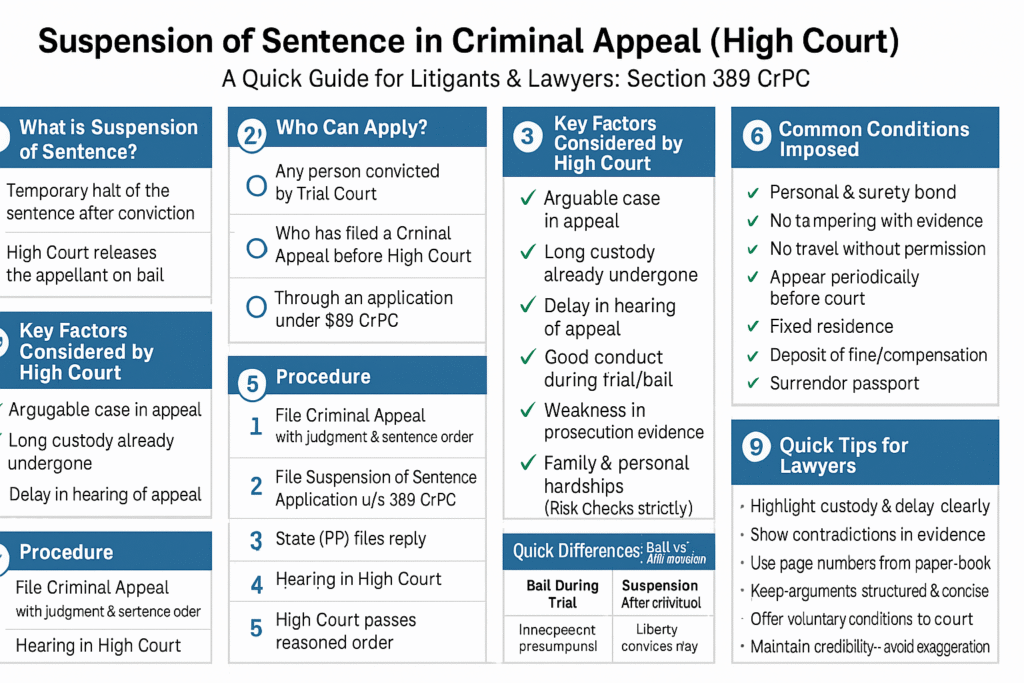
Suspension of Sentence Suspension of sentence is one of the most important reliefs sought by a convict after filing a criminal appeal before the High Court. Once a person has been convicted by the Trial Court, the sentence becomes executable immediately unless it is stayed or suspended. The appellate court—usually the High Court—has the power under the Code of Criminal Procedure, 1973 (CrPC) to suspend the sentence and release the appellant on bail pending final hearing of the appeal. For an appellant, this relief often determines whether he remains behind bars during the entire duration of the appeal (which can take several years) or whether he continues his life and livelihood until the final decision. For lawyers, this is a crucial stage requiring strategic preparation, correct legal grounds, and precise drafting. This article explains the law, procedure, tests applied by courts, important judgments, common mistakes, drafting tips, and practical advocacy points on suspension of sentence in criminal appeals before the High Court. What is Suspension of Sentence? Suspension of sentence means that the High Court temporarily keeps the execution of the sentence “on hold” while the criminal appeal is pending. It does not erase or cancel the conviction; it merely postpones the punishment. When sentence is suspended, the Court usually releases the convict on bail with specific conditions. This relief is governed by Section 389 CrPC. Statutory Provision: Section 389 CrPC Section 389 CrPC empowers the appellate court to: Suspend the execution of sentence pending appeal Release the appellant on bail Impose conditions, including deposit of fine or bond While suspending a sentence imposed by a Special Court or Court of Session, the High Court must give opportunity to the Public Prosecutor to show cause (Proviso to Section 389(1)). Key Point:The appellate court must record reasons in writing for granting or refusing suspension. Difference Between Bail and Suspension of Sentence Aspect Bail (During Trial) Suspension of Sentence (Post-Conviction) Stage Before conviction After conviction Presumption Accused is presumed innocent Conviction by Trial Court stands Test Prima facie innocence, investigation, custody Merits of conviction, arguable grounds, long incarceration Relief Release from custody Stoppage of sentence + release on bail This distinction is vital because after conviction, the burden is heavier on the appellant. When Can High Court Grant Suspension of Sentence? High Courts consider several factors. Over time, judicial principles have evolved from case law. The major grounds are: 1. Prima Facie Arguable Case The appeal must raise points that require deeper consideration—legal errors, unreliable evidence, improper appreciation, non-examination of key witnesses, contradictions, etc. The High Court is not expected to re-evaluate all evidence but must identify whether the case is arguable. 2. Long Delay in Hearing Criminal Appeals Indian High Courts are burdened with large pendency. Many appeals take 5–10 years to be decided. The Supreme Court has repeatedly held that long delay in disposal is an independent ground for suspension of sentence. Examples: Kashmira Singh v. State of Punjab Babu Singh v. State of UP Akhtari Bi (2001) 3. Conduct of the Appellant Courts consider: Presence during trial No misuse of liberty earlier No attempt to abscond No criminal antecedents (or minimal) Compliance with previous bail conditions 4. Nature of Crime & Gravity of Offence While gravity is relevant, it is not the sole ground to reject suspension. Even in serious offences—murder (302 IPC), POCSO, NDPS—High Courts regularly suspend sentence if conditions are satisfied. 5. Length of Sentence Short sentences (2–5 years) are usually suspended if the appeal cannot be heard expeditiously. 6. Delay in Lodging FIR, Contradictions, Weak Motive If the conviction appears doubtful at first glance, courts are more inclined to suspend. When Courts Usually Refuse Suspension High Courts often deny suspension when: Evidence against the appellant is strong and overwhelming The appellant has misused bail earlier, absconded, or threatened witnesses The appellant is a repeat offender The offence is of a heinous nature with societal impact There is risk of influencing witnesses or compromising evidence The appeal is likely to be heard soon (rare) Procedure for Filing Suspension of Sentence in High Court 1. Filing the Criminal Appeal Suspension application must accompany a properly filed appeal with: Certified copy of judgment & sentence order Grounds of appeal Vakalatnama Affidavit Index, list of dates, etc. 2. Filing a Separate Application Under Section 389 CrPC The application should: Narrate background of trial Point out legal errors Identify arguable issues Highlight custody period Mention conduct of appellant Annex medical records if required Provide details of family hardships, dependents 3. State’s Reply The Public Prosecutor files a reply opposing suspension. 4. Hearing Before the High Court The Court hears: Appellant’s counsel (often senior advocates) Public Prosecutor Sometimes complainant’s counsel (in victim-centric offences) 5. Order of the Court The Court passes a reasoned order: Allowing suspension & bailor Rejecting the application Conditions Usually Imposed by High Court When suspension of sentence is granted, the High Court may impose: Personal bond and surety bond Marking attendance in court/police station periodically No travel outside jurisdiction without permission No tampering with evidence or contacting witnesses Deposit of fine/compensation Stay at a fixed address Surrender passport In some High Courts, compliance reports are mandatory every 3–6 months. Important Supreme Court Judgments 1. Kashmira Singh v. State of Punjab (1977) Long delay in hearing the appeal is a valid ground for suspending sentence. 2. Babu Singh v. State of UP (1978) Personal liberty should not be sacrificed simply because an appeal is pending. 3. Akhtari Bi v. State of MP (2001) High Courts must hear criminal appeals expeditiously; otherwise suspension should be considered. 4. Atul Tripathi v. State of UP (2014) The Public Prosecutor must be given a clear opportunity to oppose suspension. 5. Preet Pal Singh v. State of UP (2020) Detailed reasoning is mandatory; suspension cannot be granted mechanically. 6. State of Haryana v. Hasmat (2004) If earlier suspension is challenged, the appellate court must reconsider the evidence. Special Situations 1. Suspension in Life Imprisonment Cases Courts scrutinise more strictly but still grant if:
 Call: 7300056080
 Email: advocatebhuvneshgoyal@gmail.com
 Office: 109, Fortune Heights, Ahinsa Circle, C-Scheme, Jaipur-302001