Rajasthan High Court Upholds Acquittal in Murder Case Due to Contradictory Circumstantial Evidence and Unexplained FIR Delay
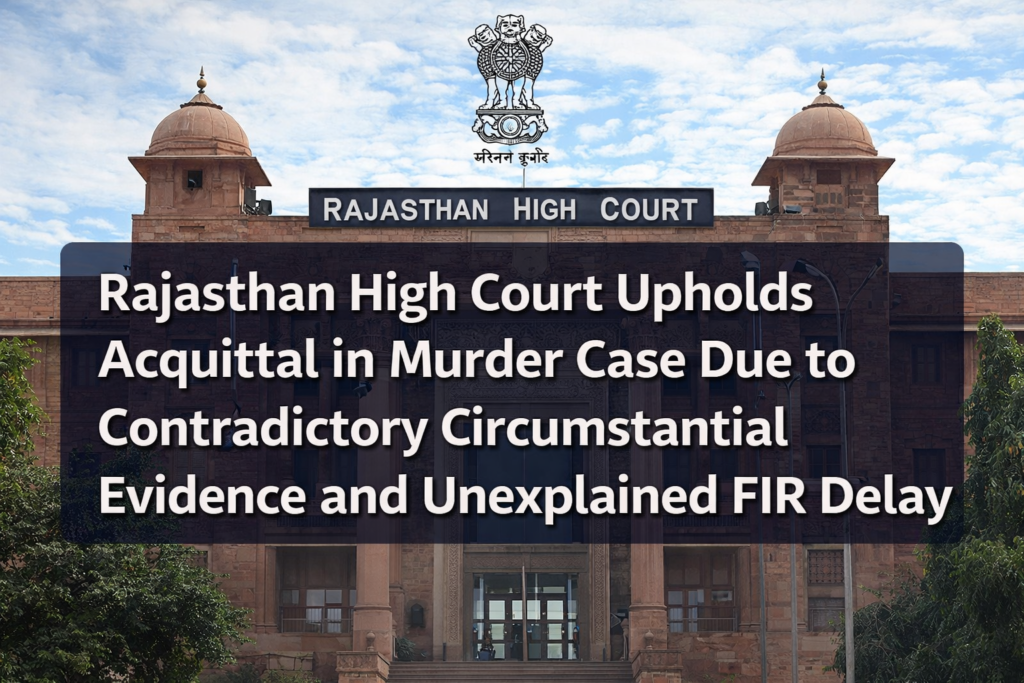
Rajasthan High Court Upholds Acquittal in Murder Case Due to Contradictory Circumstantial Evidence and Unexplained FIR Delay State of Rajasthan v. Sampat & Anr., D.B. Criminal Appeal No. 363/2002, decided on 25 February 2026 (Raj HC, Jaipur Bench), reported in 2026:RJ-JP:8788-DB, per Mahendar Kumar Goyal & Sameer Jain, JJ. (Connected with: Kalyan Ram v. Sampat Singh & Anr., D.B. Criminal Revision Petition No. 674/2001) The Rajasthan High Court, Jaipur Bench, in D.B. Criminal Appeal No. 363/2002 and connected Criminal Revision Petition No. 674/2001, delivered its judgment on 25.02.2026, dismissing both the appeal filed by the State and the revision petition filed by the complainant. The case arose from Sessions Case No. 23/1999 decided by the Additional District and Sessions Judge, Kishangarh, District Ajmer, wherein the accused persons were acquitted of the charge under Section 302 read with Section 34 IPC. The prosecution case was based on a written report dated 05.03.1999 submitted by Kalyan Ram, on the basis of which FIR No. 31/1999 was registered at Police Station Rupangarh, District Ajmer, for offences under Sections 302 and 34 IPC. It was alleged that the accused had committed the murder of Rupa Ram. After investigation, a charge-sheet was filed and charges were framed. However, after trial, the learned trial court acquitted the accused, leading to the present appeal and revision before the High Court. Before the High Court, the State and the complainant argued that the trial court had failed to properly appreciate the circumstantial evidence and that the chain of circumstances clearly established the guilt of the accused. It was submitted that the postmortem report showed an ante-mortem head injury and that a lathi was recovered on the disclosure statement of one of the accused. It was also contended that the delay in lodging the FIR was not fatal to the prosecution case. On the other hand, the counsel for the accused supported the acquittal and argued that the prosecution evidence was contradictory and unreliable. The High Court carefully examined the evidence on record and noted that the case was entirely based on circumstantial evidence. It found material contradictions in the statements of prosecution witnesses, particularly regarding what the deceased allegedly told them about the incident and who was responsible. The Court also observed that although the family members claimed to have known about the incident on the same night, the FIR was lodged after a delay of two days by a person who was neither a close family member nor a resident of the same village. No satisfactory explanation for this delay was provided. Further, the medical evidence did not fully support the prosecution version, as only a swelling on the skull was found and there were inconsistencies regarding the alleged dragging of the deceased. Importantly, the medical evidence suggested the possibility that the deceased might have suffered the fatal injury due to a fall, especially as there was evidence indicating consumption of alcohol. The Court held that the prosecution failed to establish beyond reasonable doubt that the fatal injury was caused by the accused. In view of these findings, the High Court concluded that the trial court’s judgment of acquittal did not suffer from any perversity, illegality, or infirmity warranting interference in appellate or revisional jurisdiction. Accordingly, both the criminal appeal and the revision petition were dismissed, and the acquittal of the accused was upheld. By Bhuvnesh Kumar GoyalAdvocate in Jaipur High Court
Rajasthan HC Rejects Sentence Suspension in POCSO Appeal Case
Rajasthan HC Rejects Sentence Suspension in POCSO Appeal Case Date of Order: 13.02.2026 The Rajasthan High Court, Jaipur Bench, recently dealt with a significant suspension of sentence application filed by an accused convicted under the Protection of Children from Sexual Offences (POCSO) Act. The case arose from D.B. Criminal Misc. Suspension of Sentence Application No. 2047/2024, filed along with a criminal appeal by the accused Vishnu @ Vikram, who had been sentenced to life imprisonment by the Special Court, POCSO Act, Dausa. The conviction was primarily under Sections 5(l)(m)/6 of the POCSO Act, along with alternative provisions of the Indian Penal Code, for serious allegations involving a minor victim. The applicant approached the High Court seeking suspension of sentence during the pendency of the appeal. The defence argued that the trial court had wrongly treated the victim as being below eleven years of age without sufficient evidence, and further contended that the allegations of rape were not medically corroborated. It was also submitted that there existed prior enmity between the parties, which allegedly resulted in false implication. On these grounds, the counsel requested the Court to grant relief and suspend the sentence until the appeal was decided. The State strongly opposed the plea, emphasizing the seriousness of the offence and the material evidence available on record. Upon hearing both sides, the Division Bench carefully examined the trial court judgment dated 20.03.2024. The Court noted that the victim’s age had been determined based on the birth certificate (Exhibit P-16), which showed that she was below eleven years at the time of the offence. Further, the victim’s testimony as PW-2 contained specific allegations of repeated sexual assault. Importantly, forensic evidence played a crucial role, as the DNA profile obtained from semen found on the victim’s clothing matched with the DNA sample of the accused, strengthening the prosecution’s case. Considering the gravity of the accusations, the age of the victim, and the supporting forensic material, the High Court held that this was not a fit case for granting suspension of sentence. The Bench observed that the nature of evidence and seriousness of the offence weighed against the applicant. Consequently, the application for suspension of sentence was dismissed, and the accused was directed to continue serving the sentence awarded by the trial court. This order highlights the cautious approach adopted by courts in cases involving offences against children, especially where strong testimonial and scientific evidence is available. It reiterates that suspension of sentence in serious POCSO convictions is not granted as a matter of routine and depends heavily on the strength of the prosecution’s evidence and the overall circumstances of the case.
Claim of Maintenance by a Divorced Wife
Claim of maintenance by a divorced wife A divorced wife has a statutory right to claim maintenance under Section 125 of the Code of Criminal Procedure, 1973. Every divorced wife, if otherwise eligible and unable to maintain herself, is entitled to the benefit of maintenance allowance. Divorce by itself does not extinguish the right of maintenance, and the obligation of the husband continues unless specifically discharged in accordance with law. Where the husband fails to prove that he was actually paying maintenance to the divorced wife, and merely contends that she forfeited her right due to divorce or an earlier consent decree, the essential condition of “neglect or refusal to maintain” stands satisfied. In such circumstances, a divorced wife is not required to plead or prove that she was not living separately by mutual consent. This principle has been clearly laid down by the Supreme Court in Bai Tahira v. Ali Hussain Fissalli (1979 Cr LJ 151 SC) and reaffirmed by the Kerala High Court in Kamalakshi v. Sankaran (AIR 1979 Ker 116). Under Section 127(3)(b) of the CrPC, a husband can seek absolution from his obligation under Section 125 towards a divorced wife only on proof that he has paid a sum in accordance with customary or personal law, and that such sum is reasonably sufficient to substitute the maintenance allowance. Mere assertion of divorce or settlement is not enough. This legal position was authoritatively settled in Bai Tahira v. Ali Hussain Fissalli (1979 Cr LJ 151 SC) and followed in Kamalakshi v. Sankaran (AIR 1979 Ker 116). The right of a divorced wife to receive maintenance flows directly from her status as a divorced wife. This right does not depend upon any further condition once divorce is established and inability to maintain herself is shown, as held in M. Nanu v. Vasantha (1986 Cr LJ 652). After divorce, the husband cannot insist that the wife should live with him, and consequently, the divorced wife is under no obligation to prove sufficient cause for living separately. This principle has been upheld in Velukutti v. Prasanna Kumar (1985 Cr LJ 1558 Ker) and Hari Singh v. Gulab Devi II (1989) DMC 439 (Raj). Even where the marriage has been dissolved by mutual consent, the divorced wife, if unable to maintain herself, is entitled to claim maintenance until she remarries. This position was clearly recognized in Sadasivam Pillai v. Vijaya Lakshmi (1989 Cr LJ 765). It is now a well-settled proposition of law that even where there is a valid decree of divorce, the wife remains entitled to claim maintenance under Section 125 of the CrPC. A decree of divorce cannot be used as a ground to deny maintenance, as held in Chandrakant v. Sulochana (1997 Cr LJ 520 Bom). Further, even when a decree of divorce is passed against the wife on the ground of desertion, she is not barred from claiming maintenance against her former husband from the date of the decree. This legal position has been affirmed in Jashelal v. Pushpabati (1998 Cr LJ 4740) and Harish v. Kabita Bai (2007 Cr LJ (NOC) 724 MP). Similarly, where a decree for restitution of conjugal rights had been passed prior to divorce, such decree loses all relevance once the marriage stands dissolved. After divorce, the earlier decree for restitution of conjugal rights ceases to have any legal significance, and the divorced wife cannot be denied maintenance under Section 125 CrPC. This principle was upheld in Koli Gomiben Shyamji v. Koli Laxman Premji (1998 Cr LJ 429 Guj). The Supreme Court has categorically held that a woman, after divorce, is entitled to claim maintenance from her former husband if she is unable to maintain herself and so long as she does not remarry. The ex-husband continues to remain under a statutory duty and legal obligation to provide maintenance to his divorced wife. This authoritative declaration of law is found in Rohtash Singh v. Ramendri (AIR 2000 SC 952). The fact that at the time of an initial compromise the wife did not claim maintenance, or that she did not seek maintenance at the disposal of the matrimonial suit, does not bar her from claiming maintenance at a subsequent stage. Any agreement or understanding whereby a wife relinquishes her right to future maintenance has no legal sanction, being opposed to public policy. This position has been reiterated in Bishnupriya Bhuniya v. Jhumi Banik (AIR 2007 NOC 657 Gau). By Advocate Bhuvnesh Kumar GoyalAdvocate in Jaipur High Court
Alimony in Hindu Marriage Act & Section 141 BNSS Maintenance
Alimony under the Hindu Marriage Act, 1955 and Maintenance under Section 125 CrPC (Now Section 141 BNSS) Even where alimony pendente lite is granted by the civil court in matrimonial proceeding under s. 24 of the Hindu Marriage Act in favour of the wife alone, the Magistrate under s. 125, CrPC/141 BNSS can grant higher maintenance for wife and children (Ramesh Chandra v Veena Kaushal 1979 Cr LJ 3 (SC)). However, the quantum of maintenance awarded under s. 125, CrPC /141 BNSS is adjustable with the award of alimony pendente lite granted by the Matrimonial Court (Sudip Chaudhary v Radha Chowdhury 1999 Cr LJ 466 (SC). When the plea of adjustment was not raised then the maintenance ordered under s. 125, CrPC/141 BNSS and alimony pendente lite ordered under s. 24 of the Hindu Marriage Act are payable to the wife and both the orders are required to be complied with till the final decision is rendered by the civil court. After the civil court passes the final order of alimony, the husband can apply for cancellation or variation of the order passed under s. 125, CrPC/141 BNSS (T.Rajinder Singh v Maya Devi 1996 Cr LJ 2384 (AP). Only because a proceeding under the Hindu Marriage Act 1955 is pending, an application under s. 125, CrPC/141 BNSS cannot be dismissed summarily (Balan v Pankojakhy 1992 Ker LJ 778). Even refusal of granting pendente lite maintenance by the civil court is not binding on the criminal court and the Magistrate can grant maintenance under s. 125, CrPC/141 BNSS in spite of such refusal (Ashok Nath Singh v Upasama Panwar 1994 Cr LJ 998 (H.P). In case of dismissal of husband’s petition under any one of the ss. 9 to 14 of the Hindu Marriage Act 1955, alimony under the Hindu Marriage Act cannot be granted. But the wife can maintain a petition under s. 125, CrPC (Now 141 BNSS) – Chand Dhawan v Jawaharlal Dhawan (1993)3 SCC 406; 1993 Cr LJ 2930 Petition for nullity of marriage pending Even if a petition for nullity of marriage is pending under the Hindu Marriage Act 1955, this will be no ground for refusal of maintenance to the wife under s. 125, CrPC, but in such petition for nullity of marriage, no interim direction has been given Manoj v M. Sindhi 2007 Cr LJ (NOC) 2 (Ker). Civil Court’s decree is binding on Criminal Court The question arose that if the husband obtained a decree for divorce on the ground of desertion by the wife, the petition under s. 125, CrPC cannot be dismissed summarily. The Magistrate has to scrutinize the judgment of the civil court to ascertain as to whether there was really any finding recorded by the civil court or not that the wife was guilty of desertion. However, the civil court decree is binding on the criminal court (Jasholal Agarwal v Pushupati 1994 Cr LJ 185 (Ori). Decree for restitution of conjugal rights However, despite the decree for restitution of conjugal rights passed against the wife, the wife may file an application under s. 125, CrPC unless it is proved that the person, in whose favour the decree was passed, was willing to discharge the obligation as a husband and has not secured the decree in order to frustrate the order of maintenance under s. 125, CrPC (K. NArayan Rao v Bhagyalakshmi 1984 Cr LJ 276 (Kant); Mr Shakal v Shahina Parveen (1987)1 Crima 115 (Del). When, in spite of the decree for restitution of conjugal rights, the wife refused to stay with the husband and the husband obtained a decree for divorce on the ground of desertion, the wife is not entitled to apply for maintenance under s. 125, CrPC (In the matter of Rabindra Nath Ray 1995 Cr LJ 1187 (Cal.) By Bhuvnesh Kumar GoyalAdvocate in Jaipur High Court
Corruption Conviction Quashed as Jaipur High Court Finds No Proof of Bribe Demand or Recovery
Corruption Conviction Quashed as Jaipur High Court Finds No Proof of Bribe Demand or Recovery In a detailed and reasoned judgment, the Rajasthan High Court at Jaipur, while deciding S.B. Criminal Appeal No. 1498/2023, examined the legality of the conviction recorded by the Special Judge, Prevention of Corruption Act Cases, Jaipur Metropolitan-II, against three officials of the Railway Protection Force. The appeal arose out of a judgment dated 29.05.2023 whereby the appellants were convicted under Sections 7 and 13(1)(d) read with Section 13(2) of the Prevention of Corruption Act, 1988, along with Section 120-B of the Indian Penal Code, and sentenced to one year’s rigorous imprisonment with fine. The prosecution case was founded on allegations that the appellants demanded and accepted a bribe of ₹5,000 for deleting the complainant’s name from a criminal case registered under the Railways Act. According to the complaint, an initial amount of ₹2,000 was allegedly paid, and a trap was later laid for the remaining ₹3,000, during which one of the appellants was claimed to have been caught red-handed. The High Court undertook a meticulous reappraisal of the entire oral and documentary evidence, including the testimonies of prosecution witnesses, trap proceedings, forensic reports, and sanction orders. The Court reiterated the settled legal position that, for an offence under the Prevention of Corruption Act, the prosecution must prove beyond reasonable doubt the three essential ingredients, namely a clear and specific demand of illegal gratification, acceptance or recovery of the bribe amount, and pendency of work with the accused. On an exhaustive scrutiny of the record, the Court found that the prosecution had failed to establish these foundational requirements. The alleged demand on the initial date was unsupported by any independent evidence, was not corroborated by contemporaneous recordings, and was contradicted by official duty records showing that one of the appellants was not even present at the place of occurrence. With regard to the trap proceedings, the Court noted that the currency notes were not recovered from the conscious possession of the accused and were instead found scattered on the floor. The phenolphthalein test did not yield the expected result, and several prosecution witnesses themselves admitted that the accused had not accepted the money. The presence of independent witnesses, including the Railway Magistrate, at the spot was acknowledged, yet none were examined by the prosecution, which further weakened the case. The High Court also examined the voice recordings and their transcriptions relied upon by the prosecution and found that they did not disclose any explicit or unequivocal demand for bribe. On the contrary, the conversations reflected vague and ambiguous exchanges, insufficient in law to constitute a demand. The Court emphasised that demand of illegal gratification is sine qua non for attracting the offences under the Act and cannot be inferred from conjectures or incomplete conversations. Serious infirmities were also found in the grant of prosecution sanction. The sanction orders were found to be stereotyped, mechanically issued, and lacking any indication of proper application of mind to the distinct role attributed to each accused. The evidence showed that the alleged work of the complainant was not pending with the appellants at the relevant time, as the file had already been forwarded for approval prior to the trap. In view of these cumulative deficiencies, the High Court concluded that the findings recorded by the trial court were unsustainable and based on misappreciation of evidence. Holding that the prosecution had failed to prove the charges beyond reasonable doubt, the Court allowed the criminal appeal, set aside the judgment of conviction and order of sentence dated 29.05.2023, and acquitted all the appellants of the offences alleged against them
Age Determination in POCSO Matters | Law, Procedure & Case Laws Explained

Age Determination in POCSO Matters | Law, Procedure & Case Laws Explained Age determination is the foundation of every case under the Protection of Children from Sexual Offences Act, 2012 (POCSO Act). The moment a complaint is registered alleging a sexual offence against a “child”, the entire machinery of the POCSO Act comes into motion. However, whether the Act applies at all depends on one single fact — the age of the prosecutrix on the date of the alleged incident. In many cases before trial courts and High Courts, it has been seen that disputes regarding age are not merely technical issues. They often decide whether the accused faces stringent punishment under a special law or whether the case falls back into the domain of the Indian Penal Code. Courts across India, including the Rajasthan High Court, have repeatedly held that age determination in POCSO matters must be done with extreme care, strict adherence to law, and proper appreciation of evidence. This article explains the legal principles, procedure, evidentiary value, and common disputes involved in age determination under POCSO, in a clear and practical manner. Why Age Determination Is Central to POCSO Cases Under Section 2(1)(d) of the POCSO Act, a “child” means any person below the age of 18 years. If the prosecutrix is below 18 on the date of the alleged offence, consent becomes legally irrelevant, and strict liability provisions apply. Even a consensual relationship can attract harsh punishment. On the other hand, if the prosecutrix is found to be 18 years or above, the entire prosecution under POCSO collapses. The case may then survive, if at all, only under the IPC, subject to proof of force, coercion, or other ingredients. Because of these consequences, age determination is not a formality but a substantive judicial exercise. Legal Framework Governing Age Determination in POCSO Matters The POCSO Act itself does not prescribe a detailed mechanism for age determination. Therefore, courts rely upon: • Section 94 of the Juvenile Justice (Care and Protection of Children) Act, 2015• Rules framed under the JJ Act• Settled judicial precedents of the Supreme Court and High Courts Section 94 of the JJ Act lays down a clear hierarchy of documents for age determination, which courts have consistently applied to POCSO cases as well. The Hierarchy of Evidence for Age Determination The law is settled that not all age-related documents carry equal weight. Courts must follow a strict order of preference. First Preference: School Records The most reliable document for age determination is the date of birth certificate from the school first attended, or the matriculation certificate issued by a recognised board. Courts have held that school records prepared at the time of admission, long before the dispute arose, carry high evidentiary value. However, the prosecution must prove: • The school is recognised• The entry was made in the ordinary course of business• The record is supported by oral evidence of school authorities If the school record appears manipulated, obtained later, or unsupported by admission registers, courts are cautious in relying upon it. Second Preference: Birth Certificate from Local Authority If school records are unavailable, the next best evidence is a birth certificate issued by a municipal corporation, panchayat, or registrar of births and deaths. Such certificates are considered reliable if they are contemporaneous and issued on the basis of timely registration. Late registrations without proper explanation often invite judicial suspicion. Third Preference: Medical Age Determination (Ossification Test) Only when documentary evidence is unavailable or unreliable does the court resort to medical age determination. Medical opinion, including ossification tests and radiological examination, is not conclusive. It provides an approximate age range, usually with a margin of error of two years on either side. Courts consistently hold that medical opinion cannot override reliable documentary evidence, but it becomes relevant where documents are missing, doubtful, or contradictory. Role of Medical Examination and Its Limitations In many POCSO cases, medical boards opine that the prosecutrix is “between 17 to 19 years” or “about 18 years”. Such opinions are inherently imprecise. The Supreme Court has clearly stated that when medical opinion gives a range, the benefit of doubt must go to the accused, particularly in criminal trials where liberty is at stake. Therefore, where medical age determination places the prosecutrix close to 18 years, courts often extend the margin in favour of the accused unless documentary proof conclusively establishes minority. Common Disputes in Age Determination Cases In practical litigation, age determination disputes often arise due to: • Contradictory school records• Multiple dates of birth in Aadhaar, school, and municipal records• Admission in school at a later age without proper documentation• Birth registration done years after birth• Family disputes influencing age declaration• Romantic relationships later converted into criminal cases Courts are mindful of these realities and increasingly scrutinise age-related evidence with caution. Aadhaar Card and Age Proof: Not Conclusive A common misconception is that an Aadhaar card conclusively proves age. Courts have clarified that Aadhaar is not a primary document for age determination under criminal law. Aadhaar data is often self-declared or based on secondary documents. Therefore, while it can be a supporting piece of evidence, it cannot override school or birth records prepared contemporaneously. Date of Incident Is the Deciding Factor Another settled principle is that age must be determined as on the date of the alleged incident, not the date of FIR, medical examination, or statement under Section 164 CrPC. Even a difference of a few months can be decisive. Courts have repeatedly emphasised that prosecution must establish minority on the precise date of occurrence. Burden of Proof in Age Determination In POCSO matters, the initial burden lies on the prosecution to prove that the prosecutrix was below 18 years. Once the prosecution produces prima facie evidence, the defence has the right to challenge its authenticity, credibility, and legality through cross-examination and contrary material. Age determination is ultimately a question of fact, to be decided on evidence, not assumptions or emotional considerations. Judicial Approach: Substance Over Labels
Bail in India: Meaning, Types, Legal Process, and Important Court Principles
Bail in India: Meaning, Types, Legal Process, and Important Court Principles Bail is one of the most important protections available to a person who is accused of a crime in India. The idea of bail is closely linked with personal liberty, which is guaranteed under Article 21 of the Constitution of India. The basic principle behind bail is that an accused person should not be kept in jail unnecessarily while the case is still pending, especially when guilt has not yet been proven. In Indian criminal law, bail acts as a balance between the rights of the individual and the interests of society. In practical terms, bail means the temporary release of an accused person from custody, on the condition that he or she will appear before the court whenever required and will not misuse the liberty granted. Courts have repeatedly held that “bail is the rule and jail is the exception”, particularly in cases where the offence is not serious, the investigation is complete, or the trial is likely to take a long time. What Is Bail Under Indian Law? The law relating to bail is mainly governed by the Code of Criminal Procedure, 1973 (CrPC), and now by the Bharatiya Nagarik Suraksha Sanhita (BNSS). Bail provisions depend largely on whether the offence alleged against the accused is bailable or non-bailable. In bailable offences, the accused has a legal right to be released on bail. In such cases, the police or the court cannot refuse bail if the accused is ready to furnish the required bond. In non-bailable offences, bail is not a matter of right. It is granted at the discretion of the court after considering various factors such as the nature of the offence, the severity of punishment, the possibility of the accused absconding, and the likelihood of influencing witnesses. The purpose of bail is not to punish the accused. Punishment can only come after conviction. Bail ensures that the accused remains available for trial while continuing normal life outside jail, subject to conditions imposed by the court. Types of Bail in India Indian courts generally deal with three common forms of bail: regular bail, anticipatory bail, and interim bail. Regular bail is granted to a person who has already been arrested and is in police or judicial custody. An application for regular bail is usually filed before the Magistrate or the Sessions Court, depending on the seriousness of the offence. In serious matters, such as those involving offences punishable with life imprisonment or death, the Sessions Court or High Court has jurisdiction. Anticipatory bail is a pre-arrest protection. It is sought when a person has a reasonable apprehension that he or she may be arrested in a non-bailable offence. Anticipatory bail is filed under Section 438 of CrPC (now BNSS). This remedy is especially important in cases where false or motivated FIRs are lodged. Courts in Rajasthan, including the Jaipur Bench of the Rajasthan High Court, regularly deal with anticipatory bail applications, particularly in matrimonial disputes, business conflicts, and political cases. Interim bail is temporary bail granted for a short duration, usually during the pendency of a regular or anticipatory bail application. It protects the accused from arrest or continued custody until the court finally decides the bail plea. Factors Considered by Courts While Granting Bail While deciding bail applications, courts do not conduct a full trial. However, they examine certain important aspects. The nature and gravity of the accusation play a crucial role. Serious offences such as murder, rape, terrorism, or offences under special laws like NDPS Act attract stricter scrutiny. Courts also consider whether the accused has any criminal antecedents, whether there is a chance of the accused fleeing from justice, and whether the accused may influence witnesses or tamper with evidence. The stage of investigation is also important. Once the investigation is complete and the charge-sheet is filed, courts are generally more liberal in granting bail. Another significant factor is the length of custody. If an accused has already spent a considerable time in jail and the trial is likely to take years, courts often grant bail to prevent undue hardship. Health conditions, age, and personal circumstances of the accused are also taken into account. Bail and the Principle of Personal Liberty The Supreme Court of India has repeatedly emphasised that bail decisions must respect the fundamental right to personal liberty. In State of Rajasthan v. Balchand, the Court famously observed that bail should be the norm and jail the exception. This principle has been followed consistently by High Courts, including the Rajasthan High Court. In Sanjay Chandra v. CBI, the Supreme Court held that mere seriousness of the offence is not enough to deny bail, especially when the accused is not likely to abscond or misuse liberty. The Court clearly stated that pre-trial detention should not become a form of punishment. These judgments highlight that bail is not a favour granted by courts, but a legal mechanism to ensure fairness and justice during the criminal process. Bail in Serious and Special Law Offences Certain laws impose stricter conditions for bail. For example, under the NDPS Act, bail is extremely difficult in cases involving commercial quantity of contraband. Courts must be satisfied that the accused is not guilty and will not commit any offence while on bail. Similarly, in cases under POCSO Act, courts exercise caution, though bail is not completely barred. Even in such stringent laws, courts have granted bail where procedural lapses, illegal searches, or prolonged custody are evident. This shows that despite strict statutory provisions, constitutional principles continue to guide bail jurisprudence in India. Procedure for Filing a Bail Application A bail application must clearly mention the facts of the case, sections invoked, stage of investigation, and reasons why bail should be granted. Supporting documents such as FIR, arrest memo, medical papers, and previous orders are usually annexed. Effective bail drafting focuses on legal weaknesses in the prosecution case rather than emotional arguments. In Rajasthan, bail applications may be filed
Quashing of FIR: Complete Legal Guide Under Indian Law
Quashing of FIR: Complete Legal Guide Under Indian Law Registration of an FIR is often the first and most serious step in a criminal case. Many FIRs are lodged due to personal disputes, property disagreements, matrimonial conflicts, or business rivalries. When such FIRs are false, exaggerated, or legally unsustainable, the law provides a powerful remedy — quashing of FIR by the High Court. This article explains what quashing of FIR means, when the High Court can quash an FIR, and important Supreme Court and High Court judgments governing this area of law. What Is Quashing of FIR? Quashing of FIR means cancelling the FIR and all criminal proceedings arising from it, including investigation, charge-sheet, and trial. Once an FIR is quashed, the accused is freed from the criminal case entirely. In Rajasthan, FIRs are commonly quashed by the High Court using its inherent powers to prevent abuse of law and to secure justice. Legal Provision for Quashing of FIR The High Court exercises its power mainly under: Section 482 of CrPC (now Section 528 of BNSS, 2023) Article 226 of the Constitution of India (in rare cases) These provisions allow the High Court to intervene when continuing criminal proceedings would be unfair, illegal, or oppressive. When Can the High Court Quash an FIR? The High Court has consistently held that FIR quashing is justified in clearly defined situations. FIR Does Not Disclose Any Cognizable Offence If the FIR, even if taken as true, does not make out any offence under law, the High Court can quash it. Criminal proceedings cannot be allowed to continue merely on suspicion or vague allegations. FIR Arising from Civil or Property Disputes In Rajasthan, FIRs often arise from land disputes, partnership issues, builder-buyer conflicts, and financial transactions. When the dispute is essentially civil in nature and criminal law is used only as pressure, FIR quashing is permitted. False or Malicious FIR Filed to Harass If an FIR is lodged with mala fide intention, such as to threaten, extort money, or settle personal scores, the Rajasthan High Court treats it as an abuse of process and intervenes. Matrimonial Disputes and Compromise Cases In cases under Sections 498A, 406 IPC, or related matrimonial offences, if husband and wife have amicably settled the dispute, the Jaipur High Court regularly quashes FIRs to ensure peaceful resolution. Allegations Are Absurd or Inherently Improbable Where allegations are so unrealistic that no prudent person would believe them, continuing investigation serves no purpose. Such FIRs are liable to be quashed at the threshold. Important Supreme Court Judgments on Quashing of FIR (Each explained in ~50 words) State of Haryana v. Bhajan Lal (1992) This landmark judgment laid down seven categories where FIR quashing is justified, including cases where no offence is made out, proceedings are malicious, or allegations are absurd. Rajasthan High Court routinely relies on Bhajan Lal guidelines while deciding Section 482 petitions. Gian Singh v. State of Punjab (2012) The Supreme Court held that criminal proceedings arising from personal or private disputes can be quashed if parties have settled the matter, even if the offence is non-compoundable, provided it does not affect society at large. This judgment is frequently applied by Jaipur Bench in compromise matters. Narinder Singh v. State of Punjab (2014) This judgment clarified how courts should assess compromise-based quashing, stressing factors like nature of offence, stage of proceedings, and impact on society. Rajasthan High Court uses these principles especially in matrimonial and commercial dispute FIRs. Neeharika Infrastructure v. State of Maharashtra (2021) The Supreme Court cautioned High Courts to exercise FIR quashing powers carefully and not interfere routinely at the investigation stage. However, it reaffirmed that where FIR is clearly abusive or illegal, quashing is still permissible under Section 482. High Court Approach to FIR Quashing The High Court follows a balanced approach. It protects genuine investigation but does not hesitate to quash FIRs where: Criminal law is misused for pressure FIR is based on civil or family disputes Continuation of proceedings would cause injustice Each case is examined on its own facts, without mechanical application of law. Quashing of FIR vs Bail and Anticipatory Bail Many accused first seek Anticipatory Bail to avoid arrest. However, bail only protects liberty temporarily. Quashing of FIR provides permanent relief by ending the case itself. In many High Court matters, advocates simultaneously pursue: Interim protection through Bail or anticipatory bail Final relief through FIR quashing A strategic approach depends on facts, urgency, and stage of proceedings. Can FIR Be Quashed After Charge-Sheet? Yes. FIR can be quashed even after filing of charge-sheet, and in some cases, even after framing of charges. However, courts examine the evidence more closely once investigation is complete. Difference Between FIR Quashing and Discharge FIR Quashing Discharge Done by High Court Done by Trial Court Stops case at root After charge-sheet Based on legality of FIR Based on evidence Quashing offers stronger and earlier relief. Role of a Criminal Advocate in High Court FIR Quashing FIR quashing is a technical remedy requiring: Detailed study of FIR and case diary Identification of legal defects Strong reliance on Supreme Court & HC judgments Precise drafting under Section 528 BNSS An experienced criminal advocate ensures that the petition is legally sound and convincingly argued before the High Court. Conclusion Quashing of FIR is a vital safeguard against false and motivated criminal cases. The High Court consistently intervenes where criminal law is used as a weapon rather than a remedy. While FIR quashing is not automatic, courts remain committed to protecting individual liberty and preventing abuse of the criminal justice system.
Parole in India: Meaning, Law, Procedure, Grounds, and Important Legal Aspects
Parole in India: Meaning, Law, Procedure, Grounds, and Important Legal Aspects Parole is an important part of the criminal justice system in India. It allows a convicted prisoner to be released from jail for a short period under certain conditions, without ending the sentence. The idea behind parole is not to weaken punishment, but to balance punishment with humanity, reform, and social responsibility. Indian courts have repeatedly held that a prisoner does not lose all fundamental rights after conviction. Parole is one such right-based relief, aimed at rehabilitation and maintaining family and social ties. What is Parole? Parole is a temporary release of a prisoner from jail after conviction, subject to specific conditions. During parole, the sentence continues to run, but the prisoner is allowed to live outside prison for a limited period. Parole is not an acquittal, not a suspension of sentence, and not a reduction of punishment. If the parole period ends, the prisoner must surrender back to jail. Difference Between Parole and Bail Bail and parole are often confused, but they operate at different stages of a criminal case. Bail applies to an accused person before or during trial, whereas parole applies only after conviction. Bail suspends custody, but parole is a conditional temporary release during the sentence period. Courts treat parole as an administrative decision, not a judicial one, although it is subject to judicial review. Legal Basis of Parole in India There is no single central law governing parole across India. Parole is regulated through: Prison Rules of respective States Jail Manuals Executive instructions issued by State Governments Constitutional principles under Article 21 (Right to Life and Personal Liberty) Each State has its own parole rules, such as Rajasthan Prisoners Release on Parole Rules, Delhi Prison Rules, Maharashtra Prison Rules, etc. Objectives of Granting Parole The purpose of parole is reformative, not punitive. Courts and prison authorities consider parole necessary to: Maintain family and social relations Allow the prisoner to attend urgent personal matters Support mental health and emotional stability Encourage good conduct and discipline in prison Prepare the prisoner for social reintegration Parole reflects the belief that punishment should also aim at rehabilitation. Grounds on Which Parole is Granted Parole is usually granted only on genuine and urgent grounds. Common grounds include death or serious illness of a close family member, marriage of a son, daughter, or sibling, serious illness of the prisoner, agricultural needs, or any exceptional humanitarian reason. Courts have clarified that parole is not a matter of charity, but also not an absolute right. It depends on facts, conduct, and public interest. Types of Parole Parole in India is generally classified into two types. Regular parole is granted for personal or family reasons, usually for a longer duration. Emergency parole is granted in urgent situations like death or critical illness and is usually for a shorter period. Some States also allow parole based on long-term good conduct in jail. Eligibility for Parole Not every prisoner is automatically entitled to parole. Authorities consider factors such as nature of offence, length of sentence served, conduct in jail, previous misuse of parole, likelihood of absconding, and impact on public order. In serious offences like murder, NDPS cases, terrorism, or sexual offences, parole is scrutinised very strictly. Procedure for Applying for Parole The application for parole is usually submitted through the Jail Superintendent. The request is forwarded to the District Magistrate or competent authority for verification. Police conduct a background and local inquiry to assess risk and public safety. After considering the report, the competent authority decides whether to grant or reject parole. Conditions such as surety, bond, reporting to police station, and restrictions on movement may be imposed. Conditions Imposed During Parole A prisoner released on parole must strictly follow the conditions mentioned in the parole order. These usually include staying at a specified address, not leaving the jurisdiction, maintaining peace and good behaviour, and surrendering on time. Violation of conditions can lead to cancellation of parole and adverse consequences in future applications. Can Parole Be Cancelled? Yes, parole can be cancelled at any time if the prisoner violates conditions, commits an offence, attempts to abscond, or threatens public order. In such cases, the police can arrest the prisoner and send him back to jail. Misuse of parole also affects future chances of parole or premature release. Role of Courts in Parole Matters Although parole is an administrative decision, courts play a crucial role. If parole is arbitrarily denied or delayed, the prisoner can approach the High Court under Article 226. Courts interfere when refusal of parole is unjust, mechanical, or violates constitutional rights. However, courts generally do not substitute their opinion unless there is illegality or perversity. Parole and Article 21 of the Constitution Indian courts have consistently linked parole with Article 21. The Supreme Court has held that prisoners retain their right to dignity, humane treatment, and personal liberty, subject to lawful restrictions. Parole is seen as part of the right to life with dignity, especially when denial is harsh, unreasonable, or disproportionate. Important Judicial Principles on Parole Courts have clarified that parole is meant for reformation, not relaxation of punishment. Good conduct in jail is a key factor, but not the sole ground. Public safety and victim impact are equally important. Delay in deciding parole applications has been held to be unjust, especially in emergency situations. Conclusion Parole is a vital reformative tool in India’s criminal justice system. It recognises that even convicted persons are human beings with families, emotions, and social responsibilities. At the same time, parole is not an unchecked freedom and must operate within strict legal and administrative boundaries. A fair, timely, and humane parole system strengthens both justice and society by promoting rehabilitation without compromising public safety.
Bail in NDPS Act
Bail in NDPS Act The Narcotic Drugs and Psychotropic Substances Act, 1985 (NDPS Act) is one of the strictest criminal laws in India. Getting bail in NDPS cases is far more difficult than in ordinary criminal matters because the Act aims to curb drug abuse, trafficking, and illegal possession. In this article, we break down the legal principles, bail conditions, court approach, case laws, and practical strategies used in NDPS bail matters. 1. Why Bail in NDPS is Difficult? The NDPS Act reverses the normal presumption of innocence.Once the police claim recovery of commercial quantity, the burden shifts on the accused to prove innocence at the bail stage. Two reasons make NDPS bail complex: Section 37 NDPS prohibits bail in certain cases. Courts treat drug-related offences as a threat to society. Thus, NDPS bail is not similar to bail under CrPC. 2. Types of NDPS Offences and Their Impact on Bail The nature of recovery directly affects bail possibilities. Type of Quantity Meaning Bail Position Small Quantity Very small amount defined under NDPS Notification Bail is easy — Section 37 does NOT apply Intermediate Quantity Between small and commercial Court considers facts; Section 37 does NOT apply Commercial Quantity Large quantity defined in law Bail is extremely difficult — Section 37 applies When Section 37 applies, the accused must satisfy the twin-conditions. Small Quantity, Intermediate Quantity & Commercial Quantity in NDPS – Detailed Explanation The NDPS Act classifies offences based on the quantity of the drug involved. This classification directly affects punishment, bail eligibility, and court approach. Understanding these categories is crucial because the entire bail strategy in NDPS cases depends on whether the recovery is small, intermediate, or commercial. 1. Small Quantity Under NDPS Act Small quantity is the minimum amount of a drug specified under government notification. Every narcotic drug or psychotropic substance has a defined “small quantity” limit—for example: Heroin: 5 grams Ganja: 1000 grams (1 kg) Cocaine: 2 grams MDMA/ Ecstasy: 0.5 grams Punishment for Small Quantity (Section 27 & 21(a)) Maximum 1 year imprisonment, OR Fine, OR Both The law recognizes that small quantity cases often involve addicts, not traffickers. So punishment and bail rules are lenient. Bail Position for Small Quantity Section 37 NDPS does NOT apply. Bail is treated like a normal CrPC bail. Courts usually grant bail unless:✓ Accused has past drug offences✓ There is violence or other offences linked with the case✓ The investigation indicates a trafficking network Typical Grounds for Bail in Small Quantity Cases Personal consumption First-time offender No criminal history Minor recovery No independent evidence of sale/trafficking Small quantity cases rarely require High Court intervention because Sessions Courts generally grant bail quickly. 2. Intermediate Quantity Under NDPS Act Intermediate quantity refers to any amount between small quantity and commercial quantity. For example, for heroin (small: 5g, commercial: 250g): Any recovery between 5g and 250g is intermediate. Punishment (Section 21(b)) Up to 10 years imprisonment Fine up to ₹1 lakh Punishment is higher than small quantity but not as strict as commercial quantity. Bail Position for Intermediate Quantity Section 37 does NOT apply, meaning the strict “twin-conditions” are not required. Court only checks:✓ Nature of allegations✓ Role of accused✓ Possibility of tampering with evidence✓ Criminal antecedents✓ Compliance of NDPS procedures Intermediate quantity cases fall in a grey zone—not too small, not too large—so bail depends heavily on specific facts. When Courts Grant Bail in Intermediate Quantity Recovery doubtful or planted Non-compliance of Sections 42, 50, 57 No conscious possession FSL report not submitted Accused connected only through call records or disclosure statement Long custody (6–12 months or more) When Courts Refuse Bail Direct recovery from accused Evidence of trafficking network Accused absconded earlier Repeated offences Intermediate quantity bail requires solid legal argument and attention to procedural defects. 3. Commercial Quantity Under NDPS Act Commercial quantity represents large-scale drug trafficking, and the limits are strictly defined. Examples: Heroin: 250 grams or more Ganja: 20 kg or more Cocaine: 100 grams or more MDMA: 50 grams or more Punishment (Section 21(c)) Minimum 10 years imprisonment Maximum 20 years Fine of ₹1–2 lakhs or more Because the punishment is extremely severe, the NDPS Act introduces the toughest bail restrictions for commercial quantity cases. Bail Position for Commercial Quantity — Section 37 Applies This is the most important bail rule:Bail cannot be granted unless BOTH conditions are met: Court must be satisfied accused is not guilty. Accused is not likely to commit an offence on bail. Additionally: Public Prosecutor must be heard. Court must record “reasonable grounds” in the bail order. This makes commercial quantity bail rare but not impossible. How Courts Analyse Commercial Quantity Bail Courts carefully examine: (a) Procedural Violations No written information under Section 42 Illegal search or seizure Section 50 notice incorrect Samples not properly drawn or sealed No independent witnesses Same officer conducting seizure & investigation (Mohan Lal case) (b) Weak Evidence of Conscious Possession If drugs are found in: Common areas Shared vehicles Shared rooms Fields or open spacesbail becomes stronger. (c) Length of Custody & Delay in Trial Supreme Court has granted bail where the accused spent 3+ years in jail and trial was slow (Rabi Prakash v. State of Odisha). (d) Medical Grounds Serious health issues can justify bail even in Section 37 cases. Comparison Table: Small vs Intermediate vs Commercial Quantity Factor Small Intermediate Commercial Section 37 Applies? No No Yes Bail Difficulty Easy Moderate Very Difficult Punishment Up to 1 year Up to 10 years 10–20 years Court Approach Liberal Balanced Very Strict Common Defence Personal use Procedural lapses Non-compliance & long custody Trial Duration Impact Moderate High Very High (favors bail if delayed) Final Understanding Small quantity cases are treated leniently; bail is usually granted. Intermediate quantity cases depend on facts; good defence can secure bail. Commercial quantity cases face strict barriers under Section 37, but bail is still possible if investigation is faulty, evidence is weak, or custody is prolonged. 3. Section 37 NDPS Act – The Biggest Barrier to
 Call: 7300056080
 Email: advocatebhuvneshgoyal@gmail.com
 Office: 109, Fortune Heights, Ahinsa Circle, C-Scheme, Jaipur-302001