BIFR Scheme Cannot Bind State Without Express Approval Under SICA, Rules Rajasthan High Court
BIFR Scheme Cannot Bind State Without Express Approval Under SICA, Rules Rajasthan High Court Lords Chloro Alkali Ltd. v. State of Rajasthan & Anr., S.B. Civil Writ Petition No. 990/2018Judgment dated 19 December 2025 The Rajasthan High Court, Jaipur Bench, has dismissed a writ petition filed by Lords Chloro Alkali Ltd., holding that a rehabilitation scheme sanctioned by the Board for Industrial and Financial Reconstruction cannot be enforced against the State Government in the absence of express consent as required under the Sick Industrial Companies (Special Provisions) Act, 1985. The Court also found that prolonged non-compliance by the company itself disentitled it from any relief under writ jurisdiction. The petition arose from demand notices issued in 2017 by the Rajasthan State Industrial Development and Investment Corporation for recovery of dues relating to an Interest Free Sales Tax Loan. The company contended that these demands violated a rehabilitation scheme sanctioned by BIFR in November 2006, under which the sales tax liability was settled at 26.58 per cent of the principal amount, payable in instalments without interest. On this basis, the company sought quashing of the demand notices and enforcement of the sanctioned scheme. Tracing the background, the Court noted that the company had been declared a sick industrial unit in 2002 and that a final rehabilitation scheme was approved in 2006 after circulation to various stakeholders. While the scheme contemplated substantial concessions, including in respect of sales tax dues, the State Government and its nodal agency, RIICO, disputed that any binding consent had ever been granted for such concessions. The High Court examined whether the scheme could bind the State in the absence of express consent under Section 19(2) of SICA. It found that no document or record showed affirmative approval by the competent authority of the State Government for waiver or reduction of sales tax liabilities. The order of BIFR itself recorded that RIICO had only stated that the proposal was under consideration and that settlements below the principal amount were generally not accepted, which, according to the Court, could not be treated as consent. Rejecting the argument of deemed consent, the Court held that internal correspondence, file notings, or prolonged silence cannot substitute the statutory requirement of express consent when public revenue is involved. Relying on settled judicial precedents, the Court reiterated that BIFR has no power to compel a State Government to grant fiscal concessions without such consent, and that schemes lacking this requirement are unenforceable against the State. The Court also took serious note of the petitioner’s conduct. It observed that despite the scheme prescribing a clear repayment schedule from 2006 onwards, the company had failed to make any payment for nearly eleven years and deposited an amount only in 2017. This prolonged non-compliance, the Court held, amounted to a fundamental breach of the scheme and eroded any equitable basis for invoking writ jurisdiction. On the issue of repeal of SICA, the Court acknowledged that repeal does not automatically nullify sanctioned schemes. However, it clarified that only legally binding components of a scheme survive repeal, and a provision that was never enforceable against the State for want of consent cannot be revived later. Applying the doctrine of laches, the High Court held that the petitioner’s delay and inaction were fatal to its claim. It observed that discretionary relief under Article 226 cannot be granted to a party that has failed to perform its own obligations and approaches the Court after an inordinate lapse of time. For these reasons, the Jaipur Bench concluded that the writ petition lacked merit and dismissed it, thereby upholding the demand notices issued by RIICO and reinforcing the principle that State consent is mandatory before any rehabilitation scheme can impose financial concessions affecting public revenue.
Rajasthan High Court Rejects Third Bail Plea of Police Constable in Bharatpur Murder Case, Relies on Call Records Showing Criminal Conspiracy
Rajasthan High Court Rejects Third Bail Plea of Police Constable in Bharatpur Murder Case, Relies on Call Records Showing Criminal Conspiracy Case Title: Ravindra Singh S/o Rambharosi v. State of RajasthanCourt: High Court of Judicature for Rajasthan, Bench at JaipurCitation: S.B. Criminal Miscellaneous III Bail Application No. 10667/2025Date of Judgment: December, 2025 The present judgment arises from the third bail application moved by the accused-petitioner Ravindra Singh under Section 483 of the Bharatiya Nagarik Suraksha Sanhita. The petitioner was arrested in connection with FIR No. 218/2023 registered at Police Station Halena, District Bharatpur, for serious offences under Sections 147, 148, 149, 307, 302 and 120-B of the Indian Penal Code. The matter was heard and decided by the Hon’ble Mr. Justice Praveer Bhatnagar, with the Court delivering a reasoned and complete judgment declining bail. The petitioner contended that he had been falsely implicated in the case and that no direct or substantive evidence existed to establish his role in the alleged conspiracy leading to the murder of Kuldeep Singh and the grievous injuries caused to Vijaypal. It was argued that his earlier bail application had been rejected with liberty to renew the prayer after recording the statement of the injured witness, and that subsequent developments, including material witnesses turning hostile, justified reconsideration. Emphasis was also placed on the petitioner’s long incarceration and his status as a police constable. The State and the complainant strongly opposed the bail plea, drawing the Court’s attention to the background of the case and the alleged motive. It was argued that the petitioner is the real brother of Kripal Singh, whose murder had preceded the present incident, and that the killing of Kuldeep Singh was an act of revenge carried out pursuant to a criminal conspiracy. The prosecution relied heavily on call detail records collected during investigation, which indicated sustained and repeated contact between the petitioner and the principal assailants before and after the incident. It was further pointed out that the bail application of a similarly placed co-accused, Aaditya, had already been dismissed by the High Court, and that the petitioner’s case stood on identical footing. Upon a careful perusal of the material on record, the High Court examined the call detail analysis placed by the investigating agency. The judgment records that the petitioner had made and received a significant number of calls with key co-accused over an extended period, clearly suggesting continuous communication. The Court took note of the fact that these call records formed part of an elaborate investigation and prima facie supported the prosecution’s allegation of conspiracy under Section 120-B IPC. The Court found that such evidence could not be lightly brushed aside at the stage of considering bail, particularly in a case involving allegations of murder motivated by revenge. The High Court also placed weight on the principle of parity, observing that the case of the petitioner was not distinguishable from that of the co-accused whose bail had already been rejected. The Court held that, in the absence of any new or exceptional circumstance, there was no justification to take a different view in the petitioner’s third bail application. The seriousness of the offence, the nature of allegations, and the prima facie material indicating a conspiratorial role weighed decisively against the grant of bail. Concluding its analysis, the Court held that, at the present stage, it was not inclined to enlarge the accused-petitioner on bail. Accordingly, the third bail application was dismissed. The judgment underscores the Rajasthan High Court’s consistent approach that in cases involving grave offences like murder coupled with conspiracy, sustained call-based linkage between accused persons can constitute strong prima facie material sufficient to deny bail, especially when earlier bail pleas have already been rejected on merits. Read complete order here
Age Determination in POCSO Matters | Law, Procedure & Case Laws Explained

Age Determination in POCSO Matters | Law, Procedure & Case Laws Explained Age determination is the foundation of every case under the Protection of Children from Sexual Offences Act, 2012 (POCSO Act). The moment a complaint is registered alleging a sexual offence against a “child”, the entire machinery of the POCSO Act comes into motion. However, whether the Act applies at all depends on one single fact — the age of the prosecutrix on the date of the alleged incident. In many cases before trial courts and High Courts, it has been seen that disputes regarding age are not merely technical issues. They often decide whether the accused faces stringent punishment under a special law or whether the case falls back into the domain of the Indian Penal Code. Courts across India, including the Rajasthan High Court, have repeatedly held that age determination in POCSO matters must be done with extreme care, strict adherence to law, and proper appreciation of evidence. This article explains the legal principles, procedure, evidentiary value, and common disputes involved in age determination under POCSO, in a clear and practical manner. Why Age Determination Is Central to POCSO Cases Under Section 2(1)(d) of the POCSO Act, a “child” means any person below the age of 18 years. If the prosecutrix is below 18 on the date of the alleged offence, consent becomes legally irrelevant, and strict liability provisions apply. Even a consensual relationship can attract harsh punishment. On the other hand, if the prosecutrix is found to be 18 years or above, the entire prosecution under POCSO collapses. The case may then survive, if at all, only under the IPC, subject to proof of force, coercion, or other ingredients. Because of these consequences, age determination is not a formality but a substantive judicial exercise. Legal Framework Governing Age Determination in POCSO Matters The POCSO Act itself does not prescribe a detailed mechanism for age determination. Therefore, courts rely upon: • Section 94 of the Juvenile Justice (Care and Protection of Children) Act, 2015• Rules framed under the JJ Act• Settled judicial precedents of the Supreme Court and High Courts Section 94 of the JJ Act lays down a clear hierarchy of documents for age determination, which courts have consistently applied to POCSO cases as well. The Hierarchy of Evidence for Age Determination The law is settled that not all age-related documents carry equal weight. Courts must follow a strict order of preference. First Preference: School Records The most reliable document for age determination is the date of birth certificate from the school first attended, or the matriculation certificate issued by a recognised board. Courts have held that school records prepared at the time of admission, long before the dispute arose, carry high evidentiary value. However, the prosecution must prove: • The school is recognised• The entry was made in the ordinary course of business• The record is supported by oral evidence of school authorities If the school record appears manipulated, obtained later, or unsupported by admission registers, courts are cautious in relying upon it. Second Preference: Birth Certificate from Local Authority If school records are unavailable, the next best evidence is a birth certificate issued by a municipal corporation, panchayat, or registrar of births and deaths. Such certificates are considered reliable if they are contemporaneous and issued on the basis of timely registration. Late registrations without proper explanation often invite judicial suspicion. Third Preference: Medical Age Determination (Ossification Test) Only when documentary evidence is unavailable or unreliable does the court resort to medical age determination. Medical opinion, including ossification tests and radiological examination, is not conclusive. It provides an approximate age range, usually with a margin of error of two years on either side. Courts consistently hold that medical opinion cannot override reliable documentary evidence, but it becomes relevant where documents are missing, doubtful, or contradictory. Role of Medical Examination and Its Limitations In many POCSO cases, medical boards opine that the prosecutrix is “between 17 to 19 years” or “about 18 years”. Such opinions are inherently imprecise. The Supreme Court has clearly stated that when medical opinion gives a range, the benefit of doubt must go to the accused, particularly in criminal trials where liberty is at stake. Therefore, where medical age determination places the prosecutrix close to 18 years, courts often extend the margin in favour of the accused unless documentary proof conclusively establishes minority. Common Disputes in Age Determination Cases In practical litigation, age determination disputes often arise due to: • Contradictory school records• Multiple dates of birth in Aadhaar, school, and municipal records• Admission in school at a later age without proper documentation• Birth registration done years after birth• Family disputes influencing age declaration• Romantic relationships later converted into criminal cases Courts are mindful of these realities and increasingly scrutinise age-related evidence with caution. Aadhaar Card and Age Proof: Not Conclusive A common misconception is that an Aadhaar card conclusively proves age. Courts have clarified that Aadhaar is not a primary document for age determination under criminal law. Aadhaar data is often self-declared or based on secondary documents. Therefore, while it can be a supporting piece of evidence, it cannot override school or birth records prepared contemporaneously. Date of Incident Is the Deciding Factor Another settled principle is that age must be determined as on the date of the alleged incident, not the date of FIR, medical examination, or statement under Section 164 CrPC. Even a difference of a few months can be decisive. Courts have repeatedly emphasised that prosecution must establish minority on the precise date of occurrence. Burden of Proof in Age Determination In POCSO matters, the initial burden lies on the prosecution to prove that the prosecutrix was below 18 years. Once the prosecution produces prima facie evidence, the defence has the right to challenge its authenticity, credibility, and legality through cross-examination and contrary material. Age determination is ultimately a question of fact, to be decided on evidence, not assumptions or emotional considerations. Judicial Approach: Substance Over Labels
Cancellation of Sale Deed on Grounds of Fraud or Misrepresentation
Cancellation of Sale Deed on Grounds of Fraud or Misrepresentation When someone signs a sale deed and later finds it was obtained by trickery, false promises, or concealment of important facts, the law gives remedies — one of the most important being a civil suit to cancel the sale deed. This article explains, in simple language, what “cancellation” means, when you can ask a court to cancel a sale deed because of fraud or misrepresentation, what evidence you need, how the courts look at these claims, the time limits you must watch for, and practical steps you can take. I’ve kept legal terms to a minimum and focused on helping a layperson understand what to expect. What “cancellation” of a sale deed means (and what it does not do) Cancellation is a court-ordered declaration that a written instrument — here, a sale deed — is void or voidable and therefore has no effect between the parties. If a sale deed is cancelled, it is treated as though it never passed the title it appeared to pass. Cancellation removes the legal power of that document, but it does not automatically restore possession or resolve every downstream dispute (for example, title issues, mutations, or third-party purchases may require extra steps). The remedy is available when the deed was tainted by defects like fraud, misrepresentation, coercion, undue influence, or a fundamental mistake. The legal grounds: what counts as fraud or misrepresentation Under Indian law, the contract/sale can be avoided if consent was obtained by fraud or misrepresentation. The Indian Contract Act defines fraud to include: false suggestions, active concealment of facts, promises made without intention to perform, or any other act declared fraudulent by law. Misrepresentation is a false statement of fact that induces the other party to enter the contract but without the element of deliberate deceit that fraud has. If a sale deed is executed because of such conduct, the aggrieved party has the option to have the document set aside. Courts treat fraud and misrepresentation seriously — but the allegation must be proved with clear and credible evidence. How courts evaluate claims of fraud or misrepresentation Courts follow a few consistent ideas when deciding whether to cancel a sale deed: Burden of proof: The person seeking cancellation (plaintiff) must prove fraud or misrepresentation. Mere allegations or suspicion are not enough — courts need cogent, admissible evidence. Documentary proof, contemporaneous correspondence, witness testimony, and official records (like registry entries) play a key role. When forgery or impersonation is alleged, courts examine signatures, registration records, and whether the “executant” had the capacity or presence to sign. Nature of the defect: There’s a difference between a deed that is void (invalid from the start) and one that is voidable (valid until set aside). Fraud generally makes the contract voidable at the option of the victim. If fraud is established, the court can cancel the deed and restore the parties to their earlier position so far as possible. Considerations of fairness and laches: Courts will also look at whether the plaintiff delayed unreasonably in bringing the claim. If a person knew about the deed and slept on their rights, the court may deny relief. This brings us to the limitation period discussed next. Time limits you cannot ignore (limitation) A crucial practical point: suits for cancellation of instruments or for rescission on grounds such as fraud are generally governed by the limitation framework. In most cases, three years is the relevant limitation period — and it runs from the date on which the plaintiff discovered the fraud (or could, with reasonable diligence, have discovered it). If important documents were concealed, the clock starts when the plaintiff had the means to discover them. Always note the exact date you first discovered the fraud — courts treat that date strictly. Missing the limitation window is a common reason suits fail. Typical evidence that helps prove fraud or misrepresentation If you are thinking of filing, gather focused, early evidence: The original sale deed and all annexures; certified copies from the sub-registrar’s office. Earlier title documents showing ownership before the fraudulent sale (if available). Bank records or receipts proving—or disproving—payment of consideration. If the buyer claims to have paid but there is no bank trail or receipt, that is important. Written correspondence, emails, or SMS that show promises, false statements, or that the seller/agent knew certain facts and hid them. Witness statements (neighbours, relatives, office staff, revenue officials) who can say whether the seller was present, whether the buyer was in possession, or whether unusual steps were taken to obtain signature/registration. Expert evidence (handwriting experts) where forgery or impersonation is alleged. Revenue records or mutation entries showing when the purchaser’s name was entered — sudden mutations after a forged deed are suspicious. Courts prefer contemporaneous, documentary proof; oral tales decades later are weak unless backed by documents or strong corroboration. Procedure — what the case typically looks like, step by step Pre-litigation check: Collect documents, check the registered deed copy at the sub-registrar, obtain title chain, and note dates of mutation/possession. If fraud is obvious (e.g., impersonation), consider an immediate police complaint (for forgery/impersonation) alongside civil action — though civil cancellation and criminal prosecution are separate tracks. File a civil suit for cancellation and/or declaratory relief: The plaint should clearly plead facts — when and how consent was induced by fraud, when the plaintiff discovered the fraud, and why the deed should be declared void and cancelled. Plead the limitation facts: the discovery date and reasons for any delay. Interim relief: If the property is at risk (e.g., imminent sale to a third party), you can ask the court for urgent interim orders — injunctions restraining further transfer, attachment, or mutation. Courts balance equities: interim relief is granted if the plaintiff makes a strong prima facie case and shows irreparable harm. Trial and evidence: Parties exchange documents and examine witnesses. The plaintiff must prove fraud by preponderance (civil standard) and satisfy the court with credible material. If
Illegal Construction and Demolition Laws in Rajasthan: What Property Owners Should Know
Illegal Construction and Demolition Laws in Rajasthan: What Property Owners Should Know Illegal construction — building without permission, changing a plan after permission, or building on protected land — is one of the most common causes of headaches for homeowners, buyers and small developers in Rajasthan. The law gives local authorities wide powers to stop work, seal buildings and even demolish illegal structures. But those powers are not unlimited: there are procedures to be followed, and property owners have legal avenues to challenge wrongful action. This article explains, in plain language, what is illegal, what authorities can do, what penalties may follow, and how you can protect your rights or regularise a structure when possible. What counts as “illegal construction” in Rajasthan? “Illegal construction” can mean different things, but usually it includes any of the following: Building without prior approval of the local authority (municipality, JDA, UIT, or Gram Panchayat where applicable). Deviating from the sanctioned plan — for example, adding an extra floor, changing setback distances, or converting open spaces to built-up area. Building on government land, reserved public space, green belt, road alignment or other protected land. Using false documents to obtain permission or misrepresenting the land use. Local laws such as the Rajasthan Municipalities Act, 2009 and the Rajasthan Urban Improvement Act, 1959 empower municipal bodies and urban improvement trusts to define building standards, approve plans, and act when rules are breached. If work starts without permission or in violation of the permission, the construction can be treated as “unauthorised” and action may follow. Which authorities can take action — and what can they do? Different bodies handle planning and enforcement in Rajasthan, depending on where the property is: Municipalities / Municipal Corporations (town/city areas) — enforce building byelaws and can issue stop notices, seal properties and prosecute. The Rajasthan Municipalities Act specifically gives municipalities power to demolish unauthorised works. Jaipur Development Authority (JDA) or other Development Authorities — if the plot lies within their planning area, these bodies have enforcement SOPs and powers to remove or demolish unauthorised structures after following required procedure. Urban Improvement Trusts (UITs) established under the Urban Improvement Act also have demolition powers for unauthorised buildings in their jurisdiction. Typical steps authorities may take: Inspection and notice: An inspection report followed by a notice to the owner to stop construction, correct violations, or show cause why action should not be taken. Sealing: Immediate sealing of the worksite or premises if there is a serious risk or repeated violations. Recent enforcement drives in Jaipur have shown sealing used as a first practical step. Demolition: If violations persist, authorities can demolish the unauthorised portion (or, in extreme cases, the whole structure) after following statutory procedure. Law and High Court/Supreme Court rulings require procedure to be followed; excess demolition can attract liability and compensation issues. Prosecution & recovery: Fines, prosecution and recovering demolition/repair costs from owners as arrears can follow. What legal rules protect property owners from arbitrary demolition? Authorities cannot act in a mechanical or arbitrary way. Courts in India have repeatedly held that demolition must follow the law — notice, opportunity to be heard, clear public-interest justification, limited scope (only illegal portion), and proper record of reasons. The Supreme Court has issued directions and case law emphasising that while illegal constructions are liable to be removed, statutory procedure and proportionality must be respected. If demolition goes beyond what is authorised, the owner may be entitled to compensation. Can unauthorised construction be regularised? Sometimes yes — depending on the nature and extent of the violation, the authority in charge, and state policy at the time. Regularisation (or retrospective permission) is a policy tool used by governments to bring unauthorised constructions within the legal fold — usually for a fee and subject to conditions such as safety and compliance with master plans. But regularisation is not automatic or guaranteed, especially where: The construction is on protected government land or violates environmental laws; The breach is deliberate, sizeable (like entire floors added), or affects public safety or road/utility alignments; or The courts have ordered demolition (regularisation may not be permitted in such cases). Given shifting policy and significant litigation (for example over illegal colonies in Jaipur), owners should not assume regularisation will always be available — check the current policy and any local amnesty schemes before relying on it. Recent High Court and Supreme Court actions have rejected blanket regularisation in several high-profile illegal colony matters. Practical steps property owners should take (simple, actionable) If you own property or plan construction, follow these steps to avoid trouble: Get approvals first. Always obtain sanctioned building plans and written permissions before starting work. Keep copies of all approvals and receipts. Follow the plan. If you want changes (extra room, extra floor), apply for modification — don’t just build and hope to regularise later. Check land/title. Confirm the land is not government land, road alignment, green belt, or subject to a preservation order. If it is, permissions will be restricted or denied. Respond promptly to notices. If the authority serves a show-cause notice or stop-work order, respond within the time given. Silence or delay harms your position. Document everything. Take dated photos, keep labour/contractor invoices, and store approval letters — these help in court or in discussions with authorities. Seek legal help early. For complex matters or demolition threats, consult a lawyer experienced in municipal/land law before the issue escalates. If a demolition order is issued — immediate legal remedies Check procedural compliance. Your first legal argument often is that the authority failed to follow required steps: improper notice, no hearing, or wrong service of notice. Courts take procedure seriously. Challenge the order in the High Court. Writ petitions under Article 226 (for state actions) can be filed to challenge the legality, proportionality or procedure of demolition orders. Courts can stay demolition till the petition is heard where there are strong prima facie grounds. Ask for limited relief. If demolition must proceed, ask the court to limit demolition
Challenging ITAT Order in High Court | Section 260A Income Tax Appeal
Challenging an ITAT Order in the High Court: A Complete Practical Guide The Income Tax Appellate Tribunal (ITAT) is the final fact-finding authority under the Income Tax Act, 1961. For most taxpayers, an order passed by the ITAT brings long-drawn litigation to an end. However, there are situations where an ITAT order may be legally flawed, inconsistent with settled law, or passed by ignoring binding judicial precedents. In such cases, the law provides a limited but important remedy — challenging the ITAT order before the jurisdictional High Court. Challenging an ITAT order in the High Court is not an appeal on facts. It is a legal proceeding that requires careful examination of the order, deep understanding of tax jurisprudence, and precise drafting. This article explains, in detail, when and how an ITAT order can be challenged, the legal standards applied by High Courts, and the practical considerations every taxpayer should keep in mind. Legal Basis for Challenging an ITAT Order The right to challenge an ITAT order before the High Court flows from Section 260A of the Income Tax Act, 1961. This provision allows an appeal to the High Court only if the case involves a substantial question of law. Unlike earlier stages of income tax litigation, where both facts and law can be contested, the scope of a High Court appeal is narrow. The High Court does not re-examine evidence or re-appreciate facts. Its role is limited to correcting errors of law committed by the ITAT. This restriction exists because the ITAT is considered an expert body in tax matters and is the final authority on facts. Therefore, a taxpayer or the Revenue must clearly demonstrate that the ITAT’s order suffers from a legal infirmity that goes beyond mere disagreement on facts. What Is a “Substantial Question of Law”? The most critical requirement for challenging an ITAT order is the existence of a substantial question of law. This phrase has been interpreted by courts over the years and does not have a fixed definition. However, certain principles are well settled. A substantial question of law generally arises when the ITAT: Misinterprets or wrongly applies a provision of the Income Tax Act Ignores binding judgments of the Supreme Court or jurisdictional High Court Decides an issue contrary to settled legal principles Bases its conclusion on irrelevant considerations or excludes relevant legal material Passes a perverse order where findings are unsupported by any evidence A mere error in appreciation of facts or a different possible view on evidence does not give rise to a substantial question of law. The High Court repeatedly emphasizes that it is not a second appellate forum on facts. Common Grounds on Which ITAT Orders Are Challenged In practice, ITAT orders are challenged before High Courts on several recurring legal grounds. One common situation is where the Tribunal ignores binding precedents and decides an issue in a manner inconsistent with settled law. Such disregard itself raises a substantial question of law. Another frequent ground is perversity. If the ITAT records findings that are completely contrary to the material on record or draws conclusions that no reasonable person would arrive at, the High Court may intervene. Issues involving interpretation of exemption provisions, allowability of deductions, treatment of capital versus revenue expenditure, jurisdictional errors by assessing authorities, limitation issues, or violation of principles of natural justice also often reach High Courts through Section 260A appeals. Time Limit for Filing an Appeal in the High Court An appeal against an ITAT order must be filed within 120 days from the date of receipt of the order. This limitation period is strictly applied, although the High Court may condone delay if sufficient cause is shown. In practice, taxpayers should not wait till the last moment. Obtaining a certified copy of the ITAT order, evaluating the legal merits, framing substantial questions of law, and preparing appeal papers all take time. Any delay without justification can lead to dismissal at the threshold. Procedure for Challenging an ITAT Order The process begins with a careful reading of the ITAT order. Every finding, observation, and legal reasoning must be examined to identify potential legal errors. Once a substantial question of law is identified, the appeal is drafted under Section 260A and filed before the jurisdictional High Court. The memorandum of appeal must clearly state the proposed substantial questions of law. These questions form the backbone of the case. Poorly framed or vague questions often lead to dismissal even before the matter is heard on merits. At the admission stage, the High Court decides whether the case indeed involves a substantial question of law. If satisfied, the Court formally admits the appeal and frames the questions. Only then does the matter proceed to final hearing. Role of the High Court in Section 260A Appeals The High Court’s role is supervisory, not appellate in the conventional sense. It examines whether the ITAT has correctly applied the law to the facts found. If the High Court finds that the Tribunal’s view is a possible view in law, even if another view is also possible, it will not interfere. However, where the Tribunal’s decision is contrary to statutory provisions or judicial precedents, the High Court can set aside or modify the order. In some cases, the matter may be remanded back to the ITAT for fresh consideration in accordance with law. Can the High Court Re-Examine Facts? As a general rule, no. The High Court does not re-appreciate evidence or revisit factual findings. However, if a factual finding is so unreasonable that it becomes perverse, or if it is recorded by ignoring crucial evidence, the High Court may treat it as a legal error. This distinction is subtle but important. Skilled drafting and argument are essential to demonstrate how a factual error transforms into a question of law. Interim Relief and Stay of Demand Filing an appeal before the High Court does not automatically stay recovery proceedings. If tax demand arises from the ITAT order, the appellant may
Bail in India: Meaning, Types, Legal Process, and Important Court Principles
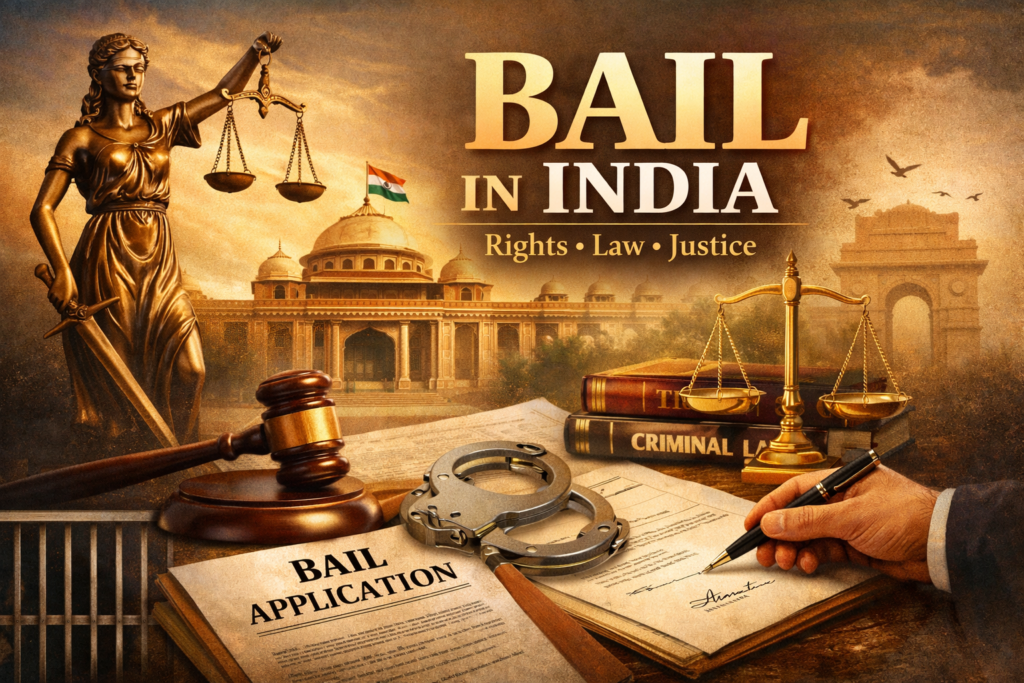
Bail in India: Meaning, Types, Legal Process, and Important Court Principles Bail is one of the most important protections available to a person who is accused of a crime in India. The idea of bail is closely linked with personal liberty, which is guaranteed under Article 21 of the Constitution of India. The basic principle behind bail is that an accused person should not be kept in jail unnecessarily while the case is still pending, especially when guilt has not yet been proven. In Indian criminal law, bail acts as a balance between the rights of the individual and the interests of society. In practical terms, bail means the temporary release of an accused person from custody, on the condition that he or she will appear before the court whenever required and will not misuse the liberty granted. Courts have repeatedly held that “bail is the rule and jail is the exception”, particularly in cases where the offence is not serious, the investigation is complete, or the trial is likely to take a long time. What Is Bail Under Indian Law? The law relating to bail is mainly governed by the Code of Criminal Procedure, 1973 (CrPC), and now by the Bharatiya Nagarik Suraksha Sanhita (BNSS). Bail provisions depend largely on whether the offence alleged against the accused is bailable or non-bailable. In bailable offences, the accused has a legal right to be released on bail. In such cases, the police or the court cannot refuse bail if the accused is ready to furnish the required bond. In non-bailable offences, bail is not a matter of right. It is granted at the discretion of the court after considering various factors such as the nature of the offence, the severity of punishment, the possibility of the accused absconding, and the likelihood of influencing witnesses. The purpose of bail is not to punish the accused. Punishment can only come after conviction. Bail ensures that the accused remains available for trial while continuing normal life outside jail, subject to conditions imposed by the court. Types of Bail in India Indian courts generally deal with three common forms of bail: regular bail, anticipatory bail, and interim bail. Regular bail is granted to a person who has already been arrested and is in police or judicial custody. An application for regular bail is usually filed before the Magistrate or the Sessions Court, depending on the seriousness of the offence. In serious matters, such as those involving offences punishable with life imprisonment or death, the Sessions Court or High Court has jurisdiction. Anticipatory bail is a pre-arrest protection. It is sought when a person has a reasonable apprehension that he or she may be arrested in a non-bailable offence. Anticipatory bail is filed under Section 438 of CrPC (now BNSS). This remedy is especially important in cases where false or motivated FIRs are lodged. Courts in Rajasthan, including the Jaipur Bench of the Rajasthan High Court, regularly deal with anticipatory bail applications, particularly in matrimonial disputes, business conflicts, and political cases. Interim bail is temporary bail granted for a short duration, usually during the pendency of a regular or anticipatory bail application. It protects the accused from arrest or continued custody until the court finally decides the bail plea. Factors Considered by Courts While Granting Bail While deciding bail applications, courts do not conduct a full trial. However, they examine certain important aspects. The nature and gravity of the accusation play a crucial role. Serious offences such as murder, rape, terrorism, or offences under special laws like NDPS Act attract stricter scrutiny. Courts also consider whether the accused has any criminal antecedents, whether there is a chance of the accused fleeing from justice, and whether the accused may influence witnesses or tamper with evidence. The stage of investigation is also important. Once the investigation is complete and the charge-sheet is filed, courts are generally more liberal in granting bail. Another significant factor is the length of custody. If an accused has already spent a considerable time in jail and the trial is likely to take years, courts often grant bail to prevent undue hardship. Health conditions, age, and personal circumstances of the accused are also taken into account. Bail and the Principle of Personal Liberty The Supreme Court of India has repeatedly emphasised that bail decisions must respect the fundamental right to personal liberty. In State of Rajasthan v. Balchand, the Court famously observed that bail should be the norm and jail the exception. This principle has been followed consistently by High Courts, including the Rajasthan High Court. In Sanjay Chandra v. CBI, the Supreme Court held that mere seriousness of the offence is not enough to deny bail, especially when the accused is not likely to abscond or misuse liberty. The Court clearly stated that pre-trial detention should not become a form of punishment. These judgments highlight that bail is not a favour granted by courts, but a legal mechanism to ensure fairness and justice during the criminal process. Bail in Serious and Special Law Offences Certain laws impose stricter conditions for bail. For example, under the NDPS Act, bail is extremely difficult in cases involving commercial quantity of contraband. Courts must be satisfied that the accused is not guilty and will not commit any offence while on bail. Similarly, in cases under POCSO Act, courts exercise caution, though bail is not completely barred. Even in such stringent laws, courts have granted bail where procedural lapses, illegal searches, or prolonged custody are evident. This shows that despite strict statutory provisions, constitutional principles continue to guide bail jurisprudence in India. Procedure for Filing a Bail Application A bail application must clearly mention the facts of the case, sections invoked, stage of investigation, and reasons why bail should be granted. Supporting documents such as FIR, arrest memo, medical papers, and previous orders are usually annexed. Effective bail drafting focuses on legal weaknesses in the prosecution case rather than emotional arguments. In Rajasthan, bail applications may be filed
Quashing of FIR: Complete Legal Guide Under Indian Law
Quashing of FIR: Complete Legal Guide Under Indian Law Registration of an FIR is often the first and most serious step in a criminal case. Many FIRs are lodged due to personal disputes, property disagreements, matrimonial conflicts, or business rivalries. When such FIRs are false, exaggerated, or legally unsustainable, the law provides a powerful remedy — quashing of FIR by the High Court. This article explains what quashing of FIR means, when the High Court can quash an FIR, and important Supreme Court and High Court judgments governing this area of law. What Is Quashing of FIR? Quashing of FIR means cancelling the FIR and all criminal proceedings arising from it, including investigation, charge-sheet, and trial. Once an FIR is quashed, the accused is freed from the criminal case entirely. In Rajasthan, FIRs are commonly quashed by the High Court using its inherent powers to prevent abuse of law and to secure justice. Legal Provision for Quashing of FIR The High Court exercises its power mainly under: Section 482 of CrPC (now Section 528 of BNSS, 2023) Article 226 of the Constitution of India (in rare cases) These provisions allow the High Court to intervene when continuing criminal proceedings would be unfair, illegal, or oppressive. When Can the High Court Quash an FIR? The High Court has consistently held that FIR quashing is justified in clearly defined situations. FIR Does Not Disclose Any Cognizable Offence If the FIR, even if taken as true, does not make out any offence under law, the High Court can quash it. Criminal proceedings cannot be allowed to continue merely on suspicion or vague allegations. FIR Arising from Civil or Property Disputes In Rajasthan, FIRs often arise from land disputes, partnership issues, builder-buyer conflicts, and financial transactions. When the dispute is essentially civil in nature and criminal law is used only as pressure, FIR quashing is permitted. False or Malicious FIR Filed to Harass If an FIR is lodged with mala fide intention, such as to threaten, extort money, or settle personal scores, the Rajasthan High Court treats it as an abuse of process and intervenes. Matrimonial Disputes and Compromise Cases In cases under Sections 498A, 406 IPC, or related matrimonial offences, if husband and wife have amicably settled the dispute, the Jaipur High Court regularly quashes FIRs to ensure peaceful resolution. Allegations Are Absurd or Inherently Improbable Where allegations are so unrealistic that no prudent person would believe them, continuing investigation serves no purpose. Such FIRs are liable to be quashed at the threshold. Important Supreme Court Judgments on Quashing of FIR (Each explained in ~50 words) State of Haryana v. Bhajan Lal (1992) This landmark judgment laid down seven categories where FIR quashing is justified, including cases where no offence is made out, proceedings are malicious, or allegations are absurd. Rajasthan High Court routinely relies on Bhajan Lal guidelines while deciding Section 482 petitions. Gian Singh v. State of Punjab (2012) The Supreme Court held that criminal proceedings arising from personal or private disputes can be quashed if parties have settled the matter, even if the offence is non-compoundable, provided it does not affect society at large. This judgment is frequently applied by Jaipur Bench in compromise matters. Narinder Singh v. State of Punjab (2014) This judgment clarified how courts should assess compromise-based quashing, stressing factors like nature of offence, stage of proceedings, and impact on society. Rajasthan High Court uses these principles especially in matrimonial and commercial dispute FIRs. Neeharika Infrastructure v. State of Maharashtra (2021) The Supreme Court cautioned High Courts to exercise FIR quashing powers carefully and not interfere routinely at the investigation stage. However, it reaffirmed that where FIR is clearly abusive or illegal, quashing is still permissible under Section 482. High Court Approach to FIR Quashing The High Court follows a balanced approach. It protects genuine investigation but does not hesitate to quash FIRs where: Criminal law is misused for pressure FIR is based on civil or family disputes Continuation of proceedings would cause injustice Each case is examined on its own facts, without mechanical application of law. Quashing of FIR vs Bail and Anticipatory Bail Many accused first seek Anticipatory Bail to avoid arrest. However, bail only protects liberty temporarily. Quashing of FIR provides permanent relief by ending the case itself. In many High Court matters, advocates simultaneously pursue: Interim protection through Bail or anticipatory bail Final relief through FIR quashing A strategic approach depends on facts, urgency, and stage of proceedings. Can FIR Be Quashed After Charge-Sheet? Yes. FIR can be quashed even after filing of charge-sheet, and in some cases, even after framing of charges. However, courts examine the evidence more closely once investigation is complete. Difference Between FIR Quashing and Discharge FIR Quashing Discharge Done by High Court Done by Trial Court Stops case at root After charge-sheet Based on legality of FIR Based on evidence Quashing offers stronger and earlier relief. Role of a Criminal Advocate in High Court FIR Quashing FIR quashing is a technical remedy requiring: Detailed study of FIR and case diary Identification of legal defects Strong reliance on Supreme Court & HC judgments Precise drafting under Section 528 BNSS An experienced criminal advocate ensures that the petition is legally sound and convincingly argued before the High Court. Conclusion Quashing of FIR is a vital safeguard against false and motivated criminal cases. The High Court consistently intervenes where criminal law is used as a weapon rather than a remedy. While FIR quashing is not automatic, courts remain committed to protecting individual liberty and preventing abuse of the criminal justice system.
Mutual Consent Divorce Under the Hindu Marriage Act, 1955
Mutual Consent Divorce Under the Hindu Marriage Act, 1955 Divorce by mutual consent is the most peaceful and dignified way to end a marriage under Indian law. When both husband and wife agree that the marriage has broken down and they cannot live together anymore, the law allows them to separate without allegations, blame, or lengthy court battles. Under the Hindu Marriage Act, 1955, this form of divorce is recognised under Section 13B. This article explains the complete legal process of mutual consent divorce, eligibility conditions, procedure, timeline, court requirements, waiver of cooling-off period, and important judgments, in a clear and practical manner. What Is Mutual Consent Divorce? A mutual consent divorce is a divorce where both spouses jointly agree to dissolve their marriage. Unlike contested divorce cases, there is no need to prove cruelty, adultery, desertion, or any other fault. The focus is only on mutual agreement and settlement. Under Section 13B of the Hindu Marriage Act, 1955, a husband and wife can file a joint petition stating that: They have been living separately, and They are unable to live together, and They have mutually agreed to dissolve the marriage. Legal Provision: Section 13B of Hindu Marriage Act Section 13B was introduced to reduce unnecessary litigation and emotional stress between parties. It provides a statutory framework for amicable separation. The section works in two stages: First Motion (Joint Petition) Second Motion (Final Hearing and Decree) Conditions for Filing Mutual Consent Divorce For filing a mutual consent divorce under Hindu law, the following conditions must be satisfied: 1. Marriage Must Be a Hindu Marriage The marriage should have been solemnised under Hindu law and registered (registration is helpful but not compulsory). 2. Living Separately for At Least One Year The parties must have lived separately for a minimum period of one year before filing the petition.“Living separately” does not necessarily mean living in different houses. Even staying under the same roof without marital relations can qualify. 3. Mutual Agreement Both husband and wife must freely consent to divorce without force, pressure, fraud, or coercion. 4. No Possibility of Reconciliation The parties must genuinely believe that the marriage cannot be saved. First Motion in Mutual Consent Divorce The process begins with filing a joint petition before the Family Court or District Court having jurisdiction. Contents of First Motion Petition The petition generally includes: Date and place of marriage Details of separation Reasons for divorce (simple statement of incompatibility is sufficient) Settlement terms regarding: Permanent alimony or maintenance Child custody and visitation (if applicable) Return of stridhan Property settlement Both parties must sign the petition and file affidavits. Appearance Before Court Both spouses must personally appear before the court for filing the application and further later for recording of statements. The court verifies consent and satisfaction of legal conditions. Cooling-Off Period of Six Months After the first motion, the law provides a cooling-off period of six months. This period is meant to give the parties time to reconsider their decision and explore reconciliation. However, this period often delays divorce even when the marriage is completely irretrievable. Waiver of Cooling-Off Period – Supreme Court Judgment In Amardeep Singh v. Harveen Kaur (2017), the Supreme Court held that the six-month cooling-off period is directory, not mandatory. Cooling-Off Period Can Be Waived If: The parties have already lived separately for a long period All disputes regarding alimony, custody, and property are settled There is no chance of reconciliation The waiting period would only prolong mental agony Courts today frequently waive this period where facts justify immediate divorce. Second Motion and Final Decree After six months (or earlier if waived), the parties file the second motion. At this stage: Both parties again appear before the court Consent is reconfirmed The court ensures that consent is voluntary If the court is satisfied, it passes a decree of divorce, dissolving the marriage legally. Time Taken for Mutual Consent Divorce Without waiver: Around 6–8 months With waiver: As fast as 1–2 months (depending on court workload) Compared to contested divorce, which can take years, mutual consent divorce is significantly faster. Alimony and Maintenance in Mutual Consent Divorce There is no fixed rule for alimony. It depends entirely on mutual agreement. Factors considered include: Income and financial capacity of both spouses Duration of marriage Standard of living Future needs Alimony can be: One-time lump sum payment, or Monthly maintenance The agreed amount is recorded in the divorce petition and becomes binding. Child Custody in Mutual Consent Divorce If the couple has children, custody arrangements must be clearly stated. Courts prioritise the welfare of the child, not the convenience of parents. Custody can be: Sole custody to one parent Joint custody Visitation rights for the non-custodial parent The court ensures that the arrangement serves the child’s best interest. Can Mutual Consent Divorce Be Withdrawn? Yes. Either party can withdraw consent at any time before the final decree. If consent is withdrawn, the court cannot grant divorce under Section 13B. Once the final decree is passed, the divorce is complete and cannot be challenged except on very limited legal grounds. Mutual Consent Divorce vs Contested Divorce Mutual consent divorce avoids: False allegations Lengthy trials Cross-examination Emotional stress Financial drain It allows parties to move on with dignity and closure. Common Mistakes to Avoid Many couples face delays due to: Incomplete settlement terms Improper drafting of petition Non-appearance of parties Disputes arising after first motion Proper legal guidance ensures smooth and quick disposal. Conclusion Mutual consent divorce under the Hindu Marriage Act is a practical, humane, and legally sound way to end a marriage that has irretrievably broken down. It respects the autonomy of individuals, reduces conflict, and saves valuable time of the court and parties. When handled correctly, with clear settlement and informed consent, it provides a clean and respectful exit from a failed marriage. By Bhuvnesh Kumar GoyalAdvocate in Jaipur High Court
Parole in India: Meaning, Law, Procedure, Grounds, and Important Legal Aspects
Parole in India: Meaning, Law, Procedure, Grounds, and Important Legal Aspects Parole is an important part of the criminal justice system in India. It allows a convicted prisoner to be released from jail for a short period under certain conditions, without ending the sentence. The idea behind parole is not to weaken punishment, but to balance punishment with humanity, reform, and social responsibility. Indian courts have repeatedly held that a prisoner does not lose all fundamental rights after conviction. Parole is one such right-based relief, aimed at rehabilitation and maintaining family and social ties. What is Parole? Parole is a temporary release of a prisoner from jail after conviction, subject to specific conditions. During parole, the sentence continues to run, but the prisoner is allowed to live outside prison for a limited period. Parole is not an acquittal, not a suspension of sentence, and not a reduction of punishment. If the parole period ends, the prisoner must surrender back to jail. Difference Between Parole and Bail Bail and parole are often confused, but they operate at different stages of a criminal case. Bail applies to an accused person before or during trial, whereas parole applies only after conviction. Bail suspends custody, but parole is a conditional temporary release during the sentence period. Courts treat parole as an administrative decision, not a judicial one, although it is subject to judicial review. Legal Basis of Parole in India There is no single central law governing parole across India. Parole is regulated through: Prison Rules of respective States Jail Manuals Executive instructions issued by State Governments Constitutional principles under Article 21 (Right to Life and Personal Liberty) Each State has its own parole rules, such as Rajasthan Prisoners Release on Parole Rules, Delhi Prison Rules, Maharashtra Prison Rules, etc. Objectives of Granting Parole The purpose of parole is reformative, not punitive. Courts and prison authorities consider parole necessary to: Maintain family and social relations Allow the prisoner to attend urgent personal matters Support mental health and emotional stability Encourage good conduct and discipline in prison Prepare the prisoner for social reintegration Parole reflects the belief that punishment should also aim at rehabilitation. Grounds on Which Parole is Granted Parole is usually granted only on genuine and urgent grounds. Common grounds include death or serious illness of a close family member, marriage of a son, daughter, or sibling, serious illness of the prisoner, agricultural needs, or any exceptional humanitarian reason. Courts have clarified that parole is not a matter of charity, but also not an absolute right. It depends on facts, conduct, and public interest. Types of Parole Parole in India is generally classified into two types. Regular parole is granted for personal or family reasons, usually for a longer duration. Emergency parole is granted in urgent situations like death or critical illness and is usually for a shorter period. Some States also allow parole based on long-term good conduct in jail. Eligibility for Parole Not every prisoner is automatically entitled to parole. Authorities consider factors such as nature of offence, length of sentence served, conduct in jail, previous misuse of parole, likelihood of absconding, and impact on public order. In serious offences like murder, NDPS cases, terrorism, or sexual offences, parole is scrutinised very strictly. Procedure for Applying for Parole The application for parole is usually submitted through the Jail Superintendent. The request is forwarded to the District Magistrate or competent authority for verification. Police conduct a background and local inquiry to assess risk and public safety. After considering the report, the competent authority decides whether to grant or reject parole. Conditions such as surety, bond, reporting to police station, and restrictions on movement may be imposed. Conditions Imposed During Parole A prisoner released on parole must strictly follow the conditions mentioned in the parole order. These usually include staying at a specified address, not leaving the jurisdiction, maintaining peace and good behaviour, and surrendering on time. Violation of conditions can lead to cancellation of parole and adverse consequences in future applications. Can Parole Be Cancelled? Yes, parole can be cancelled at any time if the prisoner violates conditions, commits an offence, attempts to abscond, or threatens public order. In such cases, the police can arrest the prisoner and send him back to jail. Misuse of parole also affects future chances of parole or premature release. Role of Courts in Parole Matters Although parole is an administrative decision, courts play a crucial role. If parole is arbitrarily denied or delayed, the prisoner can approach the High Court under Article 226. Courts interfere when refusal of parole is unjust, mechanical, or violates constitutional rights. However, courts generally do not substitute their opinion unless there is illegality or perversity. Parole and Article 21 of the Constitution Indian courts have consistently linked parole with Article 21. The Supreme Court has held that prisoners retain their right to dignity, humane treatment, and personal liberty, subject to lawful restrictions. Parole is seen as part of the right to life with dignity, especially when denial is harsh, unreasonable, or disproportionate. Important Judicial Principles on Parole Courts have clarified that parole is meant for reformation, not relaxation of punishment. Good conduct in jail is a key factor, but not the sole ground. Public safety and victim impact are equally important. Delay in deciding parole applications has been held to be unjust, especially in emergency situations. Conclusion Parole is a vital reformative tool in India’s criminal justice system. It recognises that even convicted persons are human beings with families, emotions, and social responsibilities. At the same time, parole is not an unchecked freedom and must operate within strict legal and administrative boundaries. A fair, timely, and humane parole system strengthens both justice and society by promoting rehabilitation without compromising public safety.
 Call: 7300056080
 Email: advocatebhuvneshgoyal@gmail.com
 Office: 109, Fortune Heights, Ahinsa Circle, C-Scheme, Jaipur-302001