
Delayed Written Statement Under Order 8 Rule 1 CPC - Condonation Upheld - Jaipur Rajasthan High Court
The question of whether a civil court can accept a written statement filed beyond the prescribed period under Order 8 Rule 1 of the Code of Civil Procedure, 1908 (CPC) continues to arise frequently in civil litigation.
A recent reportable judgment of the Rajasthan High Court, Jaipur Bench, has once again examined this issue and clarified that, particularly in non-commercial disputes, the court retains jurisdiction to condone delay and take a belated written statement on record, provided there is a satisfactory justification or explanation for the delay.
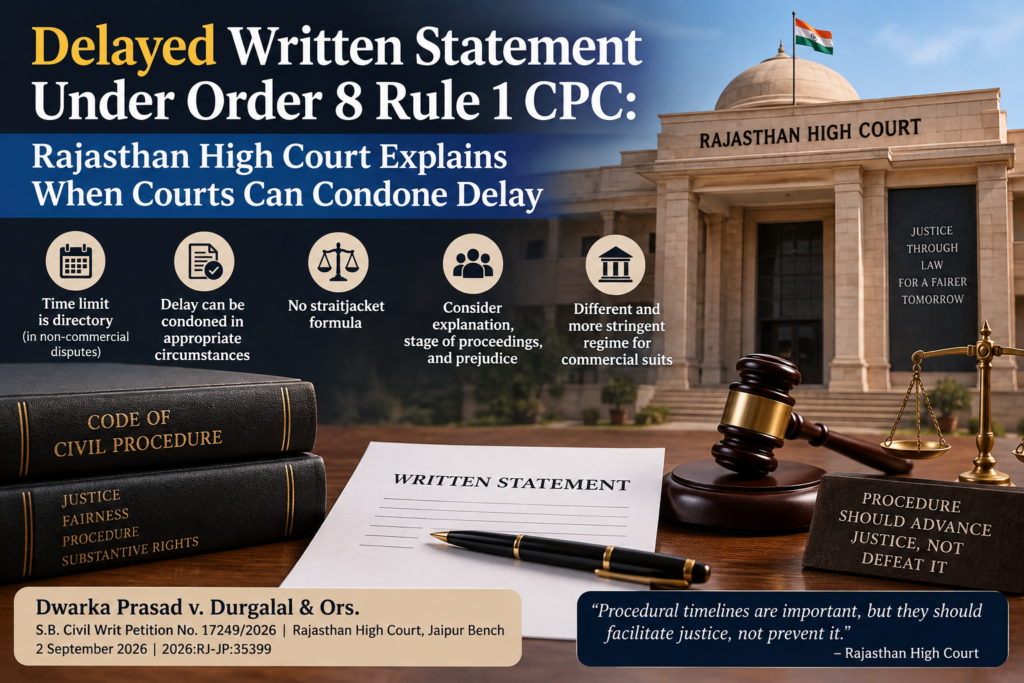
The judgment was delivered by Hon’ble Mr. Justice Sudesh Bansal on 2 September 2026 in Dwarka Prasad v. Durgalal & Ors., S.B. Civil Writ Petition No. 17249/2026.
The judgment is particularly important because it discusses the interplay between Order 8 Rule 1 CPC, procedural timelines, the discretion of the trial court, prejudice to the opposite party, and the distinction between commercial and non-commercial disputes.
What Was the Issue Before the Rajasthan High Court?
The petitioner had instituted a civil suit for permanent injunction in 2021 against several defendants. The trial court had held service of summons sufficient on the defendants.
However, while several defendants appeared through their respective advocates, Defendant No. 3 did not initially appear. Importantly, the trial court did not pass an order proceeding against Defendant No. 3 ex parte, nor did it pass an order forfeiting his right to file a written statement.
The litigation continued for several years.
Defendant No. 3 eventually entered appearance on 21 January 2026 and filed an application under Order 9 Rule 7 CPC. That application was subsequently withdrawn on 12 March 2026 because there had never been an order directing that he be proceeded against ex parte.
Thereafter, Defendant No. 3 filed his written statement on 23 April 2026, accompanied by an application seeking condonation of delay.
The trial court accepted the explanation, condoned the delay and permitted the written statement to be taken on record, subject to payment of ₹1,000 as costs to Legal Aid.
The plaintiff challenged that order before the Rajasthan High Court under Article 227 of the Constitution of India.
What Does Order 8 Rule 1 CPC Say About Filing a Written Statement?
Order 8 Rule 1 CPC prescribes the timeline within which a defendant is expected to present a written statement.
The provision is intended to prevent unnecessary delay in civil proceedings and to ensure that the defendant’s defence is placed before the court within the prescribed period.
However, the important question is:
Can a court accept a written statement after expiry of the statutory period?
According to the line of Supreme Court judgments considered by the Rajasthan High Court, the answer depends upon the nature of the proceeding and the circumstances of the particular case.
In non-commercial disputes, the time schedule under Order 8 Rule 1 CPC has been treated as directory rather than absolutely mandatory, although this does not mean that defendants have an unrestricted right to file written statements whenever they choose.
Supreme Court’s Decision in Kailash v. Nanhku
The Rajasthan High Court relied upon the landmark Supreme Court judgment in Kailash v. Nanhku & Ors., AIR 2005 SC 2441.
The Supreme Court had considered the nature of the time limit prescribed under Order 8 Rule 1 CPC and held that the provision is essentially directory in nature.
The objective of prescribing a time limit is to expedite the proceedings and not to scuttle the hearing.
The Rajasthan High Court reiterated that the court’s power to extend the time for filing a written statement is not completely taken away by Order 8 Rule 1 CPC.
This distinction is crucial.
Directory does not mean optional
A common misconception is that if Order 8 Rule 1 CPC is directory, a defendant can file a written statement at any stage without consequence.
That is not the correct position.
The court still has to consider:
- the length of the delay;
- the explanation offered for the delay;
- the circumstances of the case;
- the stage of the proceedings;
- prejudice caused to the plaintiff;
- the purpose behind the procedural timeline; and
- whether accepting the written statement would frustrate the objective of expeditious disposal.
The discretion is therefore judicial discretion, not an automatic entitlement.
What Did Atcom Technologies Say?
The Rajasthan High Court also referred to the Supreme Court’s decision in Atcom Technologies Ltd. v. Y.A. Chunawala & Co. & Ors., (2018) 6 SCC 639.
As noted by the High Court, the Supreme Court considered the period prescribed under Order 8 Rule 1 CPC and held that the proviso permits the court, for sufficient reasons, to extend the initial period of 30 days up to 90 days from the date of service of summons.
At the same time, the Supreme Court recognised that the power of the court to accept a written statement beyond the prescribed period had not been completely taken away in non-commercial matters because the provision concerns procedural law.
Thus, the law is not simply:
90 days expired = written statement can never be accepted.
Rather, in an ordinary civil/non-commercial dispute, the court may still have jurisdiction to consider a belated written statement in appropriate circumstances.
What Did Desh Raj v. Balkishan Add?
The petitioner in the Rajasthan High Court relied upon the Supreme Court’s decision in Desh Raj v. Balkishan (D) through proposed LR Ms. Rohini, (2020) 2 SCC 708.
The High Court observed that Desh Raj followed and reiterated the principles laid down in Kailash and Atcom Technologies. However, the Supreme Court had also cautioned that routine condonation of delay and a cavalier attitude towards procedural timelines should not be encouraged because such conduct can adversely affect the administration of justice.
This creates an important balance:
Courts have discretion—but discretion must not become routine indulgence.
Rajasthan High Court’s Key Finding
The Rajasthan High Court summarised the legal position in particularly clear terms.
The court held that in a non-commercial dispute, it has the power and jurisdiction to condone delay and take a written statement on record even after expiry of the timeline prescribed under Order 8 Rule 1 CPC.
However, this power is subject to the defendant providing a reasoned justification or explanation for the delay.
The Court specifically contrasted this position with commercial disputes, observing that such power does not lie with the court in the same manner in respect of commercial disputes.
Why Was the Delay Condoned in This Particular Case?
The factual circumstances were extremely important.
The High Court identified several factors in favour of Defendant No. 3.
1. No order proceeding ex parte had been passed
Although Defendant No. 3 had not initially appeared, the trial court had never passed an order proceeding against him ex parte.
Nor had the trial court passed an order forfeiting his right to file a written statement.
2. The suit was still pending at an earlier procedural stage
The proceedings had not been held up because of Defendant No. 3’s failure to file the written statement.
The suit was still pending at the stage of consideration of an Order 7 Rule 11 CPC application filed by Defendant No. 2.
3. The defendant claimed lack of knowledge of the proceedings
Defendant No. 3 took the position that the proceedings were not within his knowledge and that, immediately after acquiring knowledge, he approached the court.
He initially filed an application under Order 9 Rule 7 CPC and subsequently filed his written statement along with an application seeking condonation of delay.
4. No substantial prejudice was caused to the plaintiff
The High Court found that permitting the written statement to come on record did not cause substantial prejudice to the plaintiff.
This factor ultimately became important in the Court’s decision to uphold the trial court’s discretion.
Is There a Fixed Formula for Condoning Delay in Filing Written Statement?
No.
The Rajasthan High Court specifically observed that there cannot be a straitjacket formula for determining what constitutes sufficient explanation for delay.
Different cases may involve different factual circumstances.
Therefore, the explanation has to be assessed case by case, while keeping in mind:
- the circumstances of the defendant;
- the reason for the delay;
- the stage of the suit;
- the object of Order 8 Rule 1 CPC;
- prejudice to the plaintiff; and
- whether allowing the written statement would defeat the purpose of the procedural timeline.
This is arguably one of the most important practical takeaways from the judgment.
The Court’s Approach: Procedural Rules Should Advance Justice
The judgment demonstrates the distinction between procedural discipline and procedural rigidity.
Procedural timelines are important. Courts cannot encourage parties to casually disregard them.
At the same time, procedural rules are generally intended to facilitate the adjudication of disputes on their merits rather than prevent a party from placing its defence before the court in circumstances where doing so would not cause substantial prejudice.
The Rajasthan High Court therefore held that the explanation for delay need not necessarily be examined in an excessively rigid, strict or stringent manner, particularly where the legislative purpose behind the timeline has not been frustrated.
Commercial and Non-Commercial Suits: An Important Distinction
One of the most important aspects of the judgment is its reference to the distinction between commercial disputes and non-commercial disputes.
The Rajasthan High Court’s discussion is specifically in the context of a non-commercial civil dispute.
Therefore, advocates should be cautious about mechanically applying the principles discussed in this judgment to a commercial suit.
The statutory framework governing written statements in commercial disputes is significantly more stringent, and the Supreme Court has separately dealt with the consequences of failure to comply with the prescribed timelines.
Accordingly, whether the suit is commercial or non-commercial should be one of the first questions considered when analysing an application seeking acceptance of a delayed written statement.
Can a Written Statement Be Filed After 90 Days?
In a non-commercial civil suit, potentially yes—but not as a matter of right.
The 90-day period under Order 8 Rule 1 CPC is not to be understood as an unrestricted permission to file the written statement whenever convenient.
The court must be satisfied with the explanation for the delay and must exercise its discretion judicially.
The Rajasthan High Court’s judgment makes this distinction clear: the power exists, but routine or cavalier condonation is not encouraged.
What Advocates Should Check Before Opposing a Delayed Written Statement
From a litigation strategy perspective, an objection to a delayed written statement should not merely state that the statutory period has expired.
The following factual questions can be significant:
1. When was summons actually served?
The starting point of the relevant period must be established.
2. Was the defendant represented before the court?
Appearance, vakalatnama and participation in proceedings can become relevant to determining the defendant’s knowledge.
3. Was any ex parte order passed?
If the defendant’s right to file a written statement was expressly forfeited or an appropriate adverse order was passed, the factual and legal position may be materially different.
4. What explanation has been given for the delay?
The court is required to examine the explanation rather than mechanically condone the delay.
5. What is the present stage of the suit?
If the suit has substantially progressed, acceptance of a written statement may have different consequences than where the proceedings are still at an early stage.
6. Has the delay prejudiced the plaintiff?
Actual procedural prejudice can be an important consideration.
7. Is the suit commercial or non-commercial?
This distinction can fundamentally affect the applicable legal framework.
Rajasthan High Court’s Final Decision
After considering the facts and the Supreme Court judgments, the Rajasthan High Court held that the trial court had not committed any manifest error, patent illegality or jurisdictional error in condoning the delay and taking Defendant No. 3’s written statement on record.
The High Court further held that no substantial prejudice had been caused to the plaintiff and that the impugned order did not result in a miscarriage of justice.
Consequently, the writ petition was dismissed.
The stay application and all pending applications were also disposed of.
Key Takeaways From the Judgment
| Issue | Position emerging from the judgment |
|---|---|
| Order 8 Rule 1 CPC | Time limit is directory in non-commercial disputes |
| Can delay be condoned? | Yes, in appropriate circumstances |
| Is condonation automatic? | No |
| Is sufficient explanation required? | Yes |
| Is there a fixed formula? | No |
| Is prejudice relevant? | Yes |
| Can the court consider circumstances of each case? | Yes |
| Are routine condonations encouraged? | No |
| Commercial disputes | Different, more stringent regime applies |
| Present case | Delay condoned and written statement retained on record |
Frequently Asked Questions
1. What is the time limit for filing a written statement under Order 8 Rule 1 CPC?
Order 8 Rule 1 CPC prescribes the time within which a defendant is required to file a written statement. In ordinary civil suits, the provision contemplates 30 days and permits extension up to 90 days for sufficient reasons, while judicial decisions have recognised limited judicial discretion beyond the prescribed period in non-commercial disputes.
2. Can a written statement be accepted after 90 days?
In a non-commercial dispute, the court can, in appropriate circumstances, exercise discretion to accept a written statement beyond the prescribed timeline, provided the delay is satisfactorily explained and the circumstances justify such indulgence. Lawyer in Jaipur files an application for condonation of delay, which cam either be allowed or rejected as per the discretion of the court.
3. Is Order 8 Rule 1 CPC mandatory?
The Rajasthan High Court, relying on Kailash v. Nanhku and Atcom Technologies, reiterated that the provision is directory in nature in the context under consideration, rather than an absolute bar that completely removes the court’s power to accept a delayed written statement.
4. Does a defendant have an absolute right to file a written statement at any time?
No. The power to accept a delayed written statement is discretionary. Courts should not encourage a routine or cavalier disregard of procedural timelines. The defendant through a lawyer in jaipur, is to file an application under section 5 of limitation act, which the court may allow or reject as per the facts & circumstances of the case.
5. What factors can the court consider while deciding an application for condonation of delay?
The court can consider the explanation for delay, the circumstances of the particular case, the stage of proceedings, the purpose behind Order 8 Rule 1 CPC and prejudice to the opposite party. The Rajasthan High Court expressly held that there is no straitjacket formula.
6. Does this principle apply equally to commercial suits?
No. The judgment specifically distinguishes non-commercial disputes from commercial disputes and notes that the court’s power is different in relation to commercial disputes.
7. What happened in Dwarka Prasad v. Durgalal?
The Rajasthan High Court upheld the trial court’s decision to condone the delay of Defendant No. 3 and take his written statement on record. The writ petition challenging that order was dismissed. Advocate in Jaipur High Court may further be consulted to know more about the order of the Honourable Jaipur Rajasthan High Court.
Conclusion
The Rajasthan High Court’s judgment in Dwarka Prasad v. Durgalal & Ors. reinforces an important principle of civil procedure: procedural timelines matter, but in non-commercial disputes they do not necessarily operate as an absolute and inflexible bar to accepting a delayed written statement.
The court possesses discretion to condone delay where the circumstances justify it. However, that discretion must be exercised judicially and cannot be treated as a licence for defendants to disregard procedural timelines.
The judgment therefore strikes a balance between two competing objectives—expeditious disposal of civil litigation and adjudication of disputes on their merits.
For practitioners, the central lesson is straightforward:
A delayed written statement in a non-commercial suit is not automatically barred merely because the prescribed period has expired; however, the defendant must provide a satisfactory explanation, and the court must consider the facts, stage of proceedings, purpose of the procedural rule and prejudice to the opposite party.
The judgment is reported as [2026:RJ-JP:35399], S.B. Civil Writ Petition No. 17249/2026, decided by the Rajasthan High Court, Jaipur Bench, on 2 September 2026.
By Bhuvnesh Kumar Goyal
Advocate in Jaipur High Court

 Call: 7300056080
 Email: advocatebhuvneshgoyal@gmail.com
 Office: 109, Fortune Heights, Ahinsa Circle, C-Scheme, Jaipur-302001