
What Is a POCSO Case?
The POCSO Act is a special legislation enacted to protect children below the age of 18 years from sexual assault, sexual harassment and pornography-related offences.
The Act covers offences including:
- Penetrative sexual assault under Section 3
- Aggravated penetrative sexual assault under Section 5
- Sexual assault under Section 7
- Aggravated sexual assault under Section 9
- Sexual harassment under Section 11
- Use of a child for pornographic purposes under Section 13
- Abetment and attempt of POCSO offences
The Act also establishes a special procedure intended to make the investigation and trial more child-friendly. Sections 24 to 40 of the Act deal extensively with recording of statements, medical examination, Special Courts, presumptions, trial procedure and protection of the child during evidence.
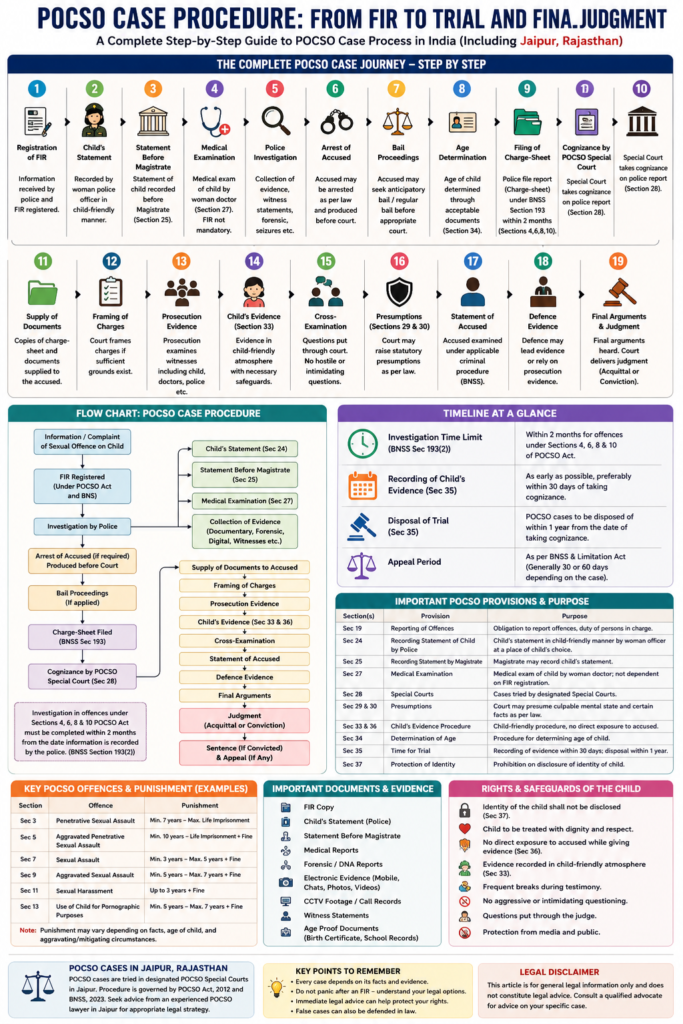
POCSO Case Procedure: Step-by-Step
The broad procedure in a POCSO case can be understood as follows:
Complaint/Information → FIR → Child’s Statement → Medical Examination → Investigation → Arrest/Bail → Collection of Evidence → Charge-Sheet → Cognizance → Supply of Documents → Framing of Charges → Prosecution Evidence → Cross-Examination → Statement of Accused → Defence Evidence → Final Arguments → Judgment → Appeal
| Stage | What Happens | Important Point |
|---|---|---|
| 1. FIR | Police register information regarding alleged offence | POCSO + BNS sections may be invoked |
| 2. Child’s Statement | Statement recorded in child-friendly manner | Section 24 POCSO |
| 3.Magistrate Statement | Statement may be recorded before Magistrate | Section 25 POCSO / applicable BNSS provision |
| 4. Medical Examination | Child medically examined | Section 27 POCSO |
| 5. Investigation | Police collect documentary, forensic, digital and oral evidence | Investigation strategy is critical |
| 6. Arrest | Accused may be arrested depending on facts and law | Arrest and FIR are separate issues |
| 7. Bail | Accused can seek appropriate bail remedy | Depends on offence and stage |
| 8. Age Determination | Court determines whether victim was below 18 | Extremely important in many cases |
| 9. Charge-sheet | Police submit investigation report | Section 193 BNSS |
| 10. Special Court | POCSO Special Court proceeds with case | Section 28 POCSO |
| 11. Charges | Court determines offences for trial | Defence can challenge prosecution case where legally permissible |
| 12. Prosecution Evidence | Prosecution examines witnesses | Includes child, doctors, police, forensic witnesses etc. |
| 13. Cross-examination | Defence tests prosecution evidence | Subject to child-protection safeguards |
| 14. Accused Statement | Accused is examined regarding circumstances appearing against him | Applicable BNSS procedure |
| 15. Defence Evidence | Defence may produce evidence | Not mandatory in every case |
| 16. Final Arguments | Both sides present their case | Evidence is analysed as a whole |
| 17. Judgment | Court acquits or convicts | Reasons must be recorded |
| 18. Sentence | Sentence considered after conviction | Depends on applicable POCSO offence |
| 19. Appeal | Aggrieved party may pursue statutory appellate remedy | Forum and limitation depend on applicable law |
Each stage is explained below.
1. Registration of FIR in a POCSO Case
A POCSO case ordinarily begins when information regarding an alleged sexual offence against a child reaches the police.
Section 19 of the POCSO Act imposes obligations relating to reporting of offences. Once information discloses a cognizable offence, the police can register an FIR and commence investigation.
Under the present criminal procedure framework, Section 173 of the BNSS deals with information relating to cognizable offences.
The FIR may contain allegations attracting provisions of both:
- POCSO Act; and
- Bharatiya Nyaya Sanhita, 2023 (BNS).
For example, depending upon the allegations and facts, a case may involve POCSO provisions along with provisions relating to rape, kidnapping, criminal intimidation or other offences under the BNS.
Can a POCSO FIR be quashed?
In appropriate cases, an accused may approach the High Court seeking quashing of the FIR or criminal proceedings. However, the availability of such a remedy depends heavily upon the facts, evidence, statutory provisions and the stage of the proceedings.
A mere settlement between the accused and the victim’s family does not automatically terminate a POCSO prosecution.
2. Recording of the Child’s Statement
One of the most important stages in a POCSO case is recording the statement of the child.
Section 24 of the POCSO Act lays down special requirements for recording the child’s statement. The objective is to ensure that the child is not unnecessarily exposed to a hostile or intimidating environment.
The law requires that the statement be recorded in a child-sensitive manner.
The statement should, as far as practicable, be recorded:
- at the residence of the child or another place where the child ordinarily resides;
- by a woman police officer not below the rank prescribed by law;
- without bringing the child into contact with the accused;
- in a manner that does not cause unnecessary distress to the child.
The law also contemplates recording through audio-video means wherever possible.
3. Statement Before the Magistrate
The child’s statement may also be recorded before a Magistrate under the applicable procedural law.
Under the POCSO framework, Section 25 specifically deals with recording of the statement of a child by a Magistrate.
Under the current criminal procedure regime, Section 183 BNSS deals with recording of confessions and statements by a Magistrate.
This statement can become an important piece of the prosecution case.
However, it is important to understand that a statement recorded during investigation is not necessarily equivalent to substantive evidence given during trial. The evidentiary value of different statements depends upon the applicable law and the circumstances in which they were recorded.
4. Medical Examination of the Child
Medical examination is another important part of a POCSO investigation.
Section 27 of the POCSO Act specifically deals with medical examination of a child.
Importantly, the medical examination can be conducted even if an FIR has not yet been registered. Where the victim is a girl child, the examination is to be conducted by a woman doctor. The examination is ordinarily conducted in the presence of the parent or another person in whom the child has trust or confidence.
Medical evidence may include:
- examination of injuries;
- collection of biological samples;
- forensic examination;
- DNA-related evidence where relevant;
- medical opinion regarding injuries or other findings.
However, the absence of injuries does not by itself determine whether a POCSO offence occurred. The court evaluates the entire body of evidence.
5. Police Investigation
After registration of the FIR, the investigating officer collects evidence relevant to the allegations.
Depending upon the facts of the case, investigation may include:
- recording statements of witnesses;
- recording the child’s statement;
- recording a Magistrate’s statement;
- medical examination;
- seizure of clothes or other articles;
- collection of forensic evidence;
- DNA examination;
- recovery of electronic devices;
- examination of mobile phones;
- collection of chats, photographs, videos or other electronic evidence;
- CCTV footage;
- location or other digital evidence;
- school or other age-related records;
- examination of the accused;
- statements of relevant witnesses;
- site inspection; and
- other documentary or scientific evidence.
The exact investigation depends upon the allegations.
Special time limit for investigation
A significant point under the current BNSS is Section 193(2).
It provides that investigation relating to offences under Sections 4, 6, 8 or 10 of the POCSO Act is to be completed within two months from the date on which the information was recorded by the officer in charge of the police station.
This is an important procedural change for practitioners handling POCSO cases.
6. Arrest of the Accused
Registration of a POCSO FIR does not mean that conviction is automatic.
The question of arrest depends upon the allegations, applicable offences, investigation and statutory requirements.
Where the accused is arrested, he is produced before the Magistrate as required by law, and the question of custody arises.
The accused may seek:
- regular bail;
- anticipatory bail, where legally maintainable;
- default/statutory bail in appropriate circumstances;
- bail before the appropriate court depending upon the offence and procedural stage.
In serious POCSO offences, bail applications can involve detailed consideration of the FIR, statements, medical evidence, age of the child, allegations, custodial requirements and other circumstances.
7. Bail in a POCSO Case
Bail in pocso is one of the first major concerns of an accused after registration of a POCSO FIR.
The appropriate court depends upon the offence, the stage of the case and the applicable statutory provisions.
In practice, a bail application may require consideration of:
- exact POCSO sections;
- punishment prescribed;
- allegations in the FIR;
- statement of the child;
- statement before Magistrate;
- medical evidence;
- age-related documents;
- possibility of tampering with evidence;
- possibility of influencing witnesses;
- custody period;
- investigation status;
- charge-sheet status; and
- criminal antecedents.
For an accused in a POCSO case, immediate legal advice after registration of the FIR can be extremely important, particularly where arrest is apprehended.
8. Determination of the Child’s Age
Age determination in POCSO is one of the most critical issues in many POCSO cases.
The POCSO Act protects a child, meaning a person below 18 years of age.
Therefore, in cases where the age is disputed or close to 18 years, determination of age can become a major issue.
Section 34 of the POCSO Act deals with the procedure where an offence is alleged to have been committed by a child and also deals with determination of age by the Special Court.
Age may be examined on the basis of legally admissible documentary and other evidence.
Documents potentially relevant to age may include:
- birth certificate;
- school admission records;
- school leaving certificate;
- municipal records;
- other government records; and
- medical/ossification examination where legally appropriate.
The importance of age determination is particularly significant where the accused claims that the prosecutrix/victim was already 18 years old at the relevant time.
9. Filing of the Charge-Sheet
Once investigation is completed, the investigating agency prepares the police report/charge-sheet.
Under Section 193 BNSS, the police report contains relevant details regarding the parties, nature of information, witnesses, whether an offence appears to have been committed, arrest/bail status and other prescribed information. Relevant documents and witness statements are also forwarded in accordance with the statutory procedure.
The police may file:
Charge-sheet
Where the investigating agency concludes that sufficient material exists to prosecute the accused.
Final report/closure report
Where the investigating agency concludes that the allegations are not sufficiently established or prosecution is otherwise not warranted on the material collected, a Final Report (FR) is filed by the Investigating officer before the Pocso Court.
A closure report does not necessarily mean that the matter automatically ends. The legal consequences depend upon the nature of the report, Protest Petition and the orders passed by the competent court.
10. POCSO Special Court
POCSO cases are tried by designated Special Courts.
Section 28 of the POCSO Act provides for designation of Special Courts.
The Special Court can take cognizance of an offence upon receiving a complaint or police report and does not necessarily require the accused to first be committed to it in the ordinary manner.
In Jaipur and other districts of Rajasthan, POCSO matters are dealt with by the designated courts having jurisdiction over the case.
Therefore, if a POCSO FIR is registered in Jaipur, the case does not ordinarily proceed like a regular civil dispute or ordinary Magistrate case; it follows the special criminal procedure applicable to POCSO matters.
11. Supply of Charge-Sheet and Documents to the Accused
After the police report is filed and the court takes the necessary procedural steps, the accused is entitled to copies of the police report and relevant documents in accordance with the applicable criminal procedure.
This stage is extremely important for the defence because the defence lawyer needs to examine the prosecution material before the next stages of the trial.
A POCSO defence lawyer will generally examine:
- FIR;
- statements;
- Magistrate statement;
- medical reports;
- forensic reports;
- DNA reports;
- electronic evidence;
- seizure memos;
- site plans;
- age documents;
- witness statements;
- call records where relevant;
- CCTV footage; and
- other documents relied upon by the prosecution.
12. Framing of Charges
After considering the material placed before it, the Special Court decides whether there is sufficient ground to proceed against the accused for the alleged offences.
If the court finds sufficient grounds, charges are framed.
The accused is then called upon to face trial for the offences specified in the charge.
At this stage, the defence may challenge the maintainability of the prosecution or seek appropriate relief, including discharge where the applicable law permits and the facts justify such a prayer.
13. Prosecution Evidence
After charges are framed, the prosecution begins presenting its evidence.
This is one of the most important stages of a POCSO trial.
The prosecution may examine:
- the child/victim;
- parents or guardians;
- eyewitnesses;
- police officers;
- doctors;
- forensic experts;
- investigating officer;
- age-document witnesses;
- electronic evidence witnesses; and
- other relevant witnesses.
The prosecution must ultimately establish the guilt of the accused in accordance with the applicable standard of proof.
14. Evidence of the Child in a POCSO Trial
POCSO provides several safeguards for the child during trial.
Section 33 gives the Special Court specific powers and requires a child-friendly atmosphere.
For example, the Special Court can permit frequent breaks and must ensure that the child is not unnecessarily called repeatedly to testify. The law also restricts aggressive questioning and character assassination of the child.
Questions from the defence or prosecution are communicated to the court, which puts them to the child in the manner prescribed by the Act.
The purpose is to protect the child while preserving the accused’s right to a fair trial.
| Type of Evidence | Examples |
|---|---|
 Victim’s Evidence Victim’s Evidence |
Statement/testimony of child |
 Police Evidence Police Evidence |
Investigating officer and other police witnesses |
 Medical Evidence Medical Evidence |
Medical examination and medical opinion |
 Forensic Evidence Forensic Evidence |
DNA, biological samples, FSL reports |
 Digital Evidence Digital Evidence |
WhatsApp chats, photographs, videos, mobile data |
 CCTV CCTV |
CCTV footage from relevant locations |
 Age Evidence Age Evidence |
Birth certificate, school records and other admissible documents |
 Witness Evidence Witness Evidence |
Parents, relatives, eyewitnesses and other witnesses |
 Circumstantial Evidence Circumstantial Evidence |
Conduct, location, surrounding circumstances etc. |
15. The Child Need Not Face the Accused While Testifying
Section 36 of the POCSO Act specifically protects the child from being exposed to the accused while giving evidence.
The Supreme Court has also emphasised the importance of protecting the child from direct exposure to the accused while recording evidence. The law permits appropriate mechanisms, including video conferencing, screens, curtains or similar arrangements where necessary.
This is an important distinction between the traditional criminal trial process and the child-friendly procedure contemplated under POCSO.
16. Cross-Examination of the Child
Cross-examination is a fundamental part of a criminal trial, including a POCSO trial.
However, cross-examination must comply with the safeguards contained in the POCSO Act.
The defence cannot be permitted to engage in:
- aggressive questioning;
- intimidation;
- unnecessary repetition;
- character assassination; or
- questioning inconsistent with the dignity of the child.
At the same time, the accused has a constitutional right to a fair trial and an effective opportunity to challenge the prosecution evidence.
Therefore, the Special Court has to balance protection of the child with the accused’s right to a fair trial.
17. Presumptions Under the POCSO Act
Another important feature of POCSO cases is the statutory presumption contained in Sections 29 and 30.
Section 29 provides a presumption in relation to certain offences under the Act, subject to the statutory requirements.
Section 30 deals with presumption of culpable mental state.
These provisions make POCSO trials particularly important from a defence perspective.
The defence should therefore carefully analyse:
- whether the ingredients of the charged offence are established;
- whether the statutory presumption is attracted;
- whether foundational facts have been established;
- inconsistencies in prosecution evidence;
- contradictions between statements;
- medical and forensic evidence;
- age evidence; and
- other circumstances capable of creating reasonable doubt.
18. Statement of the Accused
After completion of prosecution evidence, the accused is examined by the court regarding the circumstances appearing against him in evidence.
The accused gets an opportunity to explain the prosecution evidence.
The exact procedure is governed by the applicable criminal procedure law.
The accused is not required to prove his innocence in the same manner as the prosecution is required to establish guilt; the prosecution bears the primary burden of proving the case according to law.
19. Defence Evidence
After the prosecution evidence and examination of the accused, the defence may, where appropriate, lead defence evidence.
The defence may produce:
- documentary evidence;
- defence witnesses;
- expert evidence;
- electronic evidence; or
- other admissible material.
The accused may also choose not to lead defence evidence.
Whether defence evidence should be led is a strategic decision that depends upon the facts and evidence of the particular case.
20. Final Arguments
After evidence is completed, both sides make final arguments.
Prosecution arguments
The prosecution attempts to establish that:
- the victim was below 18 years of age;
- the accused committed the alleged act;
- the ingredients of the charged POCSO offence are satisfied;
- the prosecution witnesses are reliable;
- documentary, medical and forensic evidence supports the case; and
- the accused is liable to be convicted.
Defence arguments
The defence may challenge:
- identity of the accused;
- age of the child;
- ingredients of the offence;
- credibility of witnesses;
- contradictions;
- improvements;
- delay;
- medical evidence;
- forensic evidence;
- electronic evidence;
- investigation deficiencies;
- procedural violations;
- reliability of statements; and
- applicability of statutory presumptions.
The precise defence depends entirely upon the facts of the case.
21. Final Judgment in a POCSO Case
After hearing both sides, the Special Court delivers its judgment.
There can broadly be two outcomes:
Acquittal
If the prosecution fails to establish the case against the accused in accordance with law, the accused may be acquitted.
Conviction
If the court finds the prosecution case proved to the required legal standard, the accused may be convicted.
If convicted, the court then proceeds to consider the appropriate sentence in accordance with the applicable statutory provisions.
22. What Happens After Conviction?
After conviction, the court hears the parties on the question of sentence.
The sentence depends upon:
- the particular POCSO offence;
- age of the child;
- circumstances of the offence;
- aggravating circumstances;
- mitigating circumstances; and
- the statutory punishment applicable to the offence.
A convicted person may have a statutory right to challenge the conviction and sentence before the appropriate appellate court.
23. Appeal Against a POCSO Judgment
A POCSO judgment is not necessarily the end of the legal proceedings.
Depending upon the nature of the judgment and applicable procedural law, an aggrieved party may have a remedy before the appropriate appellate court.
For example, an accused convicted by a Special Court may challenge the conviction and sentence through an appeal.
Similarly, the prosecution may have appellate remedies in appropriate circumstances against an acquittal or inadequate sentence, subject to the applicable law.
The limitation period and forum should be determined carefully from the applicable procedural provisions and the nature of the order.
POCSO Case Timeline: How Long Does a Case Take?
The POCSO Act intends that cases involving children should be dealt with expeditiously.
Section 35 of the POCSO Act provides a statutory framework concerning the period for recording the evidence of the child and disposal of the case.
At the investigation stage, Section 193(2) BNSS specifically requires investigation in offences under Sections 4, 6, 8 and 10 POCSO to be completed within two months from recording of the information.
However, the actual duration of a POCSO case can vary substantially.
Factors include:
- number of accused;
- number of witnesses;
- availability of the child and witnesses;
- forensic reports;
- DNA reports;
- electronic evidence;
- age determination;
- applications filed by the parties;
- transfer of proceedings;
- court workload;
- repeated non-appearance of witnesses;
- examination and cross-examination of witnesses; and
- appellate or interlocutory proceedings.
Therefore, a lawyer should not promise a fixed completion period merely because the POCSO Act provides expedited timelines.
POCSO Case Procedure in Jaipur, Rajasthan
For a POCSO case arising in Jaipur, the broad procedure remains governed by the POCSO Act and applicable national criminal procedure laws.
The case may involve:
Police Station → Investigation → Magistrate/Procedural Court → Designated POCSO Special Court → Trial → Judgment → Appeal
A person facing a POCSO FIR in Jaipur should obtain the FIR and identify the exact sections invoked before deciding the legal strategy.
The strategy may involve consideration of:
- anticipatory bail, where legally available;
- regular bail;
- quashing proceedings before the Rajasthan High Court in appropriate cases;
- discharge;
- objections to the prosecution material;
- defence regarding age;
- challenge to the ingredients of the offence;
- challenge to unreliable or contradictory evidence; and
- trial defence.
The appropriate remedy depends upon the stage of the case.
Frequently Asked Questions About POCSO Case Procedure
Is POCSO a criminal case?
Yes. POCSO offences are criminal offences and can result in imprisonment and other statutory consequences upon conviction.
Where is a POCSO case tried?
POCSO cases are tried by designated Special Courts under Section 28 of the POCSO Act.
Can police arrest the accused in a POCSO case?
Arrest may be made in accordance with the applicable criminal procedure and the nature of the offence. Registration of an FIR and arrest are legally distinct questions.
Can an accused get bail in a POCSO case?
Yes, the accused through a lawyer in jaipur may file for bail under section 483 BNSS, bail in pocso can be granted in appropriate cases. The applicable provisions and court depend upon the offence, punishment, procedural stage and circumstances of the case.
How long does POCSO investigation take?
Under Section 193(2) BNSS, investigation concerning POCSO Sections 4, 6, 8 and 10 is required to be completed within two months from the date information is recorded by the officer in charge of the police station.
Is the child’s statement important in a POCSO case?
Yes. The child’s statements can be an important part of the prosecution evidence. Their evidentiary value is assessed by the court along with the other evidence.
Can a POCSO FIR be quashed?
In appropriate cases, high court advocate in jaipur may file a petition for quashing of the FIR under section 528 BNSS, a High Court may exercise its inherent jurisdiction to quash criminal proceedings. Whether quashing is possible depends upon the allegations, evidence, statutory provisions and circumstances of the individual case.
Is the child’s identity protected?
Yes. POCSO contains specific safeguards concerning disclosure of the identity of the child. The Special Court is required to ensure that the child’s identity is not disclosed during investigation or trial, subject to the statutory exception.
Conclusion
A POCSO case does not end with registration of an FIR. It passes through several stages—investigation, statements, medical examination, arrest and bail proceedings, collection of evidence, charge-sheet, cognizance, framing of charges, prosecution evidence, cross-examination, defence, final arguments and judgment.
For an accused, the most important stages often begin immediately after the FIR because decisions concerning bail, preservation of evidence, age determination, examination of the FIR and investigation record, and the appropriate High Court remedy can substantially affect the subsequent proceedings.
For the child and family, POCSO provides special safeguards intended to make the investigation and trial child-friendly while protecting the child’s dignity and identity.
If a POCSO FIR has been registered in Jaipur, Rajasthan, the exact legal strategy of a lawyer in jaipur should be determined after examining the FIR, the age documents, the child’s statements, the medical material and the specific POCSO and BNS sections invoked.
Legal Disclaimer: This article is intended for general legal information and does not constitute legal advice. POCSO cases are highly fact-specific, and the applicable procedure and remedies should be determined after examining the FIR, investigation record and relevant documents.

 Call: 7300056080
 Email: advocatebhuvneshgoyal@gmail.com