
Section 153C Proceedings & Taxability of Agricultural Land
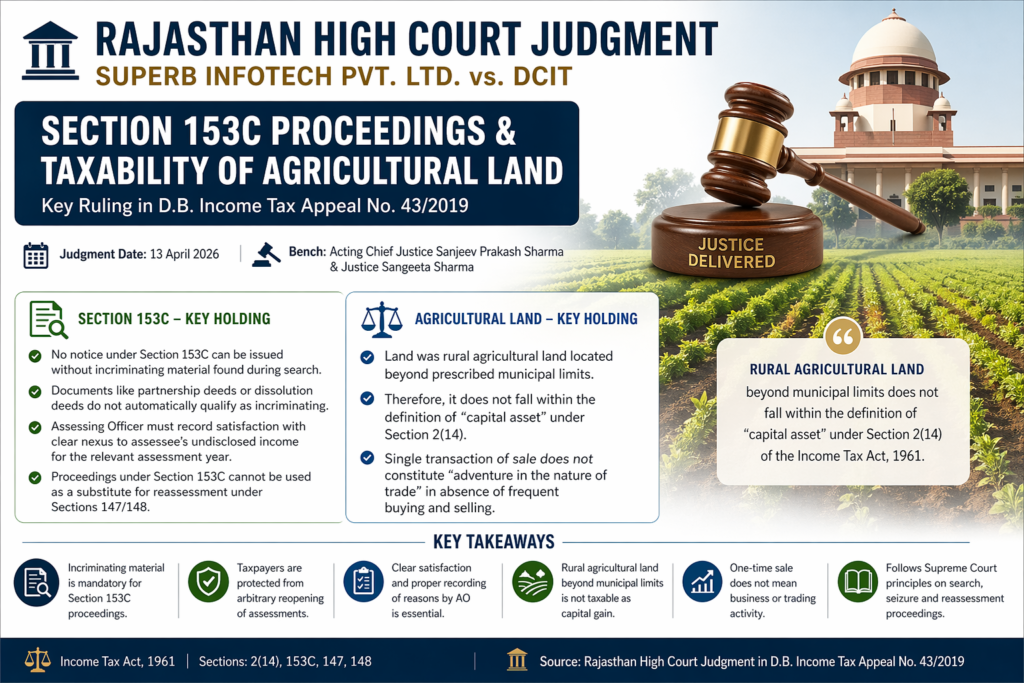
The Rajasthan High Court, in Superb Infotech Pvt. Ltd. vs. DCIT (D.B. Income Tax Appeal No. 43/2019), has delivered a significant ruling clarifying the scope of Section 153C of the Income Tax Act, 1961 and the taxability of agricultural land transactions. This judgment reinforces that reassessment proceedings under Section 153C cannot be initiated casually and must strictly comply with legal prerequisites, especially the existence of incriminating material discovered during a valid search.
The Court held that merely finding documents such as partnership deeds or dissolution deeds during a search on a third party does not automatically justify invoking Section 153C. There must be a clear nexus between the seized material and undisclosed income of the assessee for the relevant assessment year. In this case, the Assessing Officer failed to establish such linkage, and no incriminating material relating to the assessee’s income for A.Y. 2007–08 was found. Therefore, the entire reassessment proceeding was declared invalid.
Another crucial aspect addressed was whether profit from the sale of agricultural land could be taxed as business income or capital gains. The Court observed that the land in question was rural agricultural land located beyond prescribed municipal limits, and hence did not fall within the definition of a “capital asset” under Section 2(14). It further clarified that a single transaction of sale does not amount to an “adventure in the nature of trade,” especially in the absence of frequent buying and selling activities.
Importantly, the judgment reiterates the principle laid down by the Supreme Court that no addition can be made in completed assessments without incriminating material found during search proceedings. It also emphasizes that Section 153C cannot be used as a substitute for reassessment under Sections 147/148 when no new evidence is available.
In conclusion, this ruling strengthens taxpayer protection by ensuring that tax authorities follow due process before reopening assessments. It also provides clarity on the tax treatment of rural agricultural land, confirming that such transactions, when meeting statutory conditions, remain outside the scope of capital gains taxation.
Advocate in Jaipur

 Call: 7300056080
 Email: advocatebhuvneshgoyal@gmail.com
 Office: 109, Fortune Heights, Ahinsa Circle, C-Scheme, Jaipur-302001