
Legal Heirs Can Continue Criminal Appeal After Death of Victim: Rajasthan High Court Clarifies Law
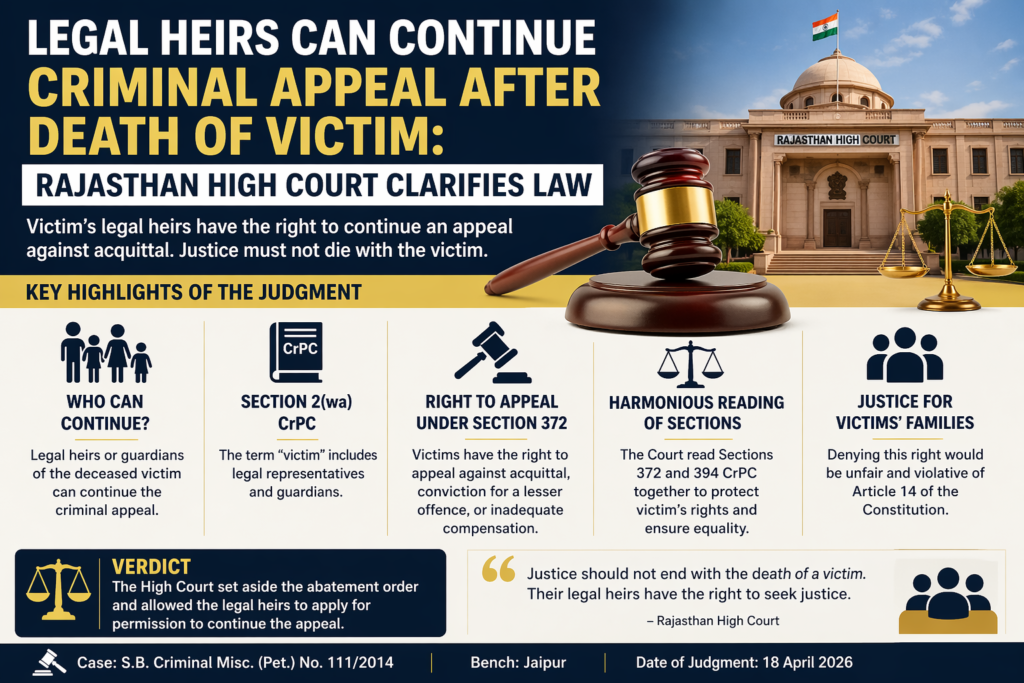
The Rajasthan High Court has recently delivered a significant judgment that strengthens the rights of victims and their families in criminal proceedings. The Court clearly held that legal heirs of a deceased victim can continue a criminal appeal against acquittal, even after the death of the original complainant. This decision brings much-needed clarity to an area where there was confusion due to gaps in the law.
In the case before the Court, the original complainant had filed a criminal case alleging fraud, forgery, and conspiracy related to land mutation. After trial, the accused were acquitted, and the complainant filed an appeal. However, during the pendency of the appeal, the complainant passed away. The appellate court dismissed the appeal as “abated” due to her death. The legal heirs then approached the High Court challenging this decision.
The central issue before the Court was whether legal heirs of a deceased victim can continue an appeal filed against acquittal. The Court examined the definition of “victim” under Section 2(wa) of the Criminal Procedure Code (CrPC), which clearly includes legal heirs and guardians. Based on this, the Court held that legal heirs step into the shoes of the victim and therefore have the right to continue legal proceedings.
Further, the Court relied on the proviso to Section 372 CrPC, which gives victims the right to appeal against acquittal, conviction for a lesser offence, or inadequate compensation. The Court interpreted this provision in a liberal and progressive manner, emphasizing that the term “victim” should not be restricted and must include legal representatives.
One of the key legal conflicts in this case was with Section 394 CrPC, which deals with abatement of appeals on the death of the appellant. Traditionally, this section allows continuation of appeals only when the accused dies, permitting their relatives to pursue the appeal. However, it does not explicitly provide the same right to the legal heirs of a victim.
The High Court resolved this conflict by adopting a purposive interpretation of the law. It held that the absence of explicit provision in Section 394 CrPC should not defeat the substantive rights granted to victims under Section 372. The Court also relied on recent Supreme Court judgments which have recognized the rights of victims and their heirs to continue appeals and prosecution.
Importantly, the Court observed that denying such a right to victims’ families would create inequality and may violate Article 14 of the Constitution. While relatives of an accused can continue appeals to protect their honour, denying the same right to victims’ families would be unjust.
Based on this reasoning, the High Court set aside the order of abatement and restored the appeal. It allowed the legal heirs to file an application seeking permission to continue the appeal, which the lower court must decide on merits.
The Court also made an important recommendation to the legislature, highlighting that Section 394 CrPC should be amended to explicitly allow legal heirs of victims to continue appeals after death. This observation shows a progressive approach towards victim rights in the criminal justice system.
In conclusion, this judgment is a landmark step in strengthening victim-centric justice in India. It ensures that legal proceedings do not end abruptly due to the death of a victim and that their family members can continue the fight for justice. This ruling will have a wide impact on criminal appeals, especially in cases involving acquittal, and provides a clear legal pathway for legal heirs to pursue justice.
Advocate in Jaipur

 Call: 7300056080
 Email: advocatebhuvneshgoyal@gmail.com
 Office: 109, Fortune Heights, Ahinsa Circle, C-Scheme, Jaipur-302001