Jaipur High Court on Transfer of Nursing Mothers: Infant Welfare and Article 21
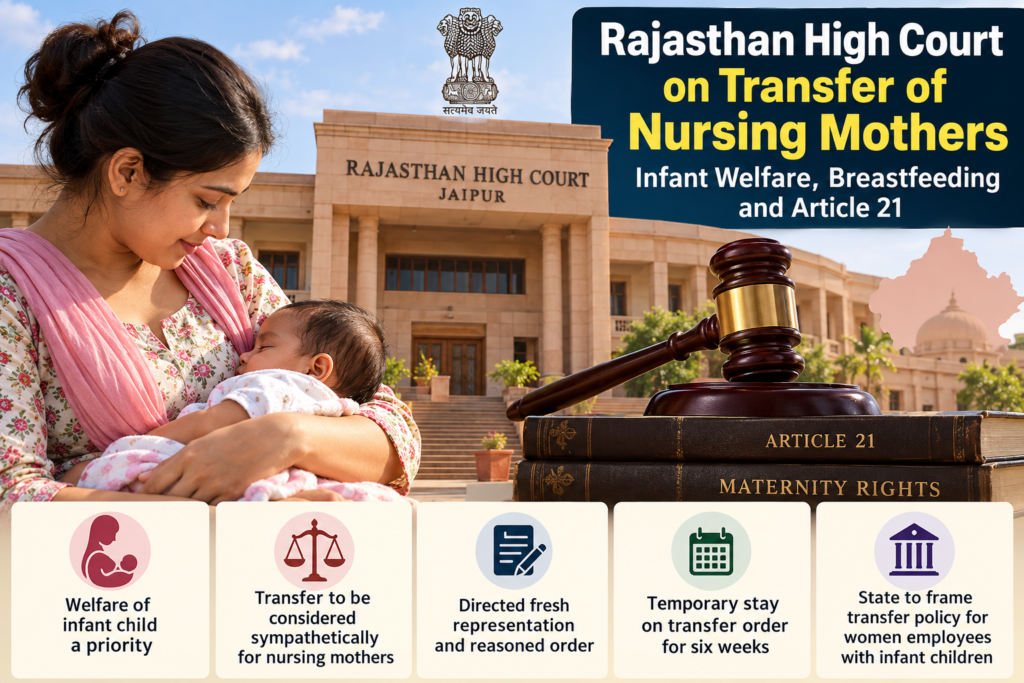
Jaipur High Court on Transfer of Nursing Mothers: Infant Welfare and Article 21 Can a government transfer a woman employee to a distant location when she has recently given birth and is caring for a two-month-old infant? Should administrative requirements take precedence over the welfare of a newborn child who depends on the mother for breastfeeding, nutrition and emotional care? These important questions came before the Rajasthan High Court, Jaipur Bench, in Suman Meena v. State of Rajasthan & Others, S.B. Civil Writ Petition No. 19649/2026. In its order dated 29 September 2026, Justice Anoop Kumar Dhand addressed the difficulties faced by a government schoolteacher who had been transferred shortly after childbirth. The Court emphasized the importance of infant welfare, maternal care, breastfeeding and a humane approach by the State when dealing with the transfer of a nursing mother. The Court directed the competent authority to reconsider the employee’s case sympathetically, ordered a temporary stay on the transfer and highlighted the need for an appropriate government transfer policy or legislation addressing the circumstances of recently delivered women employees. The judgment brings attention to an important aspect of public employment: administrative decisions involving women employees with newborn children may require consideration of the rights and welfare of both the mother and the infant. 1. Background of the Rajasthan High Court Case The case concerned Suman Meena, a Senior Teacher working at PM Shri Government Senior Secondary School, Gangapur City, District Sawai Madhopur, Rajasthan. She was transferred to Government Girls Senior Secondary School, Masalpur, District Karauli, through a transfer order dated 7 July 2026. The employee had given birth to a child on 13 May 2026, approximately two months before the transfer order was issued. The transfer created practical difficulties for the employee because her newborn child was still at an early stage of development and dependent on her for breastfeeding and maternal care. The employee challenged the transfer before the Rajasthan Civil Services Appellate Tribunal, Jaipur. However, the Tribunal rejected her appeal through an order dated 15 September 2026. Aggrieved by the Tribunal’s decision, she approached the Rajasthan High Court by filing a writ petition under its constitutional jurisdiction. The principal concern before the High Court was whether the circumstances surrounding the newborn child and the mother’s need to provide care warranted a more sensitive consideration of the transfer. 2. Why Was the Employee’s Maternity Leave Dispute Relevant? An important aspect of the case was the employee’s maternity leave history. The petitioner had previously availed maternity leave on two occasions: First maternity leave: 2 July 2020 to 28 December 2020. Second maternity leave: 13 July 2021 to 8 January 2022. During the first maternity leave period, she had given birth to a child who unfortunately passed away shortly after birth, on 2 July 2020. When she gave birth again in May 2026, her maternity leave was reportedly not granted on the technical ground that she had already availed maternity leave twice. The petitioner’s counsel argued that the earlier loss of a child and the circumstances of her latest childbirth required a compassionate assessment rather than a purely technical approach. The Court took note of the circumstances and the difficulties arising from the transfer of a recently delivered mother who was caring for an infant. It is important to distinguish the issue of maternity leave from the transfer dispute. The High Court’s operative directions concerned reconsideration of the transfer representation and temporary protection against the transfer order. The judgment did not expressly grant maternity leave or finally adjudicate the employee’s entitlement to such leave. 3. Rajasthan High Court’s Observations on Transfer of Nursing Mothers The Rajasthan High Court acknowledged the established principle that transfer is ordinarily an incident of service and that courts generally exercise restraint in interfering with administrative transfer decisions. However, the Court observed that administrative exigencies cannot be treated as an absolute justification in every circumstance. Where a transfer results in extreme hardship, particularly involving the critical care needs of an infant child, the circumstances may call for judicial consideration. The Court emphasized that the welfare of a child must receive paramount consideration when an infant’s interests are directly involved. It also observed that, as far as possible, a woman employee having an infant below one year should not be disturbed and that her case should be considered sympathetically. These observations underline the importance of examining the individual circumstances of a nursing mother before implementing a transfer that may significantly affect her ability to care for a newborn. At the same time, the Court expressly clarified that its decision was based on the peculiar facts and circumstances of the case and should not be treated as a binding precedent establishing an absolute exemption from transfer for every employee with an infant. 4. Article 21 and the Constitutional Protection of Motherhood and Infant Welfare One of the central aspects of the judgment was its discussion of Article 21 of the Constitution of India. Article 21 guarantees the right to life and personal liberty. The Court connected the welfare of the infant, maternal care, breastfeeding and the child’s development with the constitutional protection afforded by this provision. The Court observed that the right of a newborn child to receive maternal care, nutrition and development is implicit in Article 21. It also referred to Article 15(3), which enables the State to make special provisions for women and children. The judgment recognized that the relationship between a mother and a newborn infant involves more than a biological connection. It includes emotional bonding, breastfeeding, physical care and the child’s need for security during infancy. The Court further referred to the importance of the first six months of exclusive breastfeeding, recognizing the significance of this period for a child’s physical, mental and emotional development. In the circumstances before it, the Court considered that transferring the mother to a distant place could create serious difficulties for the infant and the mother. The judgment thus highlights how constitutional principles relating to dignity, motherhood and child welfare
 Call: 7300056080
 Email: advocatebhuvneshgoyal@gmail.com
 Office: 109, Fortune Heights, Ahinsa Circle, C-Scheme, Jaipur-302001