Jaipur High Court Granted Bail in Rape Case: Prolonged Relationship, Consent and Promise of Marriage Considered
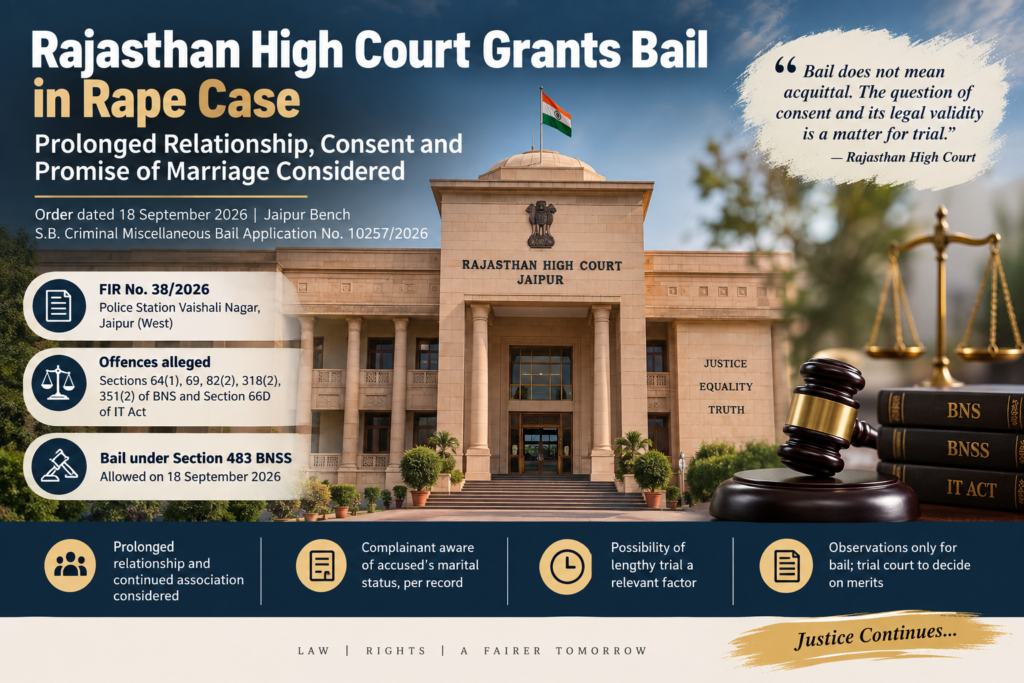
Jaipur High Court Granted Bail in Rape Case Prolonged Relationship, Consent and Promise of Marriage Considered The Rajasthan High Court, Jaipur Bench, has granted bail to an accused in a case involving allegations of rape, deception, promise of marriage, harassment and other offences under the Bharatiya Nyaya Sanhita, 2023 (BNS) and the Information Technology Act. The order was passed on 18 September 2026 by Hon’ble Mr. Justice Farjand Ali in S.B. Criminal Miscellaneous Bail Application No. 10257/2026, arising out of FIR No. 38/2026 registered at Police Station Vaishali Nagar, Jaipur (West). The bail application was filed under Section 483 of the Bharatiya Nagarik Suraksha Sanhita, 2023 (BNSS). The decision is particularly relevant to bail proceedings where the prosecution case concerns a relationship between two adults, allegations relating to a promise of marriage, and questions surrounding the nature and voluntariness of the physical relationship. The Court, while deciding the bail application, specifically examined the duration and nature of the relationship, repeated meetings, travelling and staying together, continuation of physical relations, and the complainant’s knowledge of the accused’s existing marital status. Importantly, the High Court clarified that its observations were confined to the consideration of bail and would not prejudice the trial court while deciding the case on merits. What Was the Case Before the Rajasthan High Court? The accused-petitioner was Dinesh, aged about 48 years, who was confined at Central Jail, Jaipur. The case arose from FIR No. 38/2026, registered at Police Station Vaishali Nagar, Jaipur (West). The FIR invoked: Section 64(1) BNS Section 69 BNS Section 82(2) BNS Section 318(2) BNS Section 351(2) BNS Section 66D of the Information Technology Act The order records these offences in its opening case details. The complainant, according to the FIR as recorded by the Court, was a 52-year-old divorcee residing in Pune. She allegedly came into contact with the accused through Shaadi.com, where he represented himself as a divorcee and allegedly assured her of marriage. The FIR alleged that after she came to Jaipur on 11 October 2025, the accused established physical relations with her against her will and thereafter continued the relationship on the assurance that he would marry her. The complainant further alleged that the accused repeatedly postponed the marriage and subsequently disclosed that he was already married and living with his wife and son. Allegations were also made concerning threats, harassment and pressure relating to pregnancy and miscarriage. These are allegations recorded from the FIR, and the High Court’s bail order does not constitute a final determination of their truth. What Did the Accused Argue for Bail? On behalf of the accused, it was argued that the ingredients of the alleged offences were not made out and that continued incarceration was not warranted. The defence also contended that the accused had been implicated on the basis of conjectures and surmises. The prosecution opposed the bail application and submitted that the accused should not be enlarged on bail. The High Court considered the submissions of both sides and examined the material available on record before reaching its decision on bail. Why Did the Rajasthan High Court Grant Bail? One of the most significant aspects of the order is the Court’s examination of the overall nature and duration of the relationship. The Court noted that the material on record indicated that the complainant had: remained in the company of the petitioner for a considerable period; voluntarily accompanied him on several occasions; travelled with him; stayed with him at different places; met him repeatedly; and continued physical relations over a substantial period. The Court observed that these circumstances, taken cumulatively, prima facie indicated her continued association with the petitioner. The Court also noted that, according to the material available on record, the complainant was aware that the petitioner was married and nevertheless continued associating with him for a considerable period. This aspect became one of the circumstances considered by the Court while deciding the bail application. Rajasthan High Court on Consent in a Rape Case A particularly important portion of the order concerns the distinction between consent and subsequent grievance or disappointment arising from a relationship. The Court observed that an allegation of rape necessarily involves sexual intercourse against the will or without the consent of the prosecutrix. However, at the stage of bail, the Court found that the circumstances emerging from the record did not disclose a continuous absence of willingness on the complainant’s part. The Court referred to the prolonged association, repeated meetings, travelling together, staying together and continuation of physical relations over a considerable period as circumstances that were, at that stage, suggestive of voluntary participation in the relationship. This observation was made for the limited purpose of deciding bail. What Did the Court Say About the Promise of Marriage? The Court also considered the subsequent revelation regarding the accused’s marital status and the fact that the relationship did not culminate in marriage. The Court observed that these circumstances could undoubtedly have caused distress and grievance to the complainant. However, it held that such subsequent events, by themselves, could not retrospectively render every act of physical intimacy between the parties as an act committed against her will. The Court emphasised that the surrounding circumstances and conduct of the parties must be considered in their entirety. This is an important aspect for understanding the order: the Court did not finally decide whether the complainant’s consent was legally valid or whether it was vitiated. Rather, the Court expressly stated that this ultimate question would have to be examined at the appropriate stage of trial. Did the Rajasthan High Court Decide the Accused Was Innocent? No. The order is a bail order, not a judgment after trial. The Court specifically stated that the question of whether the complainant consented to the physical relationship and whether such consent was legally vitiated was a matter to be examined at the appropriate stage of trial. Further, while granting bail, the Court expressly stated that it was not expressing any final opinion on the merits of
 Call: 7300056080
 Email: advocatebhuvneshgoyal@gmail.com
 Office: 109, Fortune Heights, Ahinsa Circle, C-Scheme, Jaipur-302001