Delayed Written Statement Under Order 8 Rule 1 CPC – Condonation Upheld – Jaipur Rajasthan High Court
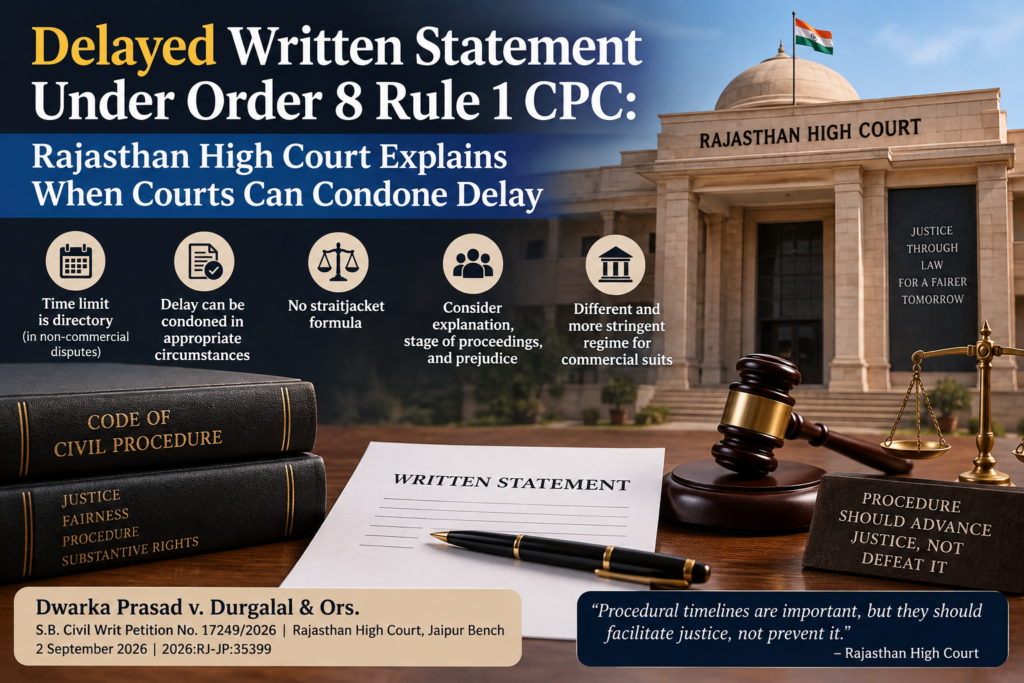
Delayed Written Statement Under Order 8 Rule 1 CPC – Condonation Upheld – Jaipur Rajasthan High Court The question of whether a civil court can accept a written statement filed beyond the prescribed period under Order 8 Rule 1 of the Code of Civil Procedure, 1908 (CPC) continues to arise frequently in civil litigation. A recent reportable judgment of the Rajasthan High Court, Jaipur Bench, has once again examined this issue and clarified that, particularly in non-commercial disputes, the court retains jurisdiction to condone delay and take a belated written statement on record, provided there is a satisfactory justification or explanation for the delay. The judgment was delivered by Hon’ble Mr. Justice Sudesh Bansal on 2 September 2026 in Dwarka Prasad v. Durgalal & Ors., S.B. Civil Writ Petition No. 17249/2026. The judgment is particularly important because it discusses the interplay between Order 8 Rule 1 CPC, procedural timelines, the discretion of the trial court, prejudice to the opposite party, and the distinction between commercial and non-commercial disputes. What Was the Issue Before the Rajasthan High Court? The petitioner had instituted a civil suit for permanent injunction in 2021 against several defendants. The trial court had held service of summons sufficient on the defendants. However, while several defendants appeared through their respective advocates, Defendant No. 3 did not initially appear. Importantly, the trial court did not pass an order proceeding against Defendant No. 3 ex parte, nor did it pass an order forfeiting his right to file a written statement. The litigation continued for several years. Defendant No. 3 eventually entered appearance on 21 January 2026 and filed an application under Order 9 Rule 7 CPC. That application was subsequently withdrawn on 12 March 2026 because there had never been an order directing that he be proceeded against ex parte. Thereafter, Defendant No. 3 filed his written statement on 23 April 2026, accompanied by an application seeking condonation of delay. The trial court accepted the explanation, condoned the delay and permitted the written statement to be taken on record, subject to payment of ₹1,000 as costs to Legal Aid. The plaintiff challenged that order before the Rajasthan High Court under Article 227 of the Constitution of India. What Does Order 8 Rule 1 CPC Say About Filing a Written Statement? Order 8 Rule 1 CPC prescribes the timeline within which a defendant is expected to present a written statement. The provision is intended to prevent unnecessary delay in civil proceedings and to ensure that the defendant’s defence is placed before the court within the prescribed period. However, the important question is: Can a court accept a written statement after expiry of the statutory period? According to the line of Supreme Court judgments considered by the Rajasthan High Court, the answer depends upon the nature of the proceeding and the circumstances of the particular case. In non-commercial disputes, the time schedule under Order 8 Rule 1 CPC has been treated as directory rather than absolutely mandatory, although this does not mean that defendants have an unrestricted right to file written statements whenever they choose. Supreme Court’s Decision in Kailash v. Nanhku The Rajasthan High Court relied upon the landmark Supreme Court judgment in Kailash v. Nanhku & Ors., AIR 2005 SC 2441. The Supreme Court had considered the nature of the time limit prescribed under Order 8 Rule 1 CPC and held that the provision is essentially directory in nature. The objective of prescribing a time limit is to expedite the proceedings and not to scuttle the hearing. The Rajasthan High Court reiterated that the court’s power to extend the time for filing a written statement is not completely taken away by Order 8 Rule 1 CPC. This distinction is crucial. Directory does not mean optional A common misconception is that if Order 8 Rule 1 CPC is directory, a defendant can file a written statement at any stage without consequence. That is not the correct position. The court still has to consider: the length of the delay; the explanation offered for the delay; the circumstances of the case; the stage of the proceedings; prejudice caused to the plaintiff; the purpose behind the procedural timeline; and whether accepting the written statement would frustrate the objective of expeditious disposal. The discretion is therefore judicial discretion, not an automatic entitlement. What Did Atcom Technologies Say? The Rajasthan High Court also referred to the Supreme Court’s decision in Atcom Technologies Ltd. v. Y.A. Chunawala & Co. & Ors., (2018) 6 SCC 639. As noted by the High Court, the Supreme Court considered the period prescribed under Order 8 Rule 1 CPC and held that the proviso permits the court, for sufficient reasons, to extend the initial period of 30 days up to 90 days from the date of service of summons. At the same time, the Supreme Court recognised that the power of the court to accept a written statement beyond the prescribed period had not been completely taken away in non-commercial matters because the provision concerns procedural law. Thus, the law is not simply: 90 days expired = written statement can never be accepted. Rather, in an ordinary civil/non-commercial dispute, the court may still have jurisdiction to consider a belated written statement in appropriate circumstances. What Did Desh Raj v. Balkishan Add? The petitioner in the Rajasthan High Court relied upon the Supreme Court’s decision in Desh Raj v. Balkishan (D) through proposed LR Ms. Rohini, (2020) 2 SCC 708. The High Court observed that Desh Raj followed and reiterated the principles laid down in Kailash and Atcom Technologies. However, the Supreme Court had also cautioned that routine condonation of delay and a cavalier attitude towards procedural timelines should not be encouraged because such conduct can adversely affect the administration of justice. This creates an important balance: Courts have discretion—but discretion must not become routine indulgence. Rajasthan High Court’s Key Finding The Rajasthan High Court summarised the legal position in particularly clear terms. The court held that in a non-commercial dispute, it
 Call: 7300056080
 Email: advocatebhuvneshgoyal@gmail.com
 Office: 109, Fortune Heights, Ahinsa Circle, C-Scheme, Jaipur-302001