POCSO Case Procedure: FIR to Trial & Judgment
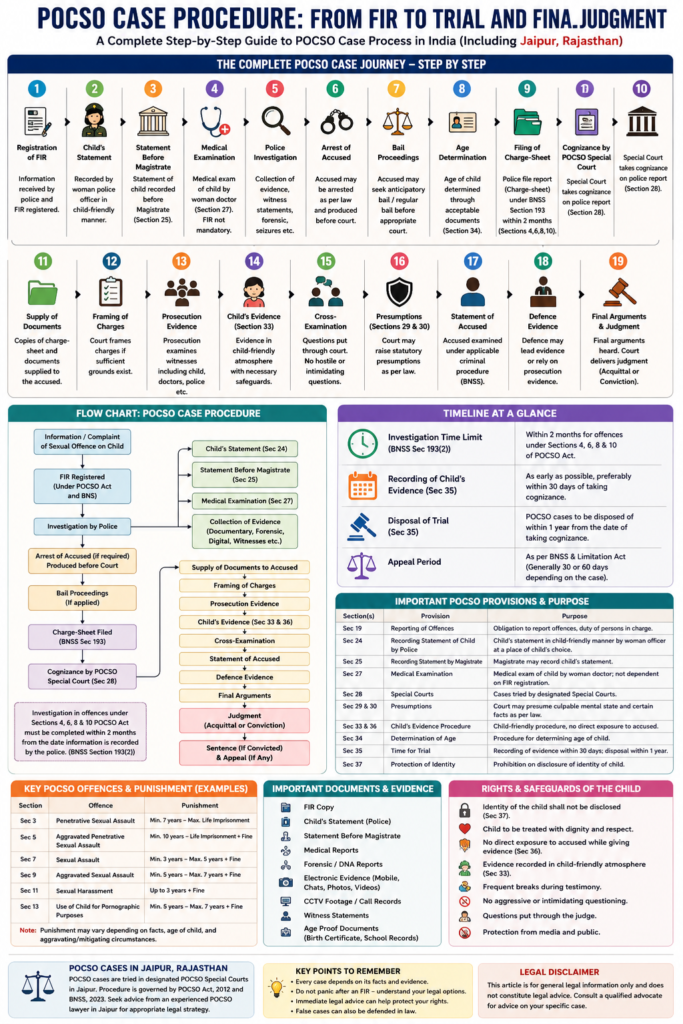
POCSO Case Procedure: FIR to Trial & Judgment A POCSO case can be significantly different from an ordinary criminal case because the Protection of Children from Sexual Offences Act, 2012 (POCSO Act) provides special procedures for reporting, investigation, recording of the child’s statement, medical examination, trial and protection of the child’s identity. If an FIR is registered under the POCSO Act, the accused and the victim’s family should understand the complete legal process—from registration of FIR and police investigation to arrest, bail, filing of the charge-sheet, framing of charges, evidence, cross-examination, final arguments and judgment. This article explains the POCSO case procedure in India, including the procedure followed before POCSO Special Courts in Jaipur, Rajasthan, and other parts of the country. Important: The procedural law applicable to criminal investigations and trials has changed with the introduction of the Bharatiya Nagarik Suraksha Sanhita, 2023 (BNSS). For cases governed by the new criminal laws, relevant BNSS provisions apply alongside the POCSO Act. What Is a POCSO Case? The POCSO Act is a special legislation enacted to protect children below the age of 18 years from sexual assault, sexual harassment and pornography-related offences. The Act covers offences including: Penetrative sexual assault under Section 3 Aggravated penetrative sexual assault under Section 5 Sexual assault under Section 7 Aggravated sexual assault under Section 9 Sexual harassment under Section 11 Use of a child for pornographic purposes under Section 13 Abetment and attempt of POCSO offences The Act also establishes a special procedure intended to make the investigation and trial more child-friendly. Sections 24 to 40 of the Act deal extensively with recording of statements, medical examination, Special Courts, presumptions, trial procedure and protection of the child during evidence. POCSO Case Procedure: Step-by-Step The broad procedure in a POCSO case can be understood as follows: Complaint/Information → FIR → Child’s Statement → Medical Examination → Investigation → Arrest/Bail → Collection of Evidence → Charge-Sheet → Cognizance → Supply of Documents → Framing of Charges → Prosecution Evidence → Cross-Examination → Statement of Accused → Defence Evidence → Final Arguments → Judgment → Appeal Stage What Happens Important Point 1. FIR Police register information regarding alleged offence POCSO + BNS sections may be invoked 2. Child’s Statement Statement recorded in child-friendly manner Section 24 POCSO 3.Magistrate Statement Statement may be recorded before Magistrate Section 25 POCSO / applicable BNSS provision 4. Medical Examination Child medically examined Section 27 POCSO 5. Investigation Police collect documentary, forensic, digital and oral evidence Investigation strategy is critical 6. Arrest Accused may be arrested depending on facts and law Arrest and FIR are separate issues 7. Bail Accused can seek appropriate bail remedy Depends on offence and stage 8. Age Determination Court determines whether victim was below 18 Extremely important in many cases 9. Charge-sheet Police submit investigation report Section 193 BNSS 10. Special Court POCSO Special Court proceeds with case Section 28 POCSO 11. Charges Court determines offences for trial Defence can challenge prosecution case where legally permissible 12. Prosecution Evidence Prosecution examines witnesses Includes child, doctors, police, forensic witnesses etc. 13. Cross-examination Defence tests prosecution evidence Subject to child-protection safeguards 14. Accused Statement Accused is examined regarding circumstances appearing against him Applicable BNSS procedure 15. Defence Evidence Defence may produce evidence Not mandatory in every case 16. Final Arguments Both sides present their case Evidence is analysed as a whole 17. Judgment Court acquits or convicts Reasons must be recorded 18. Sentence Sentence considered after conviction Depends on applicable POCSO offence 19. Appeal Aggrieved party may pursue statutory appellate remedy Forum and limitation depend on applicable law Each stage is explained below. 1. Registration of FIR in a POCSO Case A POCSO case ordinarily begins when information regarding an alleged sexual offence against a child reaches the police. Section 19 of the POCSO Act imposes obligations relating to reporting of offences. Once information discloses a cognizable offence, the police can register an FIR and commence investigation. Under the present criminal procedure framework, Section 173 of the BNSS deals with information relating to cognizable offences. The FIR may contain allegations attracting provisions of both: POCSO Act; and Bharatiya Nyaya Sanhita, 2023 (BNS). For example, depending upon the allegations and facts, a case may involve POCSO provisions along with provisions relating to rape, kidnapping, criminal intimidation or other offences under the BNS. Can a POCSO FIR be quashed? In appropriate cases, an accused may approach the High Court seeking quashing of the FIR or criminal proceedings. However, the availability of such a remedy depends heavily upon the facts, evidence, statutory provisions and the stage of the proceedings. A mere settlement between the accused and the victim’s family does not automatically terminate a POCSO prosecution. 2. Recording of the Child’s Statement One of the most important stages in a POCSO case is recording the statement of the child. Section 24 of the POCSO Act lays down special requirements for recording the child’s statement. The objective is to ensure that the child is not unnecessarily exposed to a hostile or intimidating environment. The law requires that the statement be recorded in a child-sensitive manner. The statement should, as far as practicable, be recorded: at the residence of the child or another place where the child ordinarily resides; by a woman police officer not below the rank prescribed by law; without bringing the child into contact with the accused; in a manner that does not cause unnecessary distress to the child. The law also contemplates recording through audio-video means wherever possible. 3. Statement Before the Magistrate The child’s statement may also be recorded before a Magistrate under the applicable procedural law. Under the POCSO framework, Section 25 specifically deals with recording of the statement of a child by a Magistrate. Under the current criminal procedure regime, Section 183 BNSS deals with recording of confessions and statements by a Magistrate. This statement can become an important piece of the prosecution case. However, it is important to understand that a statement recorded during investigation is not
 Call: 7300056080
 Email: advocatebhuvneshgoyal@gmail.com
 Office: 109, Fortune Heights, Ahinsa Circle, C-Scheme, Jaipur-302001