Protest Petition after filing of FR (Final Report)
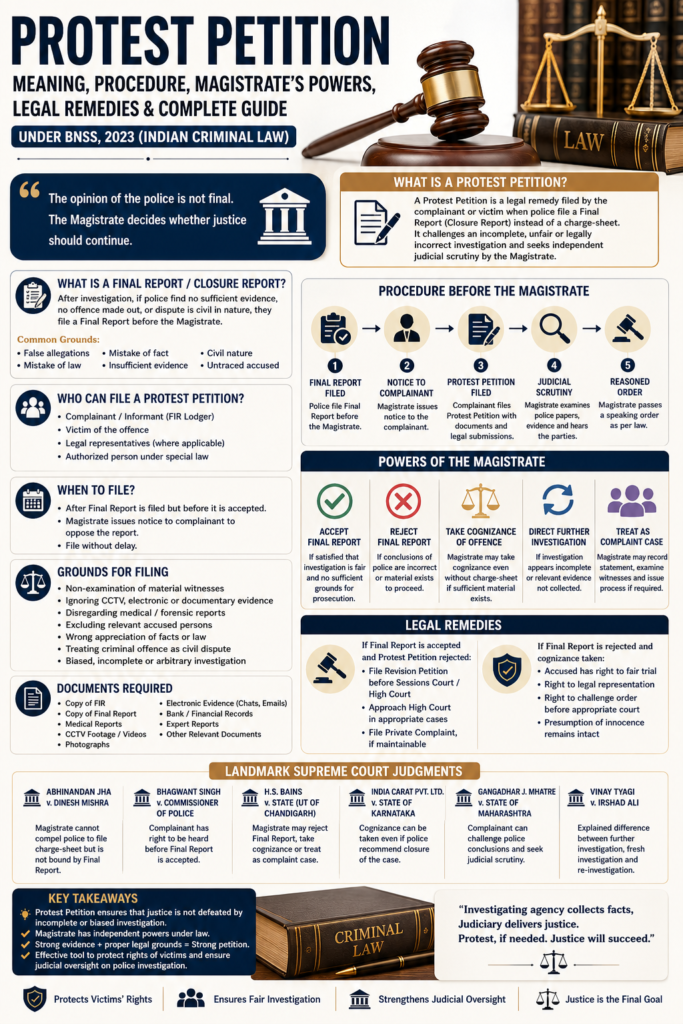
Protest Petition after filing of FR (Final Report) A Protest Petition is a legal remedy available to a complainant, informant, or victim when the police file a Final Report (Closure Report) instead of a charge-sheet after completing the investigation of a criminal case. Through a Protest Petition, the complainant requests the Judicial Magistrate to reject the police’s conclusions and independently examine whether sufficient material exists to proceed against the accused. In Indian criminal law, a Protest Petition plays a crucial role in ensuring that justice is not denied because of an incomplete, unfair, or legally incorrect police investigation. Although the Bharatiya Nagarik Suraksha Sanhita, 2023 (BNSS) does not specifically define the term “Protest Petition,” the remedy has been firmly recognized through landmark judgments of the Supreme Court of India and various High Courts. The fundamental principle governing a Protest Petition is simple: the opinion of the investigating officer is not binding upon the Magistrate. The final decision on whether criminal proceedings should continue always rests with the court. Why is a Protest Petition Important? A Protest Petition acts as an important safeguard within the Indian criminal justice system. Police officers investigate criminal offences and submit their findings before the court, but they do not determine whether the accused should ultimately face criminal proceedings. That responsibility belongs exclusively to the Magistrate. Where a complainant believes that the investigating agency has ignored material evidence, failed to examine important witnesses, misapplied the law, or conducted a biased investigation, a Protest Petition provides an opportunity to seek judicial scrutiny of the Final Report. This remedy protects victims against arbitrary investigations, strengthens judicial oversight over police action, reinforces public confidence in the administration of justice, and helps ensure that genuine criminal cases are not closed solely because of an erroneous police opinion. What is a Final Report or Closure Report? After completing the investigation of a cognizable offence, the investigating officer submits a police report before the jurisdictional Magistrate. Where sufficient evidence exists against the accused, the police file a charge-sheet recommending prosecution. Conversely, where the investigating officer concludes that there is insufficient evidence, no offence is disclosed, the allegations are false, or the dispute is civil in nature, a Final Report, also known as a Closure Report or Cancellation Report, is submitted. A Final Report may broadly be based on: False allegations; Mistake of fact; Mistake of law; Civil nature of the dispute; Insufficient evidence; Untraced accused. Importantly, the Final Report is merely the investigating officer’s opinion. The Magistrate is under no legal obligation to accept it. Is a Protest Petition Recognized under BNSS, 2023? Yes. Although the BNSS does not expressly define a Protest Petition, the legal framework governing police investigations, submission of police reports, cognizance by Magistrates, complaint proceedings, and judicial powers fully supports its maintainability. The law relating to Protest Petitions has primarily evolved through judicial precedents, particularly the decisions of the Supreme Court, which consistently hold that the Magistrate possesses independent authority to examine the police report and determine the appropriate course of action. Consequently, the remedy continues to remain fully available under the BNSS, just as it existed under the Code of Criminal Procedure, 1973. Who Can File a Protest Petition? A Protest Petition may ordinarily be filed by: The complainant or first informant who lodged the FIR. The victim of the offence. Legal representatives of the complainant or victim, where appropriate. Any person authorised under a special statute. The accused generally does not file a Protest Petition because the Final Report itself recommends closure of the criminal proceedings in the accused’s favour. When Should a Protest Petition Be Filed? A Protest Petition should ordinarily be filed after the police submit the Final Report but before the Magistrate formally accepts it. Upon receiving the Final Report, the Magistrate generally provides the complainant with an opportunity to oppose the police report before deciding whether to accept or reject it. Although neither the BNSS nor the earlier CrPC prescribes a specific limitation period for filing a Protest Petition, unnecessary delay should be avoided because acceptance of the Final Report may require the complainant to pursue alternative legal remedies before a superior court. Grounds for Filing a Protest Petition A Protest Petition should be based upon specific legal and factual deficiencies in the police investigation rather than mere dissatisfaction with its outcome. Common grounds include: Failure to examine material witnesses. Ignoring CCTV footage or electronic evidence. Failure to collect documentary evidence. Ignoring medical or forensic reports. Excluding important accused persons. Incorrect appreciation of facts. Treating a criminal offence as a purely civil dispute. Biased, incomplete, or arbitrary investigation. Failure to follow mandatory investigative procedures. Every ground should be supported by relevant facts, documents, and legal principles. How to Draft a Protest Petition A professionally drafted Protest Petition should clearly explain why the Final Report deserves to be rejected. A comprehensive Protest Petition generally includes: Details of the Court and parties. FIR number and police station. Brief facts of the case. Details of the Final Report. Deficiencies in the investigation. Evidence ignored by the police. Relevant statutory provisions. Applicable Supreme Court judgments. Supporting documents. Specific prayer seeking appropriate relief. The petition should avoid emotional allegations and instead rely upon documentary evidence, witness statements, and established legal principles. Documents Required with a Protest Petition Although the documents vary according to the facts of each case, the following documents are commonly annexed: Copy of the FIR. Copy of the Final Report. Medical reports. Certified copies of relevant documents. Photographs and videos. CCTV footage. WhatsApp chats, emails, and other electronic evidence. Expert opinions. Bank records or financial documents, where relevant. Identity documents and authorisations, where necessary. Strong documentary evidence significantly strengthens the credibility of a Protest Petition. Procedure Before the Magistrate The procedure generally follows these stages: The police complete the investigation and submit a Final Report before the Magistrate. The court examines the police papers and ordinarily issues notice to the complainant. The complainant then files a Protest Petition challenging the police report along
 Call: 7300056080
 Email: advocatebhuvneshgoyal@gmail.com
 Office: 109, Fortune Heights, Ahinsa Circle, C-Scheme, Jaipur-302001