Rajasthan High Court: No Concept of Criminal Writ Petition Under the Constitution
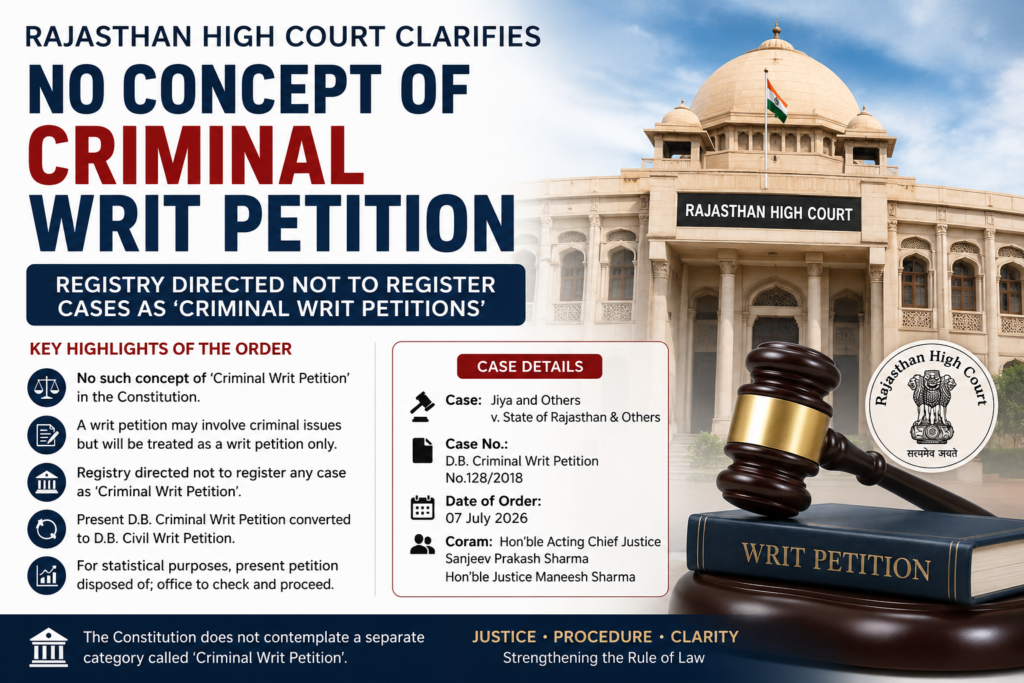
Rajasthan High Court: No Concept of Criminal Writ Petition Under the Constitution In a significant procedural ruling, the Rajasthan High Court, Jaipur Bench, has clarified that there is no separate concept of a “Criminal Writ Petition” under the Constitution of India. The Court directed the Registry not to register any case under the category of “Criminal Writ Petition” in the future. The Division Bench observed that although a writ petition may raise issues connected with a criminal matter, its criminal subject matter does not convert it into a separate constitutional category called a “Criminal Writ Petition.” Such proceedings are to be registered simply as writ petitions, while the Court may examine their nature for placement before the appropriate roster or Bench. The ruling in Jiya and Others v. State of Rajasthan and Others provides important guidance regarding the classification, registration and listing of writ petitions involving criminal law issues before the Rajasthan High Court. Case: Jiya and Others v. State of Rajasthan and OthersCourt: Rajasthan High Court, Jaipur BenchCase No.: D.B. Criminal Writ Petition No. 128/2018Date of Order: 07 July 2026Coram: Hon’ble Acting Chief Justice Mr. Sanjeev Prakash Sharma and Hon’ble Mr. Justice Maneesh Sharma Background of the Case The petition was instituted before the Rajasthan High Court as D.B. Criminal Writ Petition No. 128/2018. The Registry had also entertained and registered the matter as a criminal writ petition. While considering the matter, the Division Bench examined whether the Constitution recognises “Criminal Writ Petition” as an independent category of legal proceeding. The Court noted that the petition had earlier been adjourned sine die without any plausible reason. While dealing with its procedural status, the Court addressed the broader issue concerning the registration of cases as criminal writ petitions. No Concept of “Criminal Writ Petition” Under the Constitution The principal observation made by the Rajasthan High Court was that the Constitution does not provide for a separate category known as a “Criminal Writ Petition.” The Court observed: “A writ petition can be filed for raising the issues which may also relate to a criminal matter but the same would not be treated as a ‘Criminal Writ Petition’ and the same can only be registered as a writ petition alone.” This clarification distinguishes the nature of the issue raised in a writ petition from the constitutional character of the proceeding. A writ petition may involve issues such as: Police inaction; Illegal detention; Protection of life and personal liberty; Unlawful exercise of police powers; Failure to register an FIR; Improper criminal investigation; Violation of fundamental rights during criminal proceedings; or Illegal or arbitrary action by law-enforcement authorities. However, merely because the subject matter relates to criminal law does not create a separate constitutional proceeding called a “Criminal Writ Petition.” Registry Directed Not to Register Criminal Writ Petitions The Rajasthan High Court issued a clear direction that, henceforth, the Registry shall not register any case as a “Criminal Writ Petition.” The Court clarified that it is for the Court to examine the nature of a case and determine its placement before the appropriate roster. The Registry’s role is to register the proceeding as a writ petition rather than create a separate classification based solely on whether the dispute involves a criminal issue. This direction is likely to bring greater procedural consistency in the registration and classification of writ petitions before the Rajasthan High Court. Existing Criminal Writ Petition Converted into Civil Writ Petition In the present matter, the Court directed the Registry to treat the existing D.B. Criminal Writ Petition as a D.B. Civil Writ Petition. The Court further stated that, for statistical purposes, the D.B. Criminal Writ Petition would stand disposed of. However, the office was directed to check the matter and proceed further. Therefore, the order appears to deal primarily with the procedural classification of the petition rather than deciding the substantive rights or claims raised by the petitioners. Does the Judgment Bar Writ Petitions in Criminal Matters? No. The judgment does not prohibit a person from approaching the High Court through a writ petition merely because the dispute relates to a criminal matter. The Court expressly recognised that a writ petition may raise issues connected with criminal law. The ruling concerns the nomenclature and registration category of such petitions. Accordingly, where a person alleges a violation of fundamental or legal rights arising from police action, investigation, detention or another criminal-law-related issue, an appropriate writ petition may still be maintainable, subject to the facts of the case and applicable legal principles. The effect of the ruling is that such a petition should not be separately classified or registered as a “Criminal Writ Petition.” Difference Between a Criminal Writ Petition and a Writ Petition Involving Criminal Issues Following this judgment, the distinction may be understood as follows: Particular Position Clarified by the Rajasthan High Court Criminal Writ Petition as a separate category Not contemplated under the Constitution Writ petition involving a criminal issue May be filed in an appropriate case Registration by the High Court Registry To be registered as a writ petition Nature of dispute May still involve criminal law or police action Placement before the appropriate Bench To be examined according to the Court’s roster Existing petition in the present case Directed to be treated as a D.B. Civil Writ Petition Practical Impact of the Rajasthan High Court Judgment The judgment may have important procedural implications for advocates, litigants and the Rajasthan High Court Registry. First, petitions involving criminal issues may continue to invoke the constitutional writ jurisdiction of the High Court where legally maintainable. However, such petitions should not be treated as belonging to a separate constitutional category merely because the underlying dispute relates to criminal law. Second, the Registry has been expressly directed not to register future matters as criminal writ petitions. Third, the Court retains the authority to examine the nature of the dispute and determine the appropriate roster or Bench before which the matter should be placed. Fourth, advocates filing writ petitions concerning police action, personal
 Call: 7300056080
 Email: advocatebhuvneshgoyal@gmail.com
 Office: 109, Fortune Heights, Ahinsa Circle, C-Scheme, Jaipur-302001