Jaipur High Court on Power of High Court Under Section 311 CrPC / Section 348 BNSS to Summon Material Witness
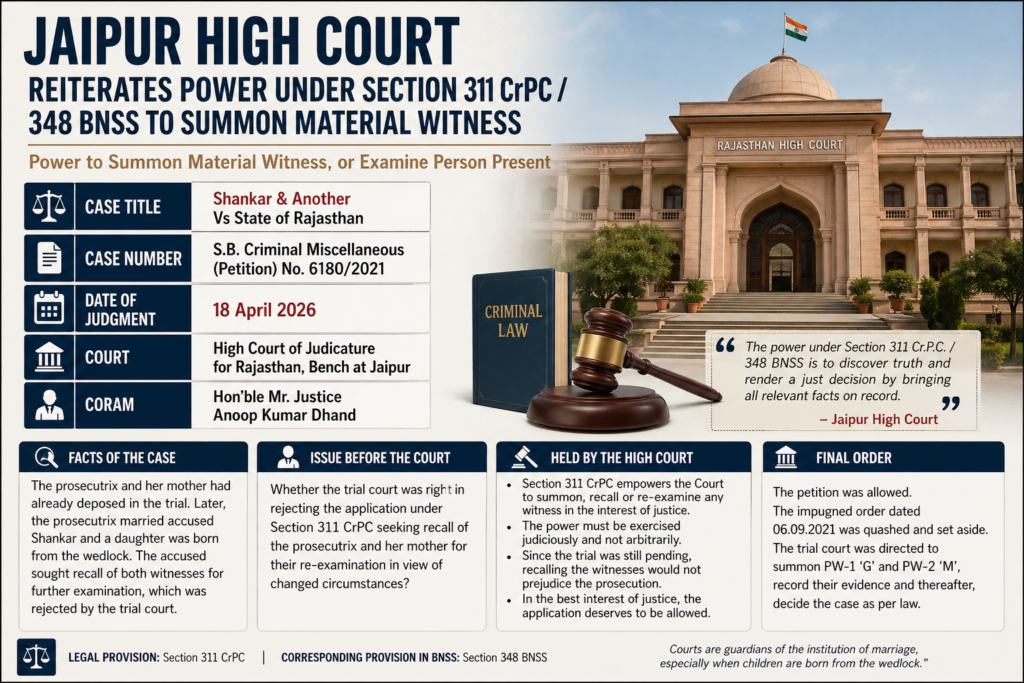
Jaipur High Court on Power of High Court Under Section 311 CrPC / Section 348 BNSS to Summon Material Witness In an important ruling concerning the power of High Court under Section 311 CrPC / Section 348 BNSS, the Jaipur High Court reaffirmed that criminal courts possess wide authority to summon any material witness, recall witnesses already examined, or examine any person present before the court whenever such evidence is necessary for a just decision. The judgment was delivered in Shankar & Anr. Vs State of Rajasthan, S.B. Criminal Miscellaneous (Petition) No. 6180/2021, decided on 18/04/2026 by Hon’ble Mr. Justice Anoop Kumar Dhand. Case Title, Number and Date of Judgment Case Title: Shankar & Another Vs State of RajasthanCase Number: S.B. Criminal Miscellaneous (Petition) No. 6180/2021Court: High Court of Judicature for Rajasthan, Bench at JaipurDate of Judgment: 18 April 2026 Facts Considered by Jaipur High Court The accused persons were facing trial for offences under Sections 376, 363 and 366 IPC along with provisions of the POCSO Act. During trial, statements of the prosecutrix and her mother had already been recorded. Later, a changed circumstance arose when the prosecutrix married one of the accused, namely Shankar, and from the marriage a daughter was born. Thereafter, the accused moved an application seeking recall of the prosecutrix and her mother for fresh examination in view of subsequent events. The trial court rejected the application on 06.09.2021, which was challenged before the Jaipur High Court. Power to Summon Material Witness or Examine Person Present The Jaipur High Court held that the object of Section 311 CrPC is to enable the court to discover truth and render a just decision after bringing all relevant facts on record. The Court observed that this power must be exercised judiciously and not arbitrarily. It further clarified that the provision cannot be used merely to fill lacunae in prosecution or defence, but can certainly be invoked where fresh evidence is necessary in the interest of justice. Section 311 CrPC / Section 348 BNSS: Court may summon, recall, or re-examine witnesses in the interest of justicetext{Section 311 CrPC / Section 348 BNSS: Court may summon, recall, or re-examine witnesses in the interest of justice}Section 311 CrPC / Section 348 BNSS: Court may summon, recall, or re-examine witnesses in the interest of justice The High Court specifically noted that since the trial was still pending, recalling the prosecutrix and her mother would not prejudice the prosecution. Rather, their further statements could assist the court in properly adjudicating the matter after considering changed circumstances. Jaipur High Court Set Aside Trial Court Order Allowing the petition, the Jaipur High Court quashed the order dated 06.09.2021 and directed the trial court to summon PW-1 and PW-2 again, record their evidence, and thereafter decide the case strictly in accordance with law. This judgment is a significant precedent on the power to summon material witness, or examine person present, showing that courts can revisit evidence where justice so requires. Legal Significance Under BNSS After replacement of CrPC by BNSS, the corresponding provision is Section 348 BNSS. Therefore, the principle laid down by the Jaipur High Court remains highly relevant even today. Courts continue to retain authority to summon any witness, recall witnesses already examined, and secure the best available evidence for a fair trial. Bhuvnesh Kumar GoyalAdvocate in Jaipur
Jaipur High Court Sets Aside RTI Second Appeal Order: Major Relief in RTI Matter Against Rajasthan State Information Commission, Jaipur
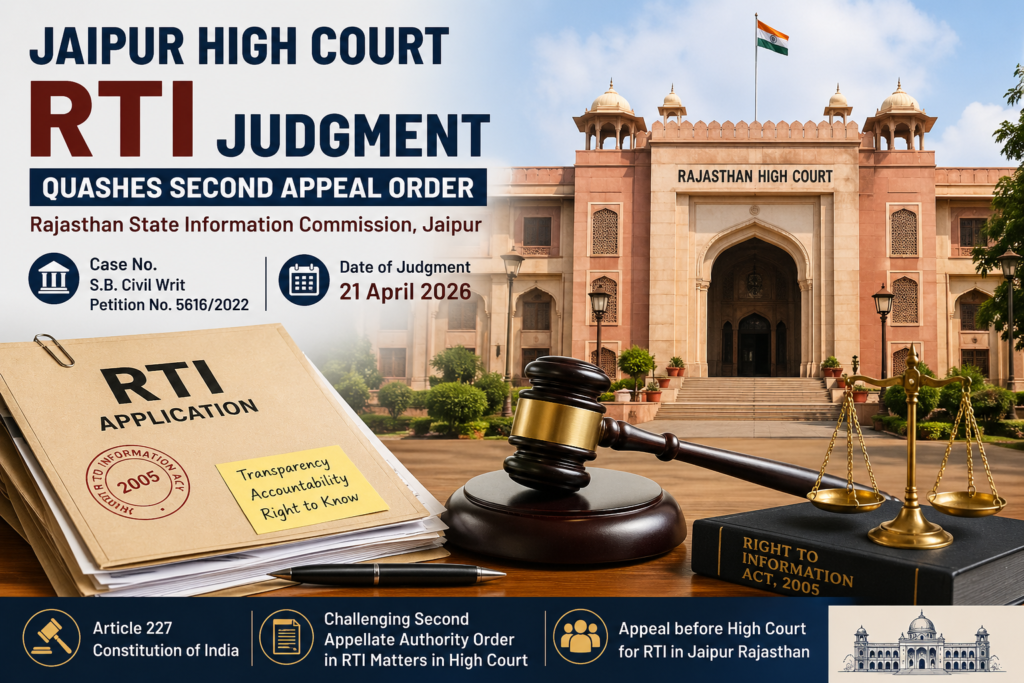
Jaipur High Court Sets Aside RTI Second Appeal Order: Major Relief in RTI Matter Against Rajasthan State Information Commission, Jaipur In an important judgment for transparency and citizens’ rights, the Jaipur High Court has quashed an order passed by the Rajasthan State Information Commission, Jaipur, holding that information under the RTI Act cannot be denied merely because the records relate to events more than twenty years old. The Court clarified that Section 8(3) of the Right to Information Act actually supports disclosure after twenty years rather than blocking it. This ruling is highly relevant for anyone considering challenging second appellate authority order in RTI matters in High Court or filing an appeal before High Court for RTI in Jaipur Rajasthan. Case Title, Date of Judgment and Case Number Case Title: Dr. Mahipal Singh Sihag vs State Public Information Officer Cum Commissioner & AnotherCase Number: S.B. Civil Writ Petition No. 5616/2022Court: High Court of Judicature for Rajasthan, Bench at JaipurJudge: Hon’ble Mr. Justice Sameer JainDate of Judgment: 21 April 2026 Background of the RTI Dispute The petitioner had filed an RTI application seeking service-related information regarding a third-party public servant, including joining date, retirement date, office orders and note sheets. The Public Information Officer rejected the request stating that the matter related to a third party and concerned events more than twenty years old. The first appeal was dismissed, and thereafter the Rajasthan State Information Commission, Jaipur, acting as the second appellate authority, also rejected the appeal on 18.12.2021. Aggrieved by this, the petitioner approached the Jaipur High Court under Article 227 of the Constitution. Jaipur High Court Findings on RTI Law The Jaipur High Court strongly criticised the reasoning adopted by the appellate authorities. The Court held that Section 8(3) of the RTI Act is a “sunset clause”, meaning that after twenty years most exemptions lose force and disclosure should ordinarily be allowed. Therefore, using the twenty-year rule as a ground to deny information was legally incorrect. The Court further observed that where third-party information is involved, the authority must follow the procedure under Section 11 of the RTI Act by issuing notice to the concerned third party and balancing privacy rights with public interest. The second appellate authority failed to follow this mandatory legal process. Final Order Passed by High Court The Jaipur High Court quashed the order dated 18.12.2021 passed by the second appellate authority. The Court directed the competent authority to supply the requested information to the petitioner within sixty days. It also directed the Registrar (Judicial) to send a copy of the judgment to the Rajasthan State Information Commission, Jaipur for compliance. Why This Judgment is Important for RTI Applicants in Rajasthan This judgment is a strong precedent for citizens seeking transparency. It confirms that when an unjust order is passed by the Information Commission, parties may consider challenging second appellate authority order in RTI matters in High Court. It also strengthens the legal route of filing an appeal before High Court for RTI in Jaipur Rajasthan where statutory authorities misinterpret the RTI Act. For litigants and advocates dealing with RTI disputes, this ruling from the Jaipur High Court sends a clear message that authorities must act according to law and cannot reject applications on arbitrary grounds Bhuvnesh Kumar GoyalAdvocate in Jaipur
 Call: 7300056080
 Email: advocatebhuvneshgoyal@gmail.com
 Office: 109, Fortune Heights, Ahinsa Circle, C-Scheme, Jaipur-302001