Rajasthan HC: Recovery Alone Not Enough in Bribery Case
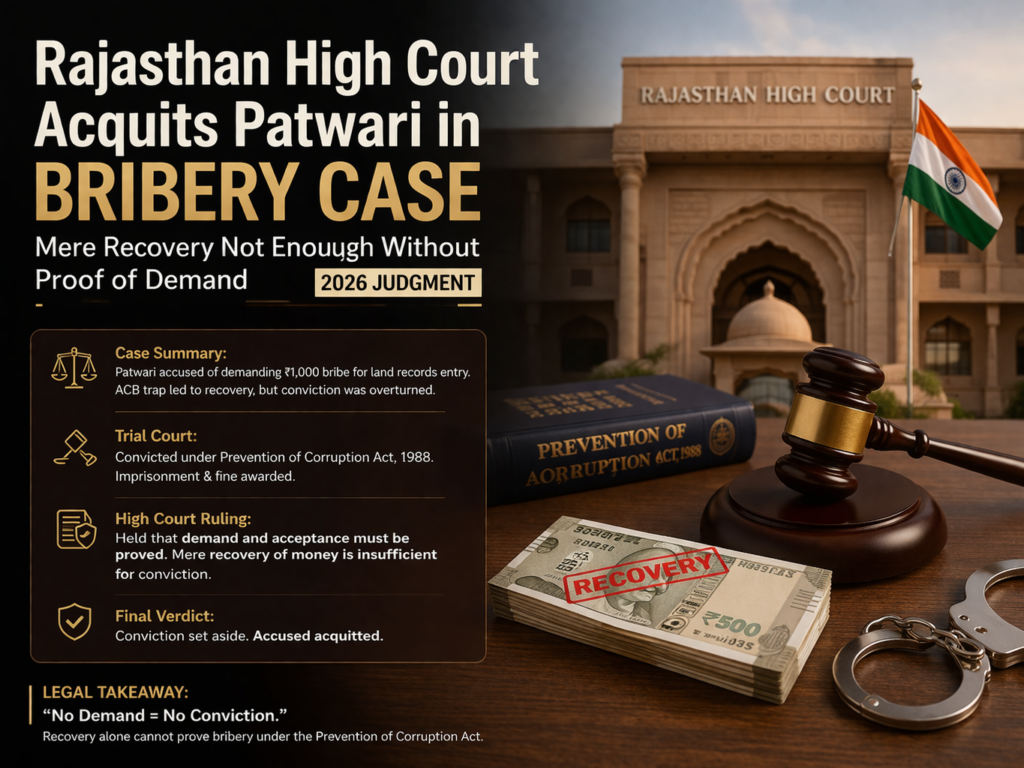
Rajasthan High Court Acquits Patwari in Bribery Case : Mere Recovery Not Enough Without Proof of Demand (2026 Judgment) In a significant judgment dated 19 March 2026, the Rajasthan High Court (Jaipur Bench) acquitted a Patwari who had earlier been convicted under the Prevention of Corruption Act, 1988. The Court clearly held that mere recovery of money is not enough to prove a bribery offence unless the prosecution is able to establish both demand and acceptance of illegal gratification beyond reasonable doubt. The case, Mohan Lal Gupta vs State of Rajasthan, arose from allegations that the accused Patwari demanded ₹1,000 from the complainant for entering certain land records. Based on the complaint, the Anti-Corruption Bureau arranged a trap and claimed to have recovered the bribe amount from the accused. The trial court relied on this recovery and convicted the accused under Sections 7 and 13 of the Prevention of Corruption Act, awarding imprisonment and fine. However, before the High Court, the accused strongly challenged the conviction. It was argued that he was not responsible for the work related to the complainant’s land and that the relevant work had already been completed earlier. The defence also pointed out that the complainant did not fully support the prosecution’s version, and there were multiple contradictions in the statements of witnesses. It was further contended that the alleged recovery of money was not properly linked to any illegal demand or acceptance. While examining the case, the High Court focused on the core legal requirement in corruption cases — proof of demand and acceptance of bribe. The Court reiterated that demand of illegal gratification is the foundation of an offence under the Prevention of Corruption Act. Without clear and reliable evidence of demand, a conviction cannot be sustained. The Court also emphasized that even if money is recovered from the accused, it must be shown that the accused knowingly accepted it as a bribe. Relying on settled law laid down by the Supreme Court, the High Court held that mere recovery of currency notes does not automatically establish guilt. The prosecution must prove a complete chain of events, starting from demand, followed by acceptance, and then recovery. If the initial demand itself is doubtful or not proved, the entire case collapses. In this case, the Court found serious deficiencies in the prosecution’s evidence. There was no clear and convincing proof that the accused had demanded any bribe. The complainant’s testimony did not fully support the prosecution, and independent evidence was lacking. Additionally, there were inconsistencies in witness statements and doubts regarding the recovery process. The Court also noted that the work for which the bribe was allegedly demanded had already been completed, which further weakened the prosecution’s case. Considering all these factors, the High Court concluded that the prosecution had failed to prove the essential ingredients of the offence beyond reasonable doubt. As a result, the benefit of doubt was given to the accused, and the conviction passed by the trial court was set aside. The accused was accordingly acquitted of all charges. This judgment is highly important from a legal perspective as it reinforces a fundamental principle of criminal law — that no person can be convicted without strict proof of guilt. In corruption cases, courts require clear evidence of demand and acceptance of bribe, and mere recovery of money is not sufficient. The decision also highlights the importance of independent and reliable evidence, especially in trap cases conducted by anti-corruption agencies. In conclusion, the Rajasthan High Court has once again clarified that in bribery cases, “no demand means no conviction.” This ruling will serve as a strong precedent for similar cases and will be particularly useful for defence in corruption matters where the prosecution relies solely on recovery without proving the basic ingredients of the offence. Bhuvnesh Kumar GoyalAdvocate in Jaipur
 Call: 7300056080
 Email: advocatebhuvneshgoyal@gmail.com
 Office: 109, Fortune Heights, Ahinsa Circle, C-Scheme, Jaipur-302001