High Court Upholds Acquittal Where Evidence Is Conflicting — Jaipur Bench Confirms Trial Court Finding
High Court Upholds Acquittal Where Evidence Is Conflicting — Jaipur Bench Confirms Trial Court Finding Case Title: State of Rajasthan v. Ramkesh & Mukesh — D.B. Criminal Leave to Appeal No. 146/2024.Date of Judgment: 11 December 2025. The facts of the case, as recorded by the trial court, relate to an incident on 20 September 2014 near a water tank at Lavana in which the deceased, Krishna Kumar, allegedly suffered injuries after an altercation and a subsequent vehicle impact. The prosecution case, set out in the police report and charge sheet, accused the respondents of causing grievous injuries and of an overt act of running the deceased down by hitting him with a Bolero vehicle (bearing registration ARJ-14-Y-5017) and assault by companions, allegations which ultimately led to investigation under sections 323, 307 and 302/34 IPC. The trial court framed and examined charges and, after trial, recorded an order of acquittal on 29 March 2023. The trial court’s judgment, as reproduced in the record, proceeded from an analysis of the ocular testimony, documentary material and medical reports relied upon by prosecution and defence. The court found divergences in the statements of prosecution witnesses, delays and discrepancies in reporting the incident to police, and material differences between various eyewitness accounts about the sequence of events, the role of the accused, and whether the vehicle impact as alleged was a deliberate act. The trial court also examined medical evidence and the injury pattern, and considered whether those materials compelled the conclusion of homicidal intent or guilty participation beyond reasonable doubt. On appeal by the State through a petition for leave, the High Court undertook a re-appreciation of the oral and documentary evidence within the narrow compass permitted on appeals against acquittal. The Bench reviewed witness depositions, the medical record and attendant circumstances, noting contradictions in key witnesses’ versions about timing, the nature of blows, presence and role of the accused at the spot, and the sequence between an altercation and the vehicle event. The Court observed that several prosecution witnesses gave differing accounts regarding whether the deceased was assaulted first, whether the Bolero struck the deceased intentionally, and whether the accused were driving the vehicle that allegedly caused the injuries. The High Court also engaged with the medical evidence and the contents of injury reports; while injuries and hospital records were on the file, the Bench recorded that the medical report did not, by itself, conclusively establish the prosecution’s pleaded narrative of deliberate homicide by vehicle impact. The Court further noted the trial court’s legitimate evaluation of delays in lodging the report, discrepancies about immediate police attendance, and the absence of convincing contemporaneous corroboration that linked the accused to the fatal result in a manner that excluded all reasonable doubt. In applying principles governing appellate interference with acquittal orders, the Bench relied upon the well-settled tests reflected in recent precedents, including the requirement that an appellate court should not overturn an acquittal unless the trial court’s view is perverse, based on misreading or omission of material evidence, or where no two reasonable views are possible and the only possible conclusion on the record is guilt. On re-appreciation, the High Court found that the trial court’s view was a possible view legitimately open on the evidence and that there was no patent perversity or omission warranting reversal. Concluding its examination, the Jaipur Bench held that the trial court’s acquittal suffered from no legal or factual infirmity sufficient to grant the State leave to appeal. The petition for leave to appeal was accordingly refused and the order of acquittal dated 29 March 2023 was affirmed; a copy of this decision was directed to be sent to the trial court for information. Read complete order here By Advocate Bhuvnesh Kumar Goyal
Rajasthan High Court Upholds Trial Court’s Direction to Restore FDR Funds: Axis Bank’s Petition Rejected
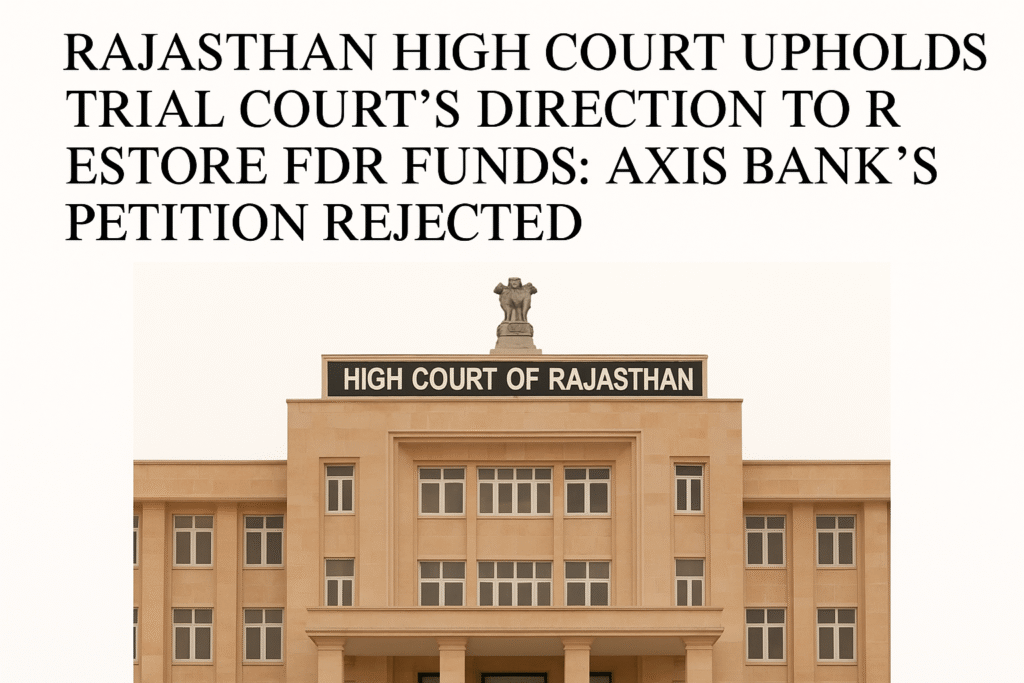
Rajasthan High Court Upholds Trial Court’s Direction to Restore FDR Funds: Axis Bank’s Petition Rejected Case Title: Axis Bank Ltd. v. State of Rajasthan & Ors., S.B. Criminal Misc. (Petn.) No. 7763/2025.Date of Judgment: 09/12/2025. Bank appropriated funds from a Fixed Deposit Receipt (FDR) that had been ordered by the trial court to be kept in the name of the Court pending trial, and the present petition challenged the trial court’s direction (dated 16.10.2025) to refund/deposit the appropriated amount. The petitioning bank relied on an order of the Debt Recovery Tribunal (DRT), Jaipur dated 20.04.2018 which had permitted temporary appropriation of the sale proceeds deposited with the bank in an FDR, and contended that the DRT order entitled it to appropriate the funds without further permission from the trial court. The criminal proceedings arose from FIR No. 43/2011 registered at Police Station Bapawar (Kota Rural) concerning alleged fraud, cheating and criminal breach of trust in relation to agricultural produce entrusted by hundreds of farmers. The trial court, exercising jurisdiction under Section 457 Cr.P.C., had on 07.07.2012 ordered auction of perishable seized produce and directed that the sale proceeds be deposited in an FDR in the name of the Court. The bank’s later application (12.04.2013) to appropriate the FDR proceeds was rejected by the trial court on 03.06.2013, and an S.B. petition filed by the bank was subsequently withdrawn with liberty to initiate recovery proceedings. The bank thereafter filed Original Application No.241/2015 before the DRT and obtained I.A. No.142/2018. The DRT, while permitting temporary appropriation, recorded that such appropriation would be without prejudice to the rights and contentions of the defendants and subject to conditions the tribunal might impose. The Rajasthan High Court’s record shows, however, that the orders of the trial court (07.07.2012 and 03.06.2013) and earlier orders of this Court were not placed before the DRT during those proceedings. On the basis of the DRT order, the petitioner-bank appropriated Rs.8,20,47,000/- from the FDR and deposited the balance. The trial court took the view that the appropriation was made in violation of its earlier orders and of orders of this Court, and therefore issued a direction dated 16.10.2025 requiring the bank to refund or re-deposit the appropriated amount with interest within seven days and issued notices to senior bank officials, including the Managing Director/CEO and the concerned Branch Manager, warning of appropriate action for non-compliance. The High Court examined the sequence of orders and petitions, including the trial court’s reasoned order under Section 457 Cr.P.C., the rejection of the bank’s interim withdrawal application, the bank’s withdrawn criminal misc. petition, and the DRT order. The Court noted that the DRT’s order appears to have been passed in ignorance of the earlier trial-court and High Court orders which had directed that the sale proceeds remain in FDR in the name of the Court. Because those earlier orders were not brought to the notice of the DRT, the DRT allowed temporary appropriation without that crucial context. Having considered the submissions of the parties and the record, the High Court held that the bank’s appropriation of the FDR amount without seeking fresh permission from the trial court was contrary to the orders dated 07.07.2012 and 03.06.2013. The Court emphasized that no one is above the law and that court orders must be obeyed. Applying these findings, the High Court found no error in the trial court’s impugned order and declined to interfere with it. Consequently, the criminal miscellaneous petition filed by Axis Bank failed and was rejected. The High Court disposed of the stay application and other pending applications, while observing that appropriate proceedings could have been initiated against the erring bank officials and that the court was sending a clear message that orders of the court must be respected. Read Complete Order here By Advocate Bhuvnesh Kumar Goyal
Jaipur High Court Affirms Acquittal in Alleged Murder Case: No Interference Warranted When Trial Court’s View Is a “Possible View” on Evidence
Jaipur High Court Affirms Acquittal in Alleged Murder Case: No Interference Warranted When Trial Court’s View Is a “Possible View” on Evidence Case Title: Raju Devi Bunkar v. State of Rajasthan & Anr., D.B. Criminal Appeal (Db) No. 302/2025 — Date of Judgment: 08/12/2025 The present appeal arises from the acquittal of respondent Govind in offences including Sections 302, 342 and 323 IPC by the trial court and the subsequent challenge to that order before the High Court. The factual matrix, as recorded in the judgment, shows that on 03.11.2012 a report (P.I.-11) was lodged regarding the death of Uttam Kumar and competing versions were placed on record by family witnesses and the accused’s side; the investigation culminated in charge-sheeting under various sections and ultimately resulted in the trial court recording acquittal on 24.04.2025. 203000003022025_5 The appellate record recounts that multiple witnesses were examined in trial — including eyewitnesses, local persons and medical evidence — and that there were significant divergences in the statements and respective versions about the events of 03.11.2012. The High Court’s summary of evidence (see pages 4–6 of the file) highlights inconsistencies in eyewitness accounts, gaps in forensic/medical corroboration for homicidal assault, and particulars such as timing, injuries and the presence or absence of demonstrative indicia on the deceased’s person that bear on the reliability of the prosecution case. The learned trial court’s approach, as noticed by the Division Bench, was to closely evaluate the oral testimony presented and to find that the prosecution failed to discharge the burden of proving guilt beyond reasonable doubt; the trial court therefore returned a view favourable to the accused. The High Court adverted to the trial court’s reasoning, including the manner in which the trial court treated the discrepancies and the nature of corroboration tendered, and placed those findings in the context of appellate interference doctrine. In applying established appellate principles, the Bench relied on the Supreme Court guidance cited in the judgment (Babu Sahebagouda Rudragoudar v. State of Karnataka and related authority), reiterating that an appellate court can disturb an acquittal only where the trial court’s view is patently perverse, is based on misreading or omission of material evidence, or where no two reasonable views are possible — in short, where the only possible conclusion from the record is guilt beyond reasonable doubt. The judgment reproduces and applies these principles to the facts of the case (see paragraph 13–14 of the judgment). After a considered re-appreciation of the record, the Division Bench concluded that the trial court’s view was a possible view which could reasonably be drawn from the evidence on record and that the scope for interference was therefore absent. The High Court recorded that neither legal nor factual infirmity of the nature required to overturn an acquittal was made out on the material before it, and accordingly the appellate challenge was dismissed and the trial court’s order of acquittal dated 24.04.2025 was held to be sustainable. The judgment directs that the decree be communicated to the trial court and is confined to the determination of the appeal under the criminal appellate jurisdiction; it does not re-open factual findings beyond the permissible limits of appellate review as spelled out in the authorities relied upon by the Bench. Read complete order here By Advocate Bhuvnesh Kumar Goyal
Bail in NDPS Act
Bail in NDPS Act The Narcotic Drugs and Psychotropic Substances Act, 1985 (NDPS Act) is one of the strictest criminal laws in India. Getting bail in NDPS cases is far more difficult than in ordinary criminal matters because the Act aims to curb drug abuse, trafficking, and illegal possession. In this article, we break down the legal principles, bail conditions, court approach, case laws, and practical strategies used in NDPS bail matters. 1. Why Bail in NDPS is Difficult? The NDPS Act reverses the normal presumption of innocence.Once the police claim recovery of commercial quantity, the burden shifts on the accused to prove innocence at the bail stage. Two reasons make NDPS bail complex: Section 37 NDPS prohibits bail in certain cases. Courts treat drug-related offences as a threat to society. Thus, NDPS bail is not similar to bail under CrPC. 2. Types of NDPS Offences and Their Impact on Bail The nature of recovery directly affects bail possibilities. Type of Quantity Meaning Bail Position Small Quantity Very small amount defined under NDPS Notification Bail is easy — Section 37 does NOT apply Intermediate Quantity Between small and commercial Court considers facts; Section 37 does NOT apply Commercial Quantity Large quantity defined in law Bail is extremely difficult — Section 37 applies When Section 37 applies, the accused must satisfy the twin-conditions. Small Quantity, Intermediate Quantity & Commercial Quantity in NDPS – Detailed Explanation The NDPS Act classifies offences based on the quantity of the drug involved. This classification directly affects punishment, bail eligibility, and court approach. Understanding these categories is crucial because the entire bail strategy in NDPS cases depends on whether the recovery is small, intermediate, or commercial. 1. Small Quantity Under NDPS Act Small quantity is the minimum amount of a drug specified under government notification. Every narcotic drug or psychotropic substance has a defined “small quantity” limit—for example: Heroin: 5 grams Ganja: 1000 grams (1 kg) Cocaine: 2 grams MDMA/ Ecstasy: 0.5 grams Punishment for Small Quantity (Section 27 & 21(a)) Maximum 1 year imprisonment, OR Fine, OR Both The law recognizes that small quantity cases often involve addicts, not traffickers. So punishment and bail rules are lenient. Bail Position for Small Quantity Section 37 NDPS does NOT apply. Bail is treated like a normal CrPC bail. Courts usually grant bail unless:✓ Accused has past drug offences✓ There is violence or other offences linked with the case✓ The investigation indicates a trafficking network Typical Grounds for Bail in Small Quantity Cases Personal consumption First-time offender No criminal history Minor recovery No independent evidence of sale/trafficking Small quantity cases rarely require High Court intervention because Sessions Courts generally grant bail quickly. 2. Intermediate Quantity Under NDPS Act Intermediate quantity refers to any amount between small quantity and commercial quantity. For example, for heroin (small: 5g, commercial: 250g): Any recovery between 5g and 250g is intermediate. Punishment (Section 21(b)) Up to 10 years imprisonment Fine up to ₹1 lakh Punishment is higher than small quantity but not as strict as commercial quantity. Bail Position for Intermediate Quantity Section 37 does NOT apply, meaning the strict “twin-conditions” are not required. Court only checks:✓ Nature of allegations✓ Role of accused✓ Possibility of tampering with evidence✓ Criminal antecedents✓ Compliance of NDPS procedures Intermediate quantity cases fall in a grey zone—not too small, not too large—so bail depends heavily on specific facts. When Courts Grant Bail in Intermediate Quantity Recovery doubtful or planted Non-compliance of Sections 42, 50, 57 No conscious possession FSL report not submitted Accused connected only through call records or disclosure statement Long custody (6–12 months or more) When Courts Refuse Bail Direct recovery from accused Evidence of trafficking network Accused absconded earlier Repeated offences Intermediate quantity bail requires solid legal argument and attention to procedural defects. 3. Commercial Quantity Under NDPS Act Commercial quantity represents large-scale drug trafficking, and the limits are strictly defined. Examples: Heroin: 250 grams or more Ganja: 20 kg or more Cocaine: 100 grams or more MDMA: 50 grams or more Punishment (Section 21(c)) Minimum 10 years imprisonment Maximum 20 years Fine of ₹1–2 lakhs or more Because the punishment is extremely severe, the NDPS Act introduces the toughest bail restrictions for commercial quantity cases. Bail Position for Commercial Quantity — Section 37 Applies This is the most important bail rule:Bail cannot be granted unless BOTH conditions are met: Court must be satisfied accused is not guilty. Accused is not likely to commit an offence on bail. Additionally: Public Prosecutor must be heard. Court must record “reasonable grounds” in the bail order. This makes commercial quantity bail rare but not impossible. How Courts Analyse Commercial Quantity Bail Courts carefully examine: (a) Procedural Violations No written information under Section 42 Illegal search or seizure Section 50 notice incorrect Samples not properly drawn or sealed No independent witnesses Same officer conducting seizure & investigation (Mohan Lal case) (b) Weak Evidence of Conscious Possession If drugs are found in: Common areas Shared vehicles Shared rooms Fields or open spacesbail becomes stronger. (c) Length of Custody & Delay in Trial Supreme Court has granted bail where the accused spent 3+ years in jail and trial was slow (Rabi Prakash v. State of Odisha). (d) Medical Grounds Serious health issues can justify bail even in Section 37 cases. Comparison Table: Small vs Intermediate vs Commercial Quantity Factor Small Intermediate Commercial Section 37 Applies? No No Yes Bail Difficulty Easy Moderate Very Difficult Punishment Up to 1 year Up to 10 years 10–20 years Court Approach Liberal Balanced Very Strict Common Defence Personal use Procedural lapses Non-compliance & long custody Trial Duration Impact Moderate High Very High (favors bail if delayed) Final Understanding Small quantity cases are treated leniently; bail is usually granted. Intermediate quantity cases depend on facts; good defence can secure bail. Commercial quantity cases face strict barriers under Section 37, but bail is still possible if investigation is faulty, evidence is weak, or custody is prolonged. 3. Section 37 NDPS Act – The Biggest Barrier to
Best POCSO Advocate in Jaipur – Advocate Bhuvnesh Kumar Goyal 7300056080
Best POCSO Advocate in Jaipur – Advocate Bhuvnesh Kumar Goyal 7300056080 The Protection of Children from Sexual Offences (POCSO) Act is one of the most sensitive and complex areas of criminal law. When a family faces a POCSO case—whether as a complainant or as an accused—it needs a lawyer who understands the law deeply and handles the matter with care, clarity, and strategy. Advocate Bhuvnesh Kumar Goyal is widely recognised as the Best POCSO Advocate in Jaipur, known for his strong courtroom presence and compassionate approach in cases involving minors. Best POCSO Advocate in Jaipur for Bail and Anticipatory Bail Securing bail or anticipatory bail in POCSO cases requires detailed case preparation, understanding of medical evidence, digital evidence, and statements of minors. Advocate Bhuvnesh Goyal has handled numerous bail matters before the POCSO Courts and the Rajasthan High Court. His clear drafting and strategic arguments help clients get timely relief in critical situations. Best POCSO Advocate in Jaipur for Defence in False Allegations False POCSO cases can destroy a person’s reputation, career, and peace of mind. Advocate Bhuvnesh Goyal specialises in building strong defence strategies by examining contradictions in statements, CCTV evidence, call records, medical reports, and other technical material. His goal is to protect the rights of the accused while ensuring the case is presented fairly before the court. Best POCSO Advocate in Jaipur for FIR Quashing & High Court Matters Many clients approach Advocate Goyal to file FIR quashing petitions under Section 482 CrPC when the allegations are fabricated or exaggerated. His experience in High Court litigation makes him one of the most trusted choices for people seeking to close a wrongly initiated case at an early stage. His petitions are drafted with clarity and supported with proper legal grounds. Best POCSO Advocate in Jaipur for Trial Representation In POCSO cases, the trial stage is the most crucial. Cross-examination of witnesses, handling testimony of minors, and presenting evidence require exceptional skill. Advocate Bhuvnesh Goyal is known for his structured courtroom strategy, strong arguments, and ability to simplify complex evidence for the court. His clients value his practical guidance and transparent communication throughout the trial. Best POCSO Advocate in Jaipur for Appeals & Legal Remedies If a party is dissatisfied with a judgment, they need a lawyer who can present the case powerfully in appeal, revision, or suspension of sentence. Advocate Goyal regularly appears before appellate courts, helping clients challenge wrongful convictions or defend favourable judgments. His legal research, drafting style, and preparation make him a preferred advocate for POCSO appeals. Why People Consider Advocate Bhuvnesh Kumar Goyal the Best POCSO Advocate in Jaipur Strong knowledge of POCSO procedures Expert in bail, anticipatory bail, and FIR quashing Sensitive handling of cases involving minors Clear guidance during police investigation Effective defence in false or exaggerated allegations High-quality drafting, research, and courtroom advocacy Transparent communication and client-focused approach Need Help in a POCSO Case? POCSO matters are serious and emotionally stressful. Having the right lawyer can change the entire outcome of the case.For consultation or urgent legal support, contact: 📞 Advocate Bhuvnesh Kumar GoyalPhone: 7300056080Jaipur, Rajasthan
Protection of Children from Sexual Offences (POCSO) Act, 2012
Protection of Children from Sexual Offences (POCSO) Act, 2012 India’s Protection of Children from Sexual Offences Act (POCSO), 2012, was supposed to be the steel frame around a fragile child. It set out to define, criminalise and make punishable every form of sexual violence against children — and at the same time to build procedures that keep a child’s dignity intact while the state seeks justice. In practice, POCSO has been both a landmark and a mirror: it exposes not only the uglier impulses of abusers but the gaps in policing, medical care, judicial capacity and social understanding. To judge its success we must look at law on the books, law in action, and the global context from which ideas and responsibilities flow. This article is a lengthy, careful excavation of POCSO — its anatomy, amendments, functioning, friction points, and how it sits amid international standards and other national laws. It draws on the Act itself, government guidelines and recent institutional practice, and situates India’s approach beside major international instruments such as the UN Convention on the Rights of the Child (and its Optional Protocols) and the Council of Europe’s Lanzarote Convention, as well as domestic statutes in the UK and the United States that crowd the same terrain. Wherever authority lets us, we anchor claims to primary sources. 1. Why a separate law for children? For decades, crimes against children were prosecuted under general provisions of the Indian Penal Code (IPC) — sections on assault, rape, obscenity, and so on. Those provisions were rarely tailored to the distinct vulnerabilities of children (physical, psychological, developmental) nor to processes that protect their identity and mental health during investigation and trial. International human rights law — notably the UN Convention on the Rights of the Child (UNCRC) and its protocols — created a moral and legal imperative for states to treat children not as small adults but as rights-holders with special protections. India’s POCSO was born in that global moment and domesticated it for Indian courts. POCSO’s aims were threefold: (a) to create specific and wide-ranging offences (including sexual harassment and child pornography); (b) to streamline procedures so that reporting, recording, medical examination and trial are child-sensitive; and (c) to ensure speedy trial through special courts. Its architecture therefore combines criminal law, child-protection procedures, and administrative rules. 2. A tour of the Act: definitions, offences and procedure Who is a “child”? POCSO defines a child as any person below 18 years of age. This bright-line definition simplifies application but also creates hard questions when age is disputed — for example, in medico-legal examinations and when consent claims surface. The Act treats the age threshold as central to the offence; an act that might be lawful between adults becomes an offence if one participant is below 18. Offences and categories The Act creates several categories of offences: Penetrative sexual assault — broadly analogous to rape but defined to capture any penetration (however slight) of the sexual organs, anus or mouth. Aggravated penetrative sexual assault — uses of weapons, multiple perpetrators, or the involvement of a person in a position of trust (teacher, doctor, guardian) carry heftier punishments. Sexual assault (non-penetrative) — includes groping, forced kissing and similar acts. Sexual harassment — encompasses acts like stalking, making sexually coloured remarks, and showing sexual content. Use of child for pornography — both production and distribution are criminalised. Punishments are severe: imprisonment terms run from several years to life imprisonment, and the 2019 amendments strengthened penalties further for specific aggravating circumstances. The law also allows for fines and compensation directed to child welfare. Procedure designed for children This is where POCSO sought real innovation: Mandatory reporting: Certain categories of professionals and any person who learns of an offence can — and, in some cases, must — report to police or a child welfare agency. Failure to report can attract penalties. Special Juvenile Police Units (SJPU) and Special Courts: The government envisaged trained police and separate trial courts to make the process less traumatic and more expedient. Recording of statement: A child’s statement is to be recorded at the child’s residence or a place of her/his choice; the law recognises the need to avoid repeated courtroom exposure. Medical examination: The Act lays down procedures to ensure a child is examined with consent, dignity, and confidentiality; in many cases, female doctors should be preferred when the victim is a female child. Child-friendly testimony: Courts are permitted to use video testimony and screens to shield a child from seeing the accused, and the courtroom language and processes are to be adapted for the child’s comprehension. Government agencies, including the National Commission for Protection of Child Rights (NCPCR), have issued operational guidelines elaborating these duties and the role of “support persons” to guide child victims through the legal maze. These guidelines also emphasize rehabilitation and tracking via dedicated portals. 3. Realities on the ground: implementation gaps and exemplars Legislation is only as strong as its implementation. On paper, POCSO’s child-centric vision is attractive; in practice, it collides with realities: Police and training Special Juvenile Police Units were envisioned as trained, sensitised wings of the force. But in many districts the SJPU is a small unit with limited training, and front-line officers often lack basic orientation about trauma-informed interviewing, confidentiality norms, or proper medical referral channels. Media and institutional reports repeatedly point to situations where police conduct insensitive cross-examinations, insist on revealing a minor’s identity to hospital staff, or fail to produce the child in court in a timely fashion — all of which re-traumatise the victim. Recent news reports show police pressure on doctors to reveal identities despite legal protections — signaling a persistent knowledge and practice gap. Medical interface Forensic and medical examination is a crucible of controversies. Clinicians must balance timely evidence collection with consent and privacy obligations. While POCSO contemplates child-sensitive exams, hospitals often lack trained pediatric forensic teams, and practices vary between urban tertiary centres and rural clinics. The Supreme Court has issued guidance on
Bail in POCSO Act Cases
Bail in Pocso Bail under the Protection of Children from Sexual Offences (POCSO) Act, 2012 is not routine. Courts apply a stricter standard because the Act deals with offences against children. However, the law does not impose an absolute bar on bail.As a senior advocate before the Supreme Court, I can say that the strength of evidence, delay in FIR, medical report, conduct of the accused, and the child’s statement—all play a crucial role in determining bail. A case registered under the Protection of Children from Sexual Offences Act, 2012 (POCSO Act) can have serious consequences for an accused because allegations under the Act involve offences against children and are dealt with by designated Special Courts. However, registration of a POCSO FIR does not mean that bail is legally impossible. The law relating to bail in POCSO cases is governed by the general law of bail, the POCSO Act and, for offences governed by the new criminal-law framework, the Bharatiya Nagarik Suraksha Sanhita, 2023 (BNSS). POCSO itself provides that the general procedural law applies to proceedings before the Special Court, subject to the Act. The Supreme Court’s recent decision in State of Uttar Pradesh v. Anurudh & Anr., 2026 INSC 47, is particularly important. The Court reaffirmed that bail proceedings are not meant to become a mini-trial and that the ordinary principles governing bail continue to apply to POCSO cases. This article explains regular bail, anticipatory bail, default bail, interim bail, the effect of Section 29 POCSO, important bail grounds, the procedure for filing a POCSO bail application, relevant Supreme Court principles and the factors considered by courts. Understanding Bail in POCSO and Why Bail is Sensitive Bail in a POCSO case means release of an accused from custody subject to conditions imposed by the competent court. POCSO cases are serious criminal proceedings, but the POCSO Act does not create an absolute prohibition on bail. The general principles of criminal bail continue to operate unless a specific statutory restriction applies. Under the current criminal procedure framework, Section 480 BNSS deals with bail in non-bailable offences, Section 482 BNSS deals with anticipatory bail, and Section 483 BNSS gives special bail powers to the High Court and Court of Session. Therefore, the correct legal position is: A person accused in a POCSO case can apply for bail, but the court exercises considerable judicial discretion after considering the allegations, evidence, age of the child, seriousness of the offence, possibility of influencing witnesses, possibility of tampering with evidence, antecedents and other circumstances. The POCSO Act was enacted to protect children (below 18 years) from: Sexual assault Sexual harassment Pornography Aggravated forms of assault Because these offences concern a minor, courts approach bail applications with: Higher scrutiny Victim-centric approach Requirement of prima facie satisfaction But the Supreme Court has repeatedly held that: “Bail cannot be denied merely because the offence is serious. Every accused has a right to liberty unless the prosecution shows real risk of misuse.” Thus, the law balances child protection with constitutional rights under Article 21. Is Bail Possible in a POCSO Case? Yes. Bail is legally possible in a POCSO case. The fact that an FIR contains offences under the POCSO Act does not create an absolute statutory bar against bail. At the same time, POCSO allegations are treated seriously. The court must balance two competing considerations: Protection of the child and the integrity of the prosecution; and The accused’s right to personal liberty and a fair criminal process. The Supreme Court has emphasized that POCSO does not itself create an entirely separate and unlimited regime of bail restrictions. In State of Uttar Pradesh v. Anurudh, the Supreme Court discussed the constitutional foundations of bail and stated that ordinary bail principles remain applicable to POCSO offences. Which Law Governs Bail in POCSO Cases After 1 July 2024? The Bharatiya Nagarik Suraksha Sanhita, 2023 (BNSS) replaced the Code of Criminal Procedure, 1973 for new criminal proceedings from 1 July 2024. The principal bail provisions under BNSS are: Type of Bail Relevant BNSS Provision Bail in non-bailable offence Section 480 BNSS Anticipatory bail Section 482 BNSS High Court/Sessions Court bail powers Section 483 BNSS Default/statutory bail Section 187(3) BNSS Bail bond and sureties Sections 485 onwards Cancellation/forfeiture-related provisions Older judgments may therefore refer to Sections 437, 438 and 439 CrPC. For proceedings governed by BNSS, the corresponding provisions are generally Sections 480, 482 and 483 BNSS. 2. Types of Bail Applicable in POCSO Cases (a) Regular Bail – Section 437 and 439 CrPC (now Section 480 and 483 BNSS) Regular bail is sought after the accused has been arrested. Under Section 480 BNSS, a person accused of a non-bailable offence may be released on bail subject to the statutory framework and judicial discretion. The provision also permits the court to impose conditions designed to ensure appearance, prevent repetition of offences and prevent inducement, threats or tampering with evidence. In a POCSO case, regular bail may be considered: During investigation; After filing of the charge-sheet; After cognizance; After framing of charges; During trial; After examination of important witnesses; Where trial is substantially delayed; Where the accused has undergone considerable custody. Whether accused will influence the child witness Evidence strength Medical report consistency In case, Section 480 BNSS bail is rejected then bail in pocso is filed before the court of Session under section 483 BNSS. In case court of session also rejects the regular bail in pocso after arrest then the bail on pocso is filed before the respective High Court under section 483 BNSS. Further, if the High Court also rejects the regular bail in pocso, then either a second bail may be filed before the same high court in case circumstances changes or new evidence arises or bail can be filed in Supreme Court as well after the rejection of bail from the high court. (b) Anticipatory Bail – Section 438 CrPC (now Section 482 BNSS) Anticipatory bail is sought before arrest when a person has a reasonable apprehension of arrest
 Call: 7300056080
 Email: advocatebhuvneshgoyal@gmail.com
 Office: 109, Fortune Heights, Ahinsa Circle, C-Scheme, Jaipur-302001