Suspension of Sentence
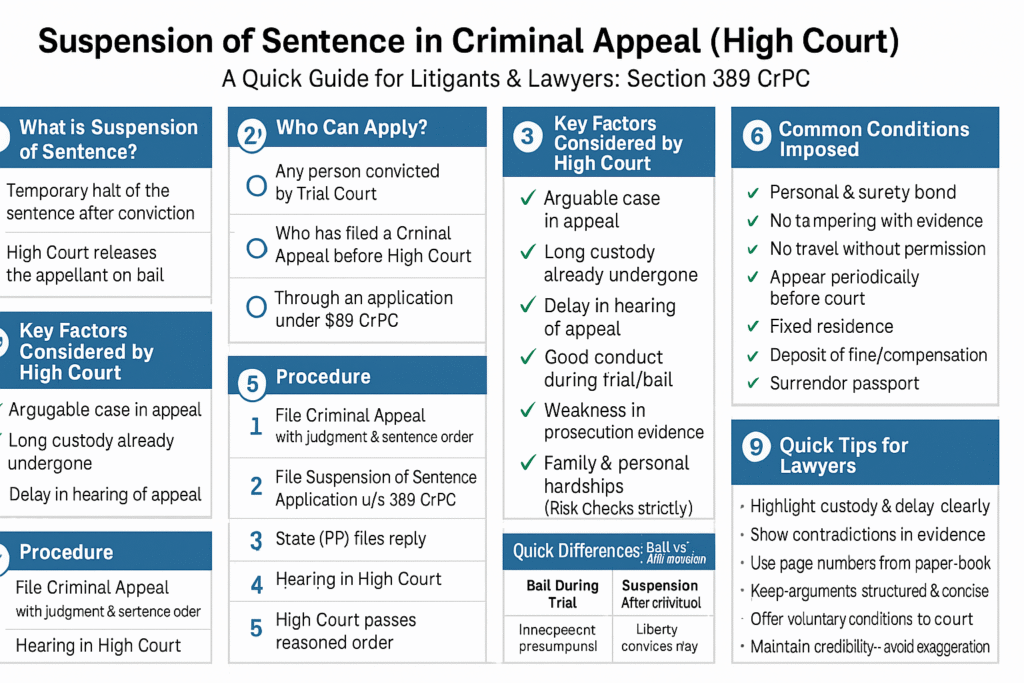
Suspension of Sentence Suspension of sentence is one of the most important reliefs sought by a convict after filing a criminal appeal before the High Court. Once a person has been convicted by the Trial Court, the sentence becomes executable immediately unless it is stayed or suspended. The appellate court—usually the High Court—has the power under the Code of Criminal Procedure, 1973 (CrPC) to suspend the sentence and release the appellant on bail pending final hearing of the appeal. For an appellant, this relief often determines whether he remains behind bars during the entire duration of the appeal (which can take several years) or whether he continues his life and livelihood until the final decision. For lawyers, this is a crucial stage requiring strategic preparation, correct legal grounds, and precise drafting. This article explains the law, procedure, tests applied by courts, important judgments, common mistakes, drafting tips, and practical advocacy points on suspension of sentence in criminal appeals before the High Court. What is Suspension of Sentence? Suspension of sentence means that the High Court temporarily keeps the execution of the sentence “on hold” while the criminal appeal is pending. It does not erase or cancel the conviction; it merely postpones the punishment. When sentence is suspended, the Court usually releases the convict on bail with specific conditions. This relief is governed by Section 389 CrPC. Statutory Provision: Section 389 CrPC Section 389 CrPC empowers the appellate court to: Suspend the execution of sentence pending appeal Release the appellant on bail Impose conditions, including deposit of fine or bond While suspending a sentence imposed by a Special Court or Court of Session, the High Court must give opportunity to the Public Prosecutor to show cause (Proviso to Section 389(1)). Key Point:The appellate court must record reasons in writing for granting or refusing suspension. Difference Between Bail and Suspension of Sentence Aspect Bail (During Trial) Suspension of Sentence (Post-Conviction) Stage Before conviction After conviction Presumption Accused is presumed innocent Conviction by Trial Court stands Test Prima facie innocence, investigation, custody Merits of conviction, arguable grounds, long incarceration Relief Release from custody Stoppage of sentence + release on bail This distinction is vital because after conviction, the burden is heavier on the appellant. When Can High Court Grant Suspension of Sentence? High Courts consider several factors. Over time, judicial principles have evolved from case law. The major grounds are: 1. Prima Facie Arguable Case The appeal must raise points that require deeper consideration—legal errors, unreliable evidence, improper appreciation, non-examination of key witnesses, contradictions, etc. The High Court is not expected to re-evaluate all evidence but must identify whether the case is arguable. 2. Long Delay in Hearing Criminal Appeals Indian High Courts are burdened with large pendency. Many appeals take 5–10 years to be decided. The Supreme Court has repeatedly held that long delay in disposal is an independent ground for suspension of sentence. Examples: Kashmira Singh v. State of Punjab Babu Singh v. State of UP Akhtari Bi (2001) 3. Conduct of the Appellant Courts consider: Presence during trial No misuse of liberty earlier No attempt to abscond No criminal antecedents (or minimal) Compliance with previous bail conditions 4. Nature of Crime & Gravity of Offence While gravity is relevant, it is not the sole ground to reject suspension. Even in serious offences—murder (302 IPC), POCSO, NDPS—High Courts regularly suspend sentence if conditions are satisfied. 5. Length of Sentence Short sentences (2–5 years) are usually suspended if the appeal cannot be heard expeditiously. 6. Delay in Lodging FIR, Contradictions, Weak Motive If the conviction appears doubtful at first glance, courts are more inclined to suspend. When Courts Usually Refuse Suspension High Courts often deny suspension when: Evidence against the appellant is strong and overwhelming The appellant has misused bail earlier, absconded, or threatened witnesses The appellant is a repeat offender The offence is of a heinous nature with societal impact There is risk of influencing witnesses or compromising evidence The appeal is likely to be heard soon (rare) Procedure for Filing Suspension of Sentence in High Court 1. Filing the Criminal Appeal Suspension application must accompany a properly filed appeal with: Certified copy of judgment & sentence order Grounds of appeal Vakalatnama Affidavit Index, list of dates, etc. 2. Filing a Separate Application Under Section 389 CrPC The application should: Narrate background of trial Point out legal errors Identify arguable issues Highlight custody period Mention conduct of appellant Annex medical records if required Provide details of family hardships, dependents 3. State’s Reply The Public Prosecutor files a reply opposing suspension. 4. Hearing Before the High Court The Court hears: Appellant’s counsel (often senior advocates) Public Prosecutor Sometimes complainant’s counsel (in victim-centric offences) 5. Order of the Court The Court passes a reasoned order: Allowing suspension & bailor Rejecting the application Conditions Usually Imposed by High Court When suspension of sentence is granted, the High Court may impose: Personal bond and surety bond Marking attendance in court/police station periodically No travel outside jurisdiction without permission No tampering with evidence or contacting witnesses Deposit of fine/compensation Stay at a fixed address Surrender passport In some High Courts, compliance reports are mandatory every 3–6 months. Important Supreme Court Judgments 1. Kashmira Singh v. State of Punjab (1977) Long delay in hearing the appeal is a valid ground for suspending sentence. 2. Babu Singh v. State of UP (1978) Personal liberty should not be sacrificed simply because an appeal is pending. 3. Akhtari Bi v. State of MP (2001) High Courts must hear criminal appeals expeditiously; otherwise suspension should be considered. 4. Atul Tripathi v. State of UP (2014) The Public Prosecutor must be given a clear opportunity to oppose suspension. 5. Preet Pal Singh v. State of UP (2020) Detailed reasoning is mandatory; suspension cannot be granted mechanically. 6. State of Haryana v. Hasmat (2004) If earlier suspension is challenged, the appellate court must reconsider the evidence. Special Situations 1. Suspension in Life Imprisonment Cases Courts scrutinise more strictly but still grant if:
 Call: 7300056080
 Email: advocatebhuvneshgoyal@gmail.com
 Office: 109, Fortune Heights, Ahinsa Circle, C-Scheme, Jaipur-302001